Flagstaff in Coconino County, Arizona — The American Mountains (Southwest)
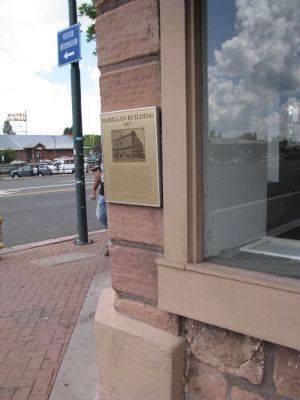
McMillan Building
1887
Photographed by Bill Kirchner, July 7, 2010
1. McMillan Building Marker
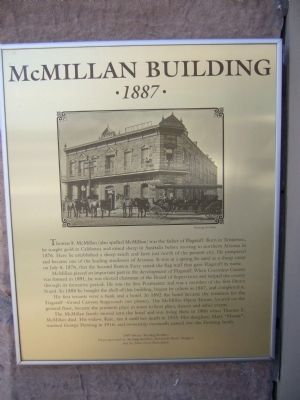
Thomas F. McMillan (also spelled McMillon) was the father of Flagstaff. Born in Tennessee, he sought gold in California and raised sheep in Australia before moving to northern Arizona in 1876. Here he established a sheep ranch and farm just north of the present city. He prospered and became one of the leading stockmen of Arizona. It was at a spring he used as a sheep camp on July 4, 1876, that the Second Boston Party raised the flag staff that gave Flagstaff its name.
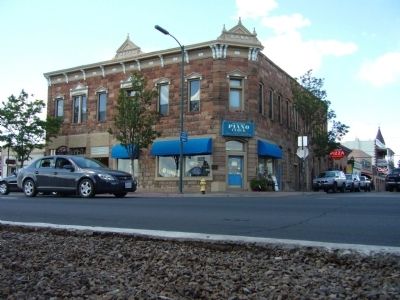
McMillan played an important part in the development of Flagstaff. When Coconino County was formed in 1891, he was elected chairman of the Board of Supervisors and helped the county through its formative period. He was the first Postmaster and was a member of the first library board. In 1888 he bought the shell of this building, begun by others in 1887, and completed it.
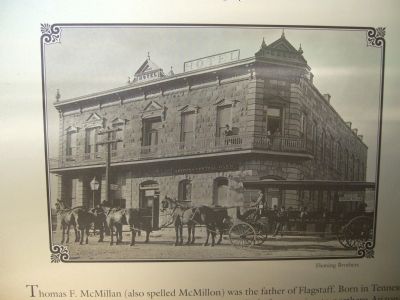
His first tenants were a bank and a hotel. In 1892 the hotel became the terminus for the Flagstaff-Grand Canyon Stagecoach (see photo). The McMillan Opera House, located on the ground floor, became the premiere place in town to host plays, dances and other events.
The McMillan family
this page online
Erected by Fleming Brothers, Richard & Sherry Mangum and the Main Street Foundation.
Topics. This historical marker is listed in this topic list: Industry & Commerce. A significant historical month for this entry is July 1831.
Location. 35° 11.863′ N, 111° 38.957′ W. Marker is in Flagstaff, Arizona, in Coconino County. It is at the intersection of West Route 66 and North Leroux Street, on the right when traveling west on West Route 66. Touch for map. Marker is at or near this postal address: 2 West Route 66, Flagstaff AZ 86001, United States of America. Touch for directions.

Regionally, this marker is in Flagstaff & High Country and in Hopi. It is also in the American Southwest, in the Mountain West, on the Colorado Plateau, and at the Four Corners. Globally, it is in North America, the Western Hemisphere, the Western World, and the Anglosphere. Historically, it finds itself in what

Photographed by Adam Margolis, May 24, 2024
2. McMillan Building Marker
Other nearby markers. At least 8 other markers are within walking distance of this marker: A different marker also named McMillan Building (a few steps from this marker); Aubineau Building (a few steps from this marker); Raymond Building (within shouting distance of this marker); Transcontinental Railroad Centennial (within shouting distance of this marker); Railroad Depot (within shouting distance of this marker); Coconino Chop House (within shouting distance of this marker); Telephone Exchange (within shouting distance of this marker); Aubineau / Andreatos Building (within shouting distance of this marker). Touch for a list and map of all markers in Flagstaff.
Photographed by Denise Boose, July 16, 2012
3. McMillan Building Marker
Photographed by Bill Kirchner, July 7, 2010
4. McMillan Building
Photo Displayed on Marker
Photographed by Bill Kirchner, July 7, 2010
5. McMillan Building
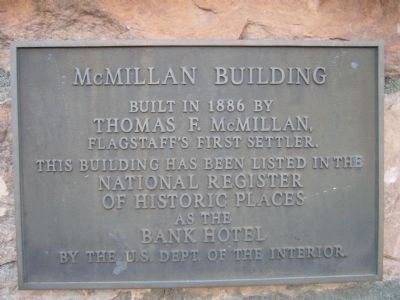
Photographed by Bill Kirchner, July 7, 2010
6. McMillan Building
Thomas F. McMillan,
Flagstaff's First Settler.
This building has been listed in the
National Register
of Historic Places
as the
Bank Hotel
by the U.S. Dept. of the Interior
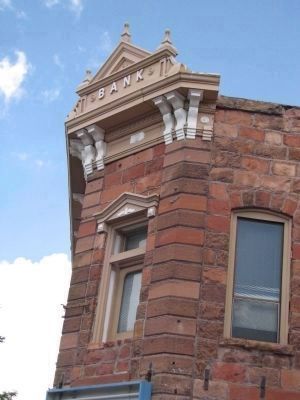
Photographed by Denise Boose, July 16, 2012
7. McMillan Building
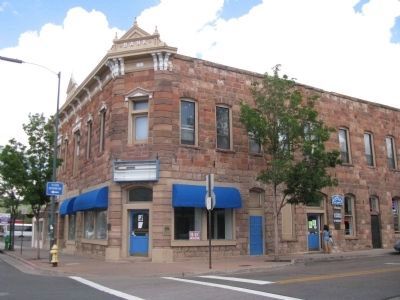
Photographed by Denise Boose, July 16, 2012
8. McMillan Building
Credits. This page was last revised on June 28, 2025. It was originally submitted on July 19, 2010, by Bill Kirchner of Tucson, Arizona. This page has been viewed 4,416 times since then and 312 times this year. Photos: 1. submitted on July 19, 2010, by Bill Kirchner of Tucson, Arizona. 2. submitted on December 16, 2024, by Adam Margolis of Mission Viejo, California. 3. submitted on October 7, 2012, by Denise Boose of Tehachapi, California. 4, 5, 6. submitted on July 19, 2010, by Bill Kirchner of Tucson, Arizona. 7, 8. submitted on October 7, 2012, by Denise Boose of Tehachapi, California. • Syd Whittle was the editor who published this page.
