New Berlin in Waukesha County, Wisconsin — The American Midwest (Great Lakes)
Cheney-Faulkner Cooper Home
Built 1840
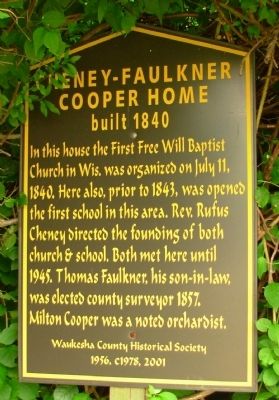
Photographed by Paul F, August 13, 2010
1. Cheney-Faulkner Cooper Home Marker
Erected 1956 by Waukesha County Historical Society. (Marker Number 21-02.)
Topics. This historical marker is listed in these topic lists: Religion & Religious Structures • Settlements & Settlers. A significant historical month for this entry is July 1958.
Location. 42° 56.341′ N, 88° 9.508′ W. Marker is in New Berlin, Wisconsin, in Waukesha County. It is on County Route Y half a mile north of Interstate 43, on the right when traveling north. Touch for map. Marker is at or near this postal address: 5810 S Racine Avenue, New Berlin WI 53146, United States of America. Touch for directions.

Regionally, this marker is in Southeast Wisconsin and in Greater Milwaukee. It is also in the American Midwest and in the Corn Belt. Globally, it is in North America, the Western
this page online
Other nearby markers. At least 8 other markers are within 3 miles of this marker, measured as the crow flies: Childhood Home of Wisconsin Governor Julius P. Heil (1876-1949) (approx. 0.3 miles away); Linnie Lac (approx. ¾ mile away); Park Arthur (approx. 1.4 miles away); Janesville Plank Road Tollgate (approx. 2½ miles away); Muskego Beach Amusement Park (approx. 2½ miles away); "Do I Smell Pizza-Burgers?" (approx. 2½ miles away); "Cornfalfa" Farms (approx. 2.6 miles away); Historic Muskego Centre Park (approx. 2.7 miles away). Touch for a list and map of all markers in New Berlin.
Another marker is no longer nearby. Freewill Baptist Church (was approx. 0.4 miles away but has been confirmed missing).
Regarding Cheney-Faulkner Cooper Home. Home is located well off the road and is a private residence.
Additional commentary.
1. Additional History about the Cheney-Faulkner Cooper Home
This home in New Berlin, in an
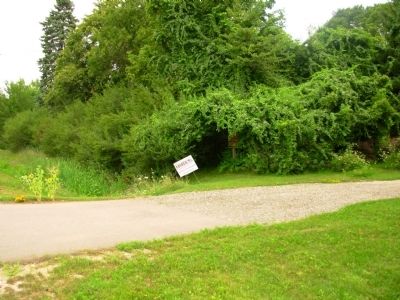
Photographed by Paul F, August 13, 2010
2. Cheney-Faulkner Cooper Home Marker
Marker as seen from the road, partially obscured by overgrowth.
Walnut trees on the property were sawed nearby in Linnie Lac at Wedges Sawmill and used for building.
The house was quite large for that time with a cellar, attic, two big rooms with fireplaces back to back, a small kitchen, a bake oven built into the chimney, and three bedrooms.
There was an Indian reservation across the road, so the Native Americans often came for trading or handouts. Since at this time there was no church for the reverend to serve, he set up the first Freewill Baptist Church in his parlor on July 11,1840. The school for Prospect Hill also began here.
When Cheney's wife died, he married Lydia Moore, mother-in-law of Thomas Faulkner.
Thomas Faulkner married Rufus Cheney's daughter, Nancy. A financial arrangement was made between Thomas and the Cheneys, to have both families live there until Cheney's' death. Then it would belong to the Faulkners.
Thomas was a farmer, surveyor, teacher, and cabinet maker.
During the years Thomas and his family lived here, he started an orchard on 39 acres and it
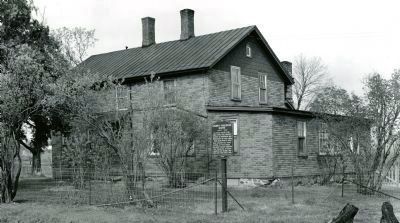
Photographed by Linda Hansen, circa 1958
3. Cheney-Faulkner Cooper Home as it looked in 1958
In 119 years only two families lived in this house. Governor Julius Heil, who lived nearby, stopped by often.
In 1927 Milton and Neoda Cooper bought the farm from Rufus Faulkner and raised their six children. The house was damaged by fire in 1964.
In 1997 the house was declared a City of New Berlin Historical landmark. It was cited twice by the U.S. Department of Interiors Historic Sites Survey. You can still see this house standing on Racine Avenue just below Prospect Hill.
— Submitted August 10, 2012, by Linda Hansen of Waukesha, Wisconsin.
Credits. This page was last revised on June 16, 2016. It was originally submitted on August 16, 2010, by Paul Fehrenbach of Richfield, Wisconsin. This page has been viewed 1,585 times since then and 50 times this year. Photos: 1, 2. submitted on August 16, 2010, by Paul Fehrenbach of Richfield, Wisconsin. 3. submitted on August 10, 2012, by Linda Hansen of Waukesha, Wisconsin. • Bill Pfingsten was the editor who published this page.
