Edenton in Chowan County, North Carolina — The American South (South Atlantic)
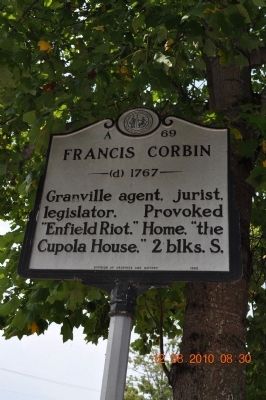
Francis Corbin
(d) 1767
Photographed by Sandra Hughes, August 12, 2010
1. Francis Corbin Marker
North Carolina History Project website entry
Click for more information.
Click for more information.
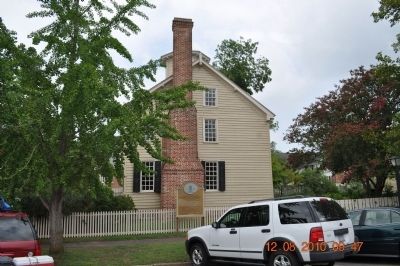
Granville agent, jurist, legislator. Provoked "Enfield Riot." Home, "the Cupola House," 2 blks. S.
Erected 1982 by Division of Archives and History. (Marker Number A-69.)
Topics and series. This historical marker is listed in these topic lists: Colonial Era • Government & Politics. In addition, it is included in the North Carolina Division of Archives and History series list.
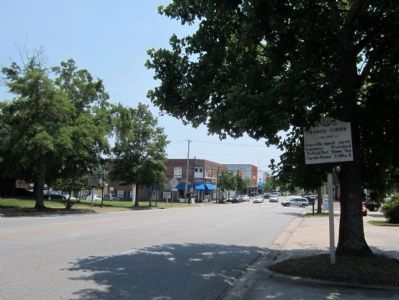
Location. 36° 3.591′ N, 76° 36.521′ W. Marker is in Edenton, North Carolina, in Chowan County. It is at the intersection of N Broad St. and Queen Street on N Broad St.. Touch for map. Marker is in this post office area: Edenton NC 27932, United States of America. Touch for directions.

Regionally, this marker is in the Coastal Plain. It is also in the American South, specifically in the Upper South, in the Tidewater, and on the Eastern Seaboard. Globally, it is in the North Atlantic Region, North America, the Western Hemisphere, the Western World, and the Anglosphere. Historically, it finds itself in what was once the territory of the Mississippian Culture, one of the original Thirteen Colonies, one of the Confederate States of America, and the Antebellum South.
Other nearby markers. At least 8 other markers are within walking distance of this marker: Barker House (a few steps from this marker); Dr. Hugh Williamson (within shouting distance of this marker); Chowan County Courthouse (within shouting distance of this marker); a different marker also named Edenton Tea Party (within shouting distance of this marker); James Iredell, Jr (within shouting distance of this marker); Mackeys Ferry (about 400 feet away, measured in a direct line); Chowan County Ultimate Sacrifice Memorial (about 400 feet away); Chowan County Veterans Memorial (about 400 feet away). Touch for a list and map
this page online
Another marker is no longer nearby. Edenton Tea Party (was within shouting distance of this marker but has been replaced with another marker now near it).
Also see . . .
1. Francis Corbin. Stopping Points entry:
Most of Francis Corbin’s life before his arrival in America remains a mystery. It is assumed that he was born in England, possibly London, in the early 1700s. (Submitted on August 23, 2010, by Sandra Hughes Tidwell of Killen, Alabama, USA.)
2. Enfield, North Carolina. Town History:
An event in Enfield's history which probably helped to spark American independence was the "Enfield Riot," one of the earliest political actions against British tyranny. In January, 1759, a group of backwoodsmen seized Lord Granville's land saint, Francis Corbin, in Edenton and brought him to Enfield. (Submitted on August 24, 2010, by Sandra Hughes Tidwell of Killen, Alabama, USA.)
Additional commentary.
1.
Having moved from England to Edenton, NC, when I married a native of that town - the first colonial capital of North Carolina - I had always been surprised that nobody there
Photographed by Sandra Hughes, August 12, 2010
2. Cupola House
— Submitted March 7, 2021.
Photographed by Bernard Fisher, June 28, 2012
3. Francis Corbin Marker
Internet Archive
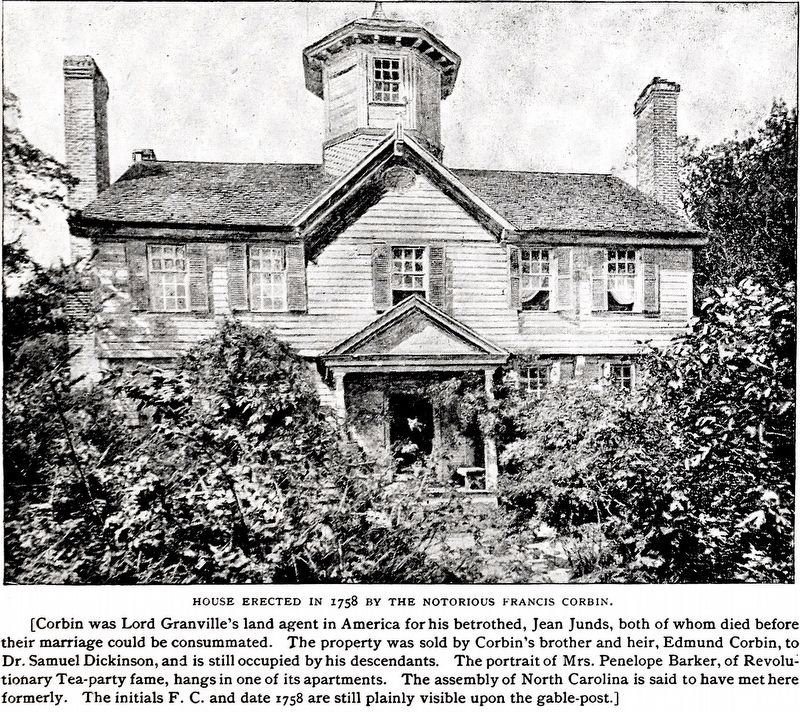
4. House Erected In 1758 by The Notorious Francis Corbin.
Corbin was Lord Granville's land agent in America for his betrothed, Jean Junds, both of whom died before their marriage could be consummated. The property was sold by Corbin's brother and heir, Edmund Corbin, to Dr. Samuel Dickinson, and is still occupied by his descendants. The portrait of Mrs. Penelope Barker, of Revolutionary Tea-party fame, hangs in one of its apartments. The assembly of North Carolina is said to have met here formerly. The initials F. C. and date 1758 are still plainly visible upon the gable-post.
From The Magazine of American History, Vol. XXVIII, No. 6, December 1892.
From The Magazine of American History, Vol. XXVIII, No. 6, December 1892.
Credits. This page was last revised on May 19, 2024. It was originally submitted on August 23, 2010, by Sandra Hughes Tidwell of Killen, Alabama, USA. This page has been viewed 1,182 times since then and 38 times this year. Photos: 1, 2. submitted on August 23, 2010, by Sandra Hughes Tidwell of Killen, Alabama, USA. 3. submitted on July 2, 2012, by Bernard Fisher of Richmond, Virginia. 4. submitted on October 25, 2020, by Allen C. Browne of Silver Spring, Maryland. • Bill Pfingsten was the editor who published this page.
