Lafayette in Tippecanoe County, Indiana — The American Midwest (Great Lakes)
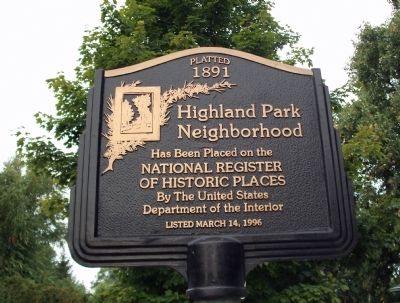
Highland Park Neighborhood
Platted 1891
Photographed by Courtesy:: Carly C. Kindig, August 22, 2010
1. Highland Park Neighborhood Marker
Has Been Placed on the
National Register
of Historic Places
by The United States
Department of the Interior
Listed March 14, 1996
Topics. This historical marker is listed in this topic list: Notable Places. A significant historical date for this entry is March 14, 1823.
Location. 40° 24.589′ N, 86° 53.208′ W. Marker is in Lafayette, Indiana, in Tippecanoe County. It is on Highland Avenue south of Kossuth Street, on the right when traveling south. Touch for map. Marker is in this post office area: Lafayette IN 47905, United States of America. Touch for directions.

Regionally, this marker is in Central Indiana. It is also in the American Midwest and in the Corn Belt. Globally, it is in North America, the Western Hemisphere, the Western World, and the Anglosphere. Historically, it finds itself in what was once the Viceroyalty of New France, the territory of the Mississippian Culture, and the Northwest Territory.
Other nearby markers. At least 8 other markers are within walking distance of this marker: Highland Park (approx. 0.2 miles away); Ninth Street Hill (approx. 0.2 miles away);
this page online
Another marker is no longer nearby. Camp Tippecanoe (was approx. half a mile away but has been confirmed missing).
Also see . . . NRHP Nomination Form (PDF). 36 page document includes a descriptive inventory of homes and a map. It was prepared by Gary Louis Nowling and Paul Diebold of the Highland Park Neighborhood Association in 1995. Statement of Significance:
Highland Park Neighborhood Historic District is a locally significant example of a turn of the century planned suburban development in the Victorian “landscape garden” style. The district meets Criterion A as an important representation of suburban expansion of Lafayette, Indiana.(Submitted on August 5, 2025, by J. J. Prats of Powell, Ohio.)
Criterion C is met under the areas of landscape architecture and architecture.The distinctive winding streets of the area and provisions for a public park are unusual in Lafayette. The prominent Midwestern landscape and engineering firm of Earnshaw and Punshon, Cincinnati, Ohio, designed the subdivision, and it is a good example of their work. Architecturally distinctive homes dot the neighborhood. Good examples of popular residential styles and types include Queen Anne, Colonial Revival, Tudor Revival, Bungalow/Craftsman, Spanish Eclectic, and others. Homes vary in type and style, but most are two stories high, creating a uniform overall appearance.Photographed by Courtesy:: Carly C. Kindig, August 22, 20102. Highland Park Neighborhood Marker
William Digby platted the town of Lafayette in 1825. The town of Lafayette is named after Marie Joseph Paul Yves Rock Gilbert Du Motier, better known locally as the Marquis de Lafayette. In 1824-25 the Marquis de Lafayette was invited to tour the United States and be honored by its citizens. In mid-May 1825, the Marquis was in the Jeffersonville, Indiana, area, and William Digby chose to honor the Marquis by naming his newly settled town “Lafayette.”
In those early years the two major industries in the area were John Purdue’s Lafayette Agriculture Works and John Sample’s Lafayette Plow Works. In addition, there were several mills powered by the Wabash River. The Wabash and Erie Canal brought more industries to Lafayette, and several breweries were founded in Lafayette during this period.
Lafayette entered the railroad era in 1853 with the arrival of the New Albany and Salem (Monon) line. This began a period of rapid growth and physical development which would last to the financial panic of the 1870s. Population figures had reached 13, 506 in 1870 (up from 2,000 in 1840 during the Canal days). With the growth In the 1890’s Lafayette put forth an incentive package which resulted in the Monon Shops, with 1,000 workers on the payroll, moving to Lafayette from New Albany, Indiana.
Along with leaps in population and physical growth, Lafayette experienced, in its own ways, the urban patterns so typical of the United States at this The breakthrough of rail technology led to the invention of light rail travel in the form of trolleys. Trolleys, coupled with the growing middle class’s desire for housing away from city centers, led to the planning of suburbs to take advantage of this desire. Lafayette’s first trolley line began in 1883 and was electrified in 1888. Three lines were built, the first on Main Street, then north on 9th Street to the Monon Shops, another on Main and south on 9th Street “up the hill”, and lastly, one across the Wabash and into West Lafayette. Constricted by hills which made residential growth difficult, the trolleys opened up lands which were close to downtown but out of reasonable walking distance. This is particularly true of Highland Park, located high up 9th Street.
The last piece in the puzzle of residential growth was the development of the “landscape garden” suburb during the middle and late 19th centuries. Fostered by the development of “rural cemeteries” such as Mount Auburn in the 1840s, and urban parks such as Central Park in the 1850s and 60s, the landscape garden suburb offered relief from the tiresome orthogonal grid of the city. Streets often followed natural contours and lots were of pre-planned sizes. Special provisions were often made for public places and ornamental plantings. In a sense, the landscape garden suburb is model for modem subdivision developments. Although east coast cities often saw the growth of such suburbs, the most significant example in the Midwest was Riverside in Chicago. Frederick Law Olmstead created the plan for Riverside in 1869, and it set the trend for suburbs for years to come. Indeed, in Lafayette, the Perrin Addition of 1873 (Perrin Historic District, NR, 9-10-79) represents an early attempt at landscape garden planning. The Perrin district plan abandons the conventional grid of Lafayette for streets which follow the topography of the hillside. Perrin lacks, however, the provisions for public spaces and uniformity of buildings which Riverside pioneered. The planners of Highland Park (1892) followed through with these conventions, making it a distinct example of this type of planning in Lafayette. Other examples of landscape garden suburbs in Indiana also arose at this time. In Indianapolis, developers of Irvington ( 1870), Brightwood (1872, with additions before 1900) and Golden Hill (1872) followed the trend of naturalistic landscaping, curvilinear streets, and planned public places.
Earnshaw and Punshon, engineers and architects of Cincinnati, are credited with the design of Highland Park, according to records in possession of the successor firm of McGill, Smith, Punshon, Inc. Joseph Earnshaw was a master of the landscape garden style. He began his career in Cincinnati at Spring Grove Cemetery. Spring Grove was being redesigned in the new Victorian manner in the 1850s and this likely inspired Earnshaw’s later works. Earnshaw designed other landscapes in the garden landscape manner, including: Highland Lawn Cemetery, Terre Haute (NR, 1884); Prospect Cemetery, Toronto, Canada (1889); Southern Indiana Hospital for the Insane, Evansville (1890); Columbian Park, Lafayette (1891 ); and others. Another significant commission in the 1890s was for the design of Oakland, California. After 1890, Thomas Punshon, a long time associate, became a full partner in the firm. Traits of Earnshaw and Punshon’s works are seen in all these examples. Most are planned around the topographic features of the site. Roadways are winding, creating picturesque views. Highland Park has all these traits and is a fine example of Earnshaw and Punshon’s works. An addition to Highland Park was planned by Earnshaw and Punshon within several years of the original plat, although it was only partially implemented, due the development of a private country club with golf course south of the neighborhood. The addition was to have had a larger public park while retaining the winding street pattern. Only the south side of Owen and the inclusion of Cherokee A venue were developed.
The Highland Park Land Company was formed in 1891 by James Reynolds, William Ross, and David L. Ross for the purpose of “buying, selling, improving and platting into lots” approximately 160 acres of Reynolds’ “highland” pasture land. In 1892, 160 acres of Reynolds’ pasture were transformed into Highland Park, a highly organized, well promoted neighborhood development. Following the contours of a natural gully, the plan called for a circular drive on the land in part circumscribed by the gully, with streets winding to follow the ridge on the south edge of the gully. The gully was platted as Glenway Lane. Promotion for the subdivision mentioned “fine residences, elegant avenues, cement walks, handsome streets, shade trees, water and gas availability, no alleys, no dust or noise, perfect drainage near the heart of the city, and moderate prices.” This sounds like a description of the perfect residential environment for 1996, but this is how the new Highland Park Addition was described over 100 years ago in 1891. And if this were not enough to entice potential homeowners, public transportation was available every fifteen minutes by the electric street car to the noisy and dusty downtown Lafayette business area.
In 1893 the Lafayette School Board let bids for a school to be called Columbian School to be built in Highland Park. The school was built in the new section of Highland Park Addition II, platted in 1893, on lots 13 7, 13 8, 164, and 165. In 1924, Columbian School was razed, and a new school, called Highland School, was built. In 1979 Highland School was closed and became known as the Highland Christian School.
In 1924 a “bicycle bridge” was built over the ravine (Glenway Lane) so that the children living on the north side of the ravine could get to the Highland School without having to walk up and down through the ravine or making the long trek around Glenway Lane.
The original plat boasted a triangular park, an island bordered by Miami, Pontiac, and Highland Avenues. This park was originally used for neighborhood gatherings and still serves that function today for the Highland Park Neighborhood Association. Since Lafayette’s first park, Columbian Park, was established in 1891, the concept of a public park in a planned neighborhood was very progressive for Lafayette at the time.
Highland Park developed as an early 20th century neighborhood. Many merchants, businessmen, and lawyers made their homes in this neighborhood, including J. Frank Hanley, who served as Governor of Indiana from 1904-1908, while living in the home he had built at 739 Owen Street.
The ensuing years saw some of the most elegant homes in the city of Lafayette erected in Highland Park Neighborhood. Because Highland Park homes were built during several decades, architectural styles vary widely. Unlike the Perrin district, homes in Highland Park are more uniform in height, setback, and massing. Earlier homes include outstanding examples of Queen Anne, Colonial Revival, Tudor Revival, American Four Square, and Free Classic. Later styles include Prairie, Craftsman, Renaissance Revival, Bungalow, Spanish Eclectic, and Classic Revival. Several outstanding homes are described in more detail in Section 7.
As Highland Park aged, the older homes fell out of favor and became expensive to maintain. Some homes were modernized or divided into apartments. In the past decade this trend has been reversed due to a renewed interest in historic preservation. Now several neighborhood residences have had shingles or metal siding removed to reveal the original clapboard, and all but four of the homes with apartments have been reconverted to single family homes. The Tippecanoe County Interim Report, published in May, 1990, lists 11 outstanding houses, and 24 notable houses. All but 11 of the remaining houses are listed as contributing. Highland Park Neighborhood remains virtually unchanged over the years. The integrity of the contributing homes remains, as does the bicycle bridge, Highland Park Triangle, and Highland Christian School. With few intrusions, Highland Park Neighborhood remains much like it was envisioned to become in the 1890’s.
Additional commentary.
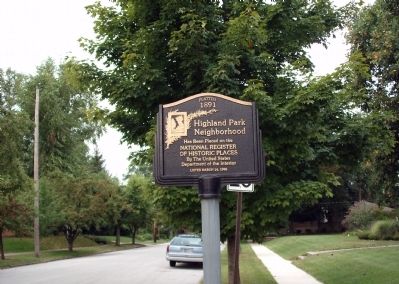
1. One of three identical markers
There are three markers like this one, all marked the same and but for differences in wear and tear they and upkeep the three would be identical. The other two are at 40°24'15.4"N 86°53'19.8"W and 40°24'33.2"N 86°53'23.7"W. Note To Editor only visible by Contributor and editor
— Submitted June 17, 2025, by Linda Ann Swihart of West Lafayette, Indiana.
Credits. This page was last revised on August 5, 2025. It was originally submitted on August 26, 2010, by Al Wolf of Veedersburg, Indiana. This page has been viewed 799 times since then and 33 times this year. Photos: 1, 2. submitted on August 26, 2010, by Al Wolf of Veedersburg, Indiana. • Syd Whittle was the editor who published this page.
Editor’s want-list for this marker. Photos of the other two identical markers at 40°24'15.4"N 86°53'19.8"W and 40°24'33.2"N 86°53'23.7"W each on their own new page (click add-a-marker) • Photos of some of the homes, buildings, parks and bridges described in the Statement of Significance. • Can you help?
