Near Cambridge in Dane County, Wisconsin — The American Midwest (Great Lakes)
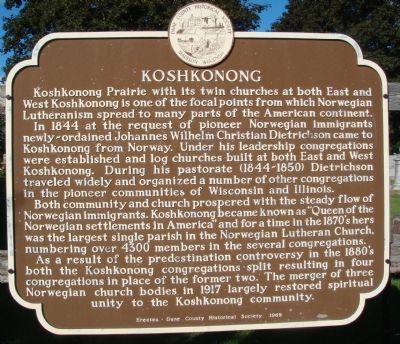
Koshkonong
Photographed by William J. Toman, September 4, 2010
1. Koshkonong Marker
In 1844 at the request of pioneer Norwegian immigrants newly-ordained Johannes Wilhelm Christian Dietrichson came to Koshkonong from Norway. Under his leadership congregations were established and log churches built at both East and West Koshkonong. During his pastorate (1844-1850) Dietrichson traveled widely and organized a number of other congregations in the pioneer communities of Wisconsin and Illinois.
Both community and church prospered with the steady flow of Norwegian immigrants. Koshkonong became known as "Queen of the Norwegian settlements in America" and for a time in the 1870's hers was the largest single parish in the Norwegian Lutheran Church, numbering over 4300 members in the several congregations.
As a result of the predestination controversy in the 1880's both the Koshkonong congregations split resulting in four congregations in place of the former two. The merger of three Norwegian church bodies in 1917 largely restored
this page online
Erected 1969 by the Dane County Historical Society. (Marker Number 11.)
Topics and series. This historical marker is listed in these topic lists: Religion & Religious Structures • Settlements & Settlers. In addition, it is included in the Norwegian-Americans, and the Wisconsin, Dane County Historical Society series lists. A significant historical year for this entry is 1844.
Location. 42° 57.177′ N, 89° 2.885′ W. Marker is near Cambridge, Wisconsin, in Dane County. It is on East Church Road 0.4 miles west of Hillside Road, on the right when traveling west. Touch for map. Marker is at or near this postal address: 454 East Church Street Road, Cambridge WI 53523, United States of America. Touch for directions.

Regionally, this marker is in Southeast Wisconsin and in Greater Madison. It is also in the American Midwest and in the Corn Belt. Globally, it is in North America, the Western Hemisphere, the Western World, and the Anglosphere. Historically, it finds itself in what was once the territory of the Mississippian Culture and also the Northwest Territory.
Other nearby markers. At
Photographed by William J. Toman, September 4, 2010
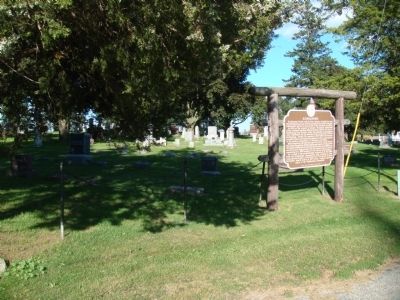
2. Koshkonong Marker
Another marker is no longer nearby. Sterling North (was approx. 5.2 miles away but has been confirmed missing).
More about this marker. The marker is between the two East Koshkonong church buildings that were built during the split in the East Koshkonong congregation. The West Koshkonong church is located a few miles to the northwest.
Also see . . .
1. East Koshkonong Church. (Submitted on September 26, 2010, by William J. Toman of Green Lake, Wisconsin.)
2. Western Koshkonong Church. (Submitted on September 26, 2010, by William J. Toman of Green Lake, Wisconsin.)
Photographed by William J. Toman, September 4, 2010
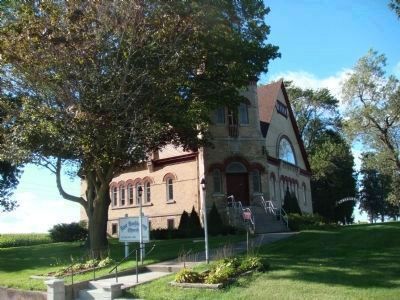
3. First East Koshkonong Church
This church was built in 1893 just west of the East Koshkonong Church after the congregation split in a dispute over predestination, that is, the question of whether man must cooperate with God in attaining his salvation or whether it is dependent alone on the grace of God.
Photographed by William J. Toman, September 4, 2010
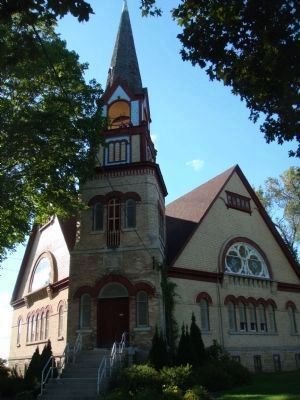
4. First East Koshkonong Church
View of the unusual corner steeple.
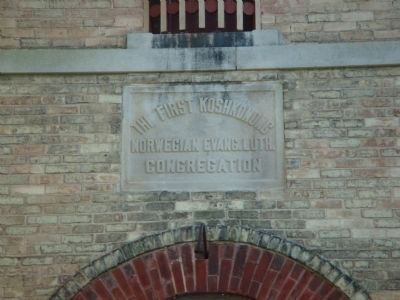
Photographed by William J. Toman, September 4, 2010
5. First East Koshkonong Church
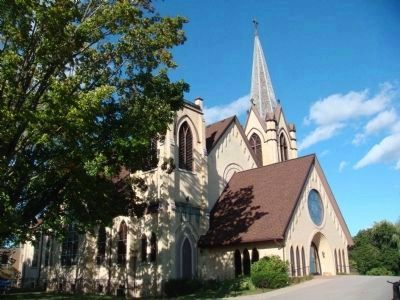
Photographed by William J. Toman, September 4, 2010
6. East Koshkonong Church
This church was built in 1897 to replace the first stone church that had been built in 1858 (which, in turn, had replaced the original log cabin church built in 1845).
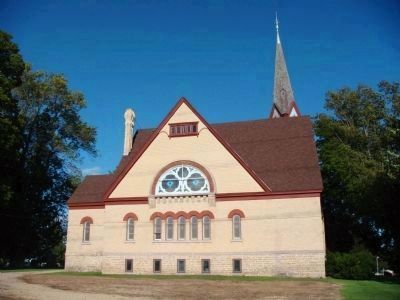
Photographed by William J. Toman, September 4, 2010
7. East Koshkonong Church
The stone from the 1845 church was used to build the basement of this 1897 church.
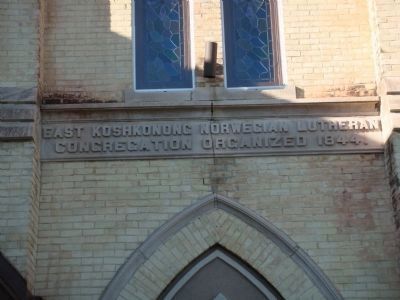
Photographed by William J. Toman, September 4, 2010
8. Closeup of the East Koshkonong Church
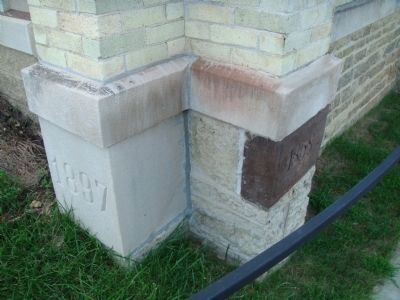
Photographed by William J. Toman, September 4, 2010
9. East Koshkonong Church
Church cornerstones showing the original 1845 cornerstone for the first stone church and the cornerstone for the 1897 replacement.
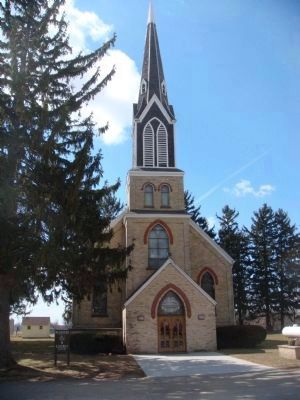
Photographed by William J. Toman, April 2, 2011
10. Western Koshkonong Lutheran Church
This is one of the two Lutheran churches at West Koshkonong.
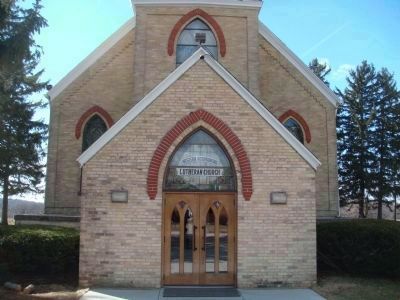
Photographed by William J. Toman, April 2, 2011
11. Western Koshkonong Lutheran Church
This is a closeup of one of the two Lutheran churches at West Koshkonong.
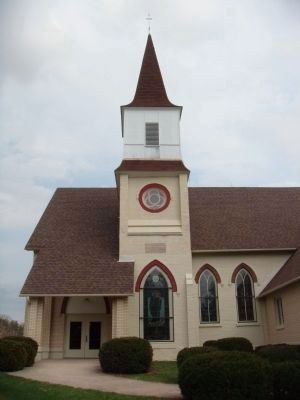
Photographed by William J. Toman, April 10, 2011
12. West Koshkonong Lutheran Church
It appears that this church originally had a corner steeple like the First East Koshkonong Lutheran Church. See the nearby "West Koshkonong Lutheran Congregation" marker for this church.
Credits. This page was last revised on October 15, 2020. It was originally submitted on September 25, 2010, by William J. Toman of Green Lake, Wisconsin. This page has been viewed 2,231 times since then and 79 times this year. Photos: 1, 2, 3, 4, 5. submitted on September 25, 2010, by William J. Toman of Green Lake, Wisconsin. 6, 7, 8, 9. submitted on September 26, 2010, by William J. Toman of Green Lake, Wisconsin. 10, 11. submitted on April 8, 2011, by William J. Toman of Green Lake, Wisconsin. 12. submitted on April 10, 2011, by William J. Toman of Green Lake, Wisconsin. • Bill Pfingsten was the editor who published this page.
