Near Henrico in Henrico County, Virginia — The American South (Mid-Atlantic)
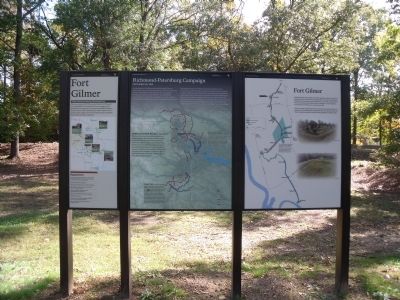
Fort Gilmer
Richmond-Petersburg Campaign
Photographed by Bernard Fisher, October 24, 2010
1. Fort Gilmer Marker
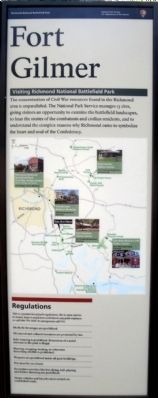
Fort Gilmer
Visiting Richmond National Battlefield Park
The concentration of Civil War resources found in the Richmond area is unparalleled. The National Park Service manages 13 sites, giving visitors an opportunity to examine the battlefield landscapes, to hear the stories of the combatants and civilian residents, and to understand the complex reasons why Richmond came to symbolize the heart and soul of the Confederacy.
Regulations
This is a partial list of park regulations. Site is open sunrise to sunset. Report suspicious activities to any park employee or call 804-795-5018. In emergencies call 911.
Alcoholic beverages are prohibited.
All natural and cultural resources are protected by law.
Relic hunting is prohibited. Possession of a metal detector in the park is illegal.
Hunting, trapping, feeding, or otherwise disturbing wildlife is prohibited.
Weapons are prohibited inside all park buildings.
Pets must be on a leash.
Recreation activities like kite-flying, ball-playing, and frisbee throwing are prohibited.
Motor vehicles and bicycles must remain on established roads.
(center panel)
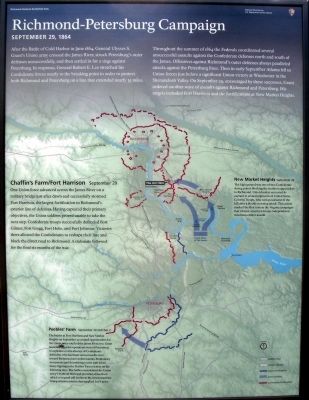
Richmond-Petersburg Campaign
September 29, 1864
After
this page online
Throughout the summer of 1864 the Federals coordinated several unsuccessful assaults against the Confederate defenses north and south of the James. Offensives against Richmond’s outer defenses always paralleled attacks against the Petersburg lines. Then in early September Atlanta fell to Union forces just before a significant victory at Winchester in the Shenandoah Valley. On September 29, encouraged by the successes, Grant ordered another wave of assaults against Richmond and Petersburg. His targets included Fort Harrison and the fortifications at New Market Heights.
Chaffin’s Farm/Fort Harrison September 29
One Union force advanced across the James River on a military bridge just after dawn and successfully stormed Fort Harrison, the largest
Photographed by Bernard Fisher, October 24, 2010
2. Left Panel
New Market Heights September 29
The high ground was one of two Confederate strong points blocking the southern approaches to Richmond. Union leaders entrusted its capture to several regiments of United States Colored Troops, who took possession of the hill after a bloody morning attack. This action marked the first time in the Virginia campaigns that African American troops independently mounted a major assault.
Peebles’ Farm September 29-October 2
The battles at Fort Harrison and New Market Heights on September 29 created opportunities for the Union army south of the James River, too. Grant launched offensive operations west of Petersburg to capitalize on the absence of Confederate defenders who had been sent across the river
Photographed by Bernard Fisher, October 24, 2010
3. Center Panel
(right panel)
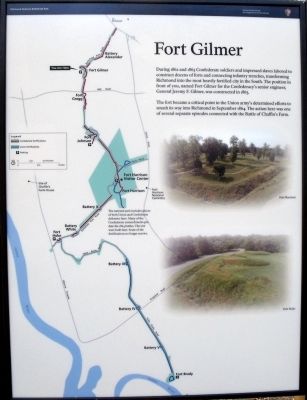
Fort Gilmer
During 1862 and 1863 Confederate soldiers and impressed slaves labored to construct dozens of forts and connecting infantry trenches, transforming Richmond into the most heavily fortified city in the South. The position in front of you, named Fort Gilmer for the Confederacy’s senior engineer, General Jeremy F. Gilmer, was constructed in 1863.
The fort became a critical point in the Union army’s determined efforts to smash its way into Richmond in September 1864. The action here was one of several separate episodes connected with the Battle of Chaffin’s Farm.
Erected 2010 by Richmond National Battlefield Park.
Topics. This historical marker is listed in these topic lists: Forts and Castles • War, US Civil. A significant historical month for this entry is June 1864.
Location. 37° 26.818′ N,
Photographed by Bernard Fisher, October 24, 2010
4. Right Panel

Regionally, this marker is in Virginia’s Piedmont, in Central Virginia, and in the Richmond Metropolitan Area. It is also in the American South, specifically in the Upper South, and on the Eastern Seaboard. Globally, it is in the North Atlantic Region, North America, the Western Hemisphere, the Western World, and the Anglosphere. Historically, it finds itself in what was once the territory of the Mississippian Culture, one of the original Thirteen Colonies, one of the Confederate States of America, and the Antebellum South.
Other nearby markers. At least 8 other markers are within walking distance of this marker: Hopeless Attacks (here, next to this marker); Richmond Defences (approx. 0.2 miles away); St. James School (approx. 0.4 miles away); St. James Hall and Cemetery (approx. 0.4 miles away); a different marker
Photographed by Bernard Fisher, October 24, 2010
5. Fort Gilmer
Other markers no longer nearby. Richmond Battlefields (was here, next to this marker but has been replaced with another marker now near it); Black Troops Attack at Chaffin’s Farm (was within shouting distance of this marker but has been replaced with another marker now near it).
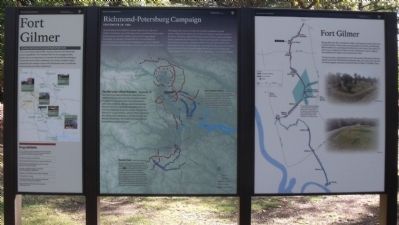
More about this marker. On the left panel is a map of Civil War sites managed by the Richmond National Battlefield Park.
On the center panel is a map of the Richmond and Petersburg defenses and the Union assaults begun on September 29, 1864.
On the right panel is a map of the NPS Fort Harrison unit with the caption, "The national park includes pieces of both Union and Confederate defensive lines. Many of the Confederate entrenchments predate the 1864 battles. The rest were built later. Some of the fortifications no longer survive." Also shown are photos of Forts Harrison and Hoke.
Related marker. Click here for another marker that is related to this marker. Old Marker At This Location titled "Richmond Battlefields".
Also see . . .
1. Richmond National Battlefield Park. (Submitted on October 25, 2010, by Bernard Fisher of Richmond, Virginia.)
2. Chaffin’s Farm/New Market Heights. CWSAC Battle Summary (Submitted on October 25, 2010, by Bernard Fisher of Richmond, Virginia.)
3. Battle of New Market Heights: USCT Soldiers Proved Their Heroism. Civil War Preservation Trust (Submitted on October 25, 2010, by Bernard Fisher of Richmond, Virginia.)
Credits. This page was last revised on November 5, 2021. It was originally submitted on October 25, 2010, by Bernard Fisher of Richmond, Virginia. This page has been viewed 3,228 times since then and 134 times this year. Photos: 1, 2, 3, 4, 5. submitted on October 25, 2010, by Bernard Fisher of Richmond, Virginia.
