Selma in Dallas County, Alabama — The American South (East South Central)
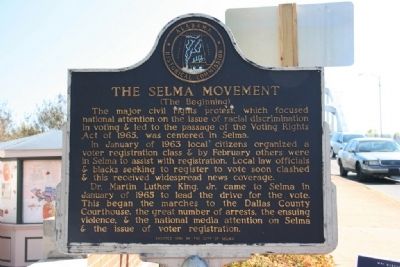
The Selma Movement
(The Beginning)
⎯⎯⎯
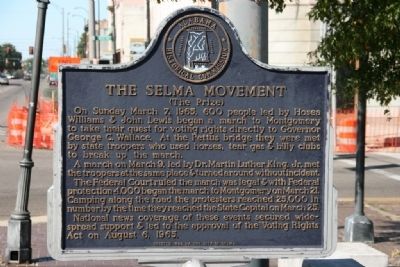
(The Prize)
Photographed by Tim & Renda Carr, November 6, 2010
1. The Selma Movement Marker (The Beginning)
In January of 1963 local citizens organized a voter registration class & by February others were in Selma to assist with registration. Local law officials & blacks seeking to register to vote soon clashed & this received widespread news coverage.
Dr. Martin Luther King, Jr. came to Selma in January of 1965 to lead the drive to vote. This began the marches to the Dallas County Courthouse, the great number of arrests, the ensuing violence, & national media attention on Selma & the issue of voter registration.
A march on March 9, led by Dr. Martin Luther King, Jr. met the troopers at the same place & turned around
this page online
The Federal Court ruled the march was legal & with Federal protection 4,000 began the march to Montgomery on March 21. Camping along the road the protesters reached 25,000 in number by the time they reached the State Capital on March 25.
National news coverage of these events secured wide-spread support & led to the approval of the Voting Rights Act on August 6, 1865.
Erected 1990 by Alabama Historical Commission / City of Selma.
Topics and series. This historical marker is listed in these topic lists: African Americans • Civil Rights. In addition, it is included in the Alabama Historical Commission series list. A significant historical month for this entry is January 1963.
Location. Marker has been permanently removed. It was located near 32° 24.388′ N, 87° 1.14′ W. Marker was in Selma, Alabama, in Dallas County. It was at the intersection of Broad Street (U.S. 80) and Water Avenue, on the right when traveling north on Broad Street. Exact marker location now has a different Civil Rights marker erected. Touch for map. Marker was in this post office area: Selma AL 36701, United States of America.
We have been informed
Photographed by Tim & Renda Carr, November 6, 2010
2. The Selma Movement Marker (The Prize)
Regionally, this marker was in the American South, specifically in the Deep South, and in the Black Belt. Globally, it was in North America, a Gulf of Mexico state, the Western Hemisphere, the Western World, and the Anglosphere. Historically, it found itself in what was once New Spain, the territory of the Mississippian Culture, one of the Confederate States of America, and the Antebellum South.

Other nearby markers. At least 8 other markers are within walking distance of this location: 'Bloody Sunday' Attack at Edmund Pettus Bridge / U.S. Congress Approves Voting Rights Act of 1965 (here, next to this marker); This Tablet Commemorates the Visit of Lafayette (about 300 feet away, measured in a direct line); Water Avenue (about 300 feet away); Edmund Pettus Bridge (about 300 feet away); Site of Selma-Dallas County’s 1st Bridge 1884-1940 (about 300 feet away); St. James Hotel (about 400 feet away); Lafayette's Tour (about 400 feet away); The Sleeping Prophet (about 400 feet away). Touch for a list and map of all markers
Photographed by Mark Hilton, March 25, 2015
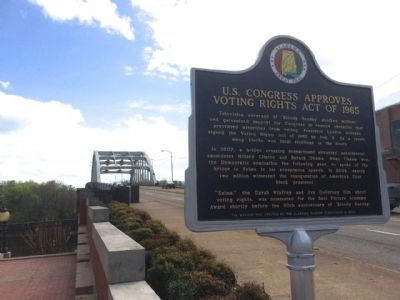
3. Voting Rights Act of 1965 Marker
Related marker. Click here for another marker that is related to this marker.
Photographed by Mark Hilton, March 25, 2015
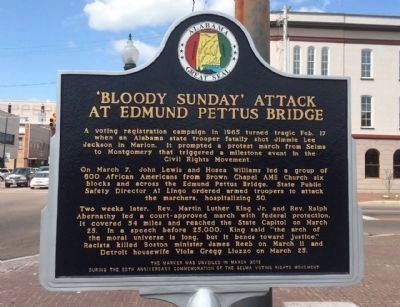
4. Bloody Sunday Attack at Pettus Bridge marker.
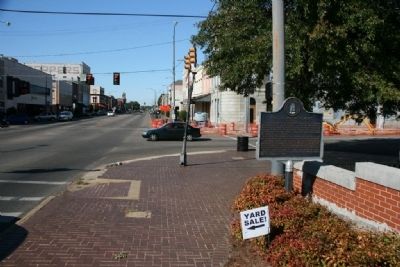
Photographed by Tim & Renda Carr, November 6, 2010
5. The Selma Movement Marker
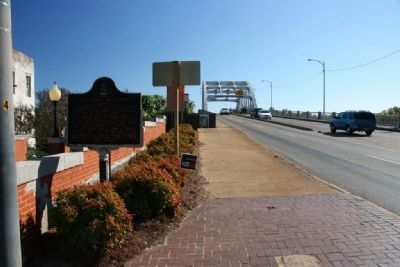
Photographed by Tim & Renda Carr, November 6, 2010
6. The Selma Movement Marker and The Edmund Pettus Bridge
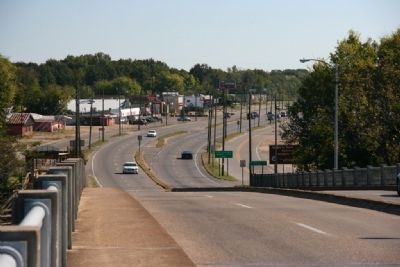
Photographed by Tim & Renda Carr, November 6, 2010
7. Looking South from the Edmund Pettus Bridge
It was here on this side of the bridge where the Alabama State Troopers attacked the Civil Rights Marchers.
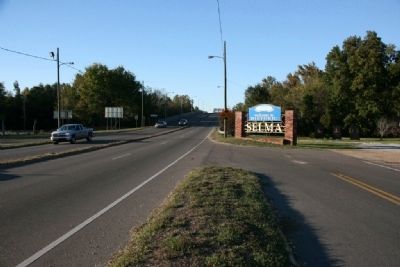
Photographed by Tim & Renda Carr, November 6, 2010
8. North View Of The Edmund Pettus Bridge
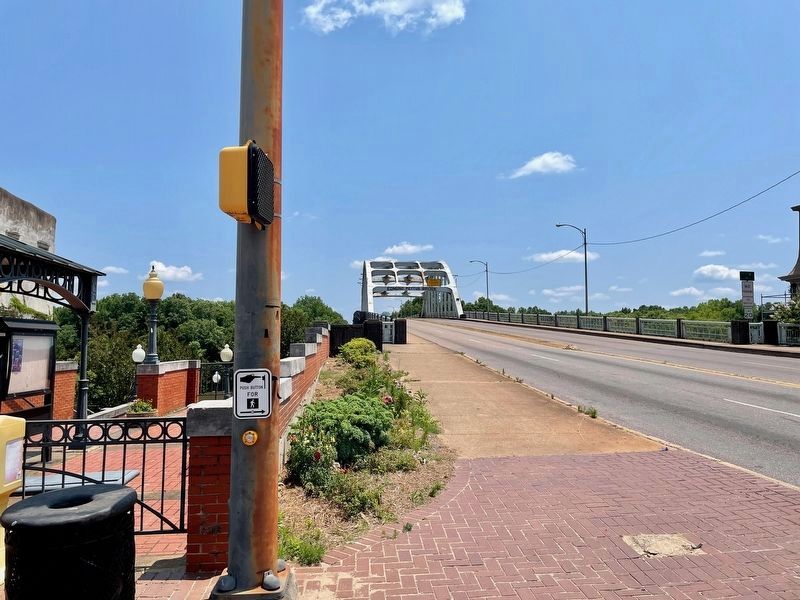
Photographed by Mark Hilton, May 28, 2023
9. Marker was hit by a vehicle and never replaced.
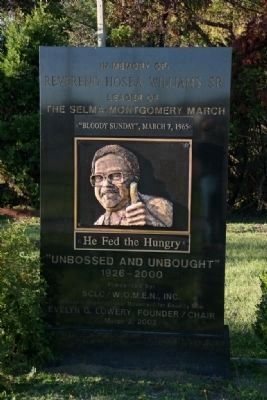
Photographed by Tim & Renda Carr, November 6, 2010
10. Rev. Hosea Williams, Sr.
"Bloody Sunday" March 7, 1965
"He Fed the Hungry"
"Unbossed and Unbought"
1926 - 2000
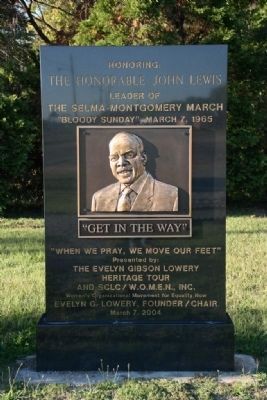
Photographed by Tim & Renda Carr, November 6, 2010
11. Hon. John Lewis
"Bloody Sunday" March 7, 1965
"Get in the Way"
"When we pray we move our feet"
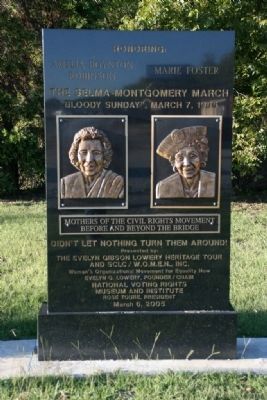
Photographed by Tim & Renda Carr, November 6, 2010
12. Amelia Boynton Robinson and Marie Foster
"Bloody Sunday", March 7, 1965
Mothers of the Civil Rights Movement
Before and Beyond the Bridge
Didn't let nothing turn them around!
Credits. This page was last revised on May 28, 2023. It was originally submitted on November 7, 2010, by Timothy Carr of Birmingham, Alabama. This page has been viewed 3,306 times since then and 79 times this year. Photos: 1, 2. submitted on November 7, 2010, by Timothy Carr of Birmingham, Alabama. 3, 4. submitted on March 25, 2015, by Mark Hilton of Montgomery, Alabama. 5, 6. submitted on November 7, 2010, by Timothy Carr of Birmingham, Alabama. 7, 8. submitted on November 8, 2010, by Timothy Carr of Birmingham, Alabama. 9. submitted on May 28, 2023, by Mark Hilton of Montgomery, Alabama. 10, 11, 12. submitted on November 8, 2010, by Timothy Carr of Birmingham, Alabama. • Syd Whittle was the editor who published this page.
