Near Kempton in Tipton County, Indiana — The American Midwest (Great Lakes)
The Dunham House
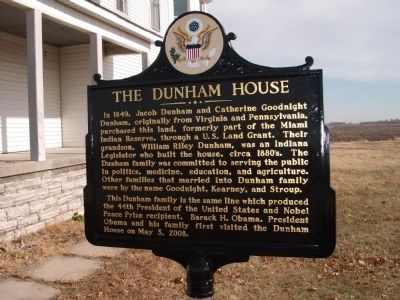
Photographed by Courtesy:: Marilyn Wolf, November 10, 2010
1. The Dunham House Marker
(Click on any of these photos to see the details.)
This Dunham Family is the same line which produced the 44th President of the United States and Nobel Peace Prize recipient, Barack H. Obama. President Obama and his family first visited the Dunham House on May 3, 2008.
Erected 2010.
Topics. This historical marker is listed in this topic list: Government & Politics. A significant historical date for this entry is May 3, 2008.
Location. 40° 16.827′ N, 86° 13.897′ W. Marker is near Kempton, Indiana, in Tipton County. It is on South West Street (County Road S1150W) north of State Road 28, on the right when traveling north. Touch for map. Marker is at or near this postal address: 709 South West
this page online

Regionally, this marker is in Central Indiana. It is also in the American Midwest and in the Corn Belt. Globally, it is in North America, the Western Hemisphere, the Western World, and the Anglosphere. Historically, it finds itself in what was once the territory of the Mississippian Culture and also the Northwest Territory.
Other nearby markers. At least 8 other markers are within 10 miles of this marker, measured as the crow flies: Old Log Store Built 1850 (approx. 3.8 miles away); Roberts Settlement (approx. 8.8 miles away); Kirklin Public Library (approx. 9.1 miles away); Tipton County (Indiana) Veterans Memorial (approx. 9.7 miles away); Deputy Carl Koontz (approx. 9.7 miles away); Boxley Homestead (approx. 9.9 miles away); Indiana Celebration Point Of History (approx. 9.9 miles away); Tipton County (Indiana) World War I and II Memorial (approx. 10 miles away).
Also see . . . "A History in Progress". Courtesy "thedunhamhouse.com" (Official Web-site of The Dunham House):: is a link to the history of Dunham House - - plus an introduction
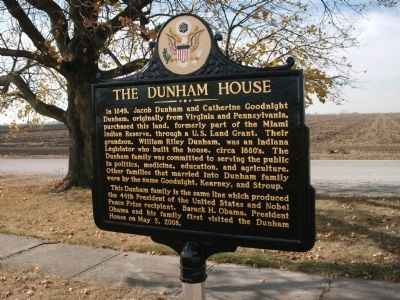
Photographed by Courtesy:: Marilyn Wolf, November 10, 2010
2. Obverse View - - The Dunham House Marker
Photographed by Courtesy:: Marilyn Wolf, November 10, 2010
3. Top of The Dunham House Marker
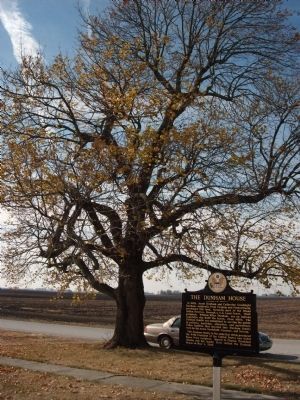
Photographed by Courtesy:: Marilyn Wolf, November 10, 2010
4. Wide Obverse View - - The Dunham House Marker
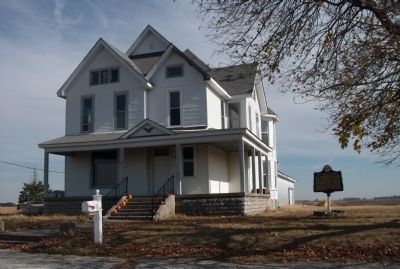
Photographed by Courtesy:: Marilyn Wolf, November 10, 2010
5. The Dunham House -and- Marker
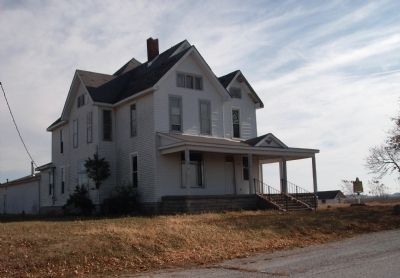
Photographed by Courtesy:: Marilyn Wolf, November 10, 2010
6. The Dunham House
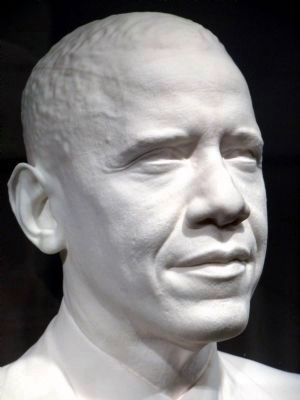
Photographed by Allen C. Browne, February 16, 2015
7. Barack Obama
This 3–D printed portrait of Barack Obama can be found in the National Portrait Gallery in Washington D.C.
“Before the development of photography in th early nineteenth century, artists created life masks to capture an accurate likeness of a person. Life and death masks also helped memorialize individuals. Phrenology, the pseudoscience of reading character through facial features and the shape of the head, also fueled interest in life and death masks in the nineteenth century.
In 2014 President Barack Obama became the first sitting president to have his likeness captured with 3–D imaging and printing technologies. The Smithsonian's Digitization Program Office created this high–resolution 1:1 scale 3–D image by combining a series of digital photographs with data from patterned light scanners. The resulting image captures, with great accuracy, the actual features of the subject, as opposed to a portrait artist's interpretation of those features.
This is one of a number of the Portrait Gallery's likenesses of President Obama. The president's official portrait for the museum's ‘America's Presidents’ installation will be commissioned at a later time.” — National Portrait Gallery
“Before the development of photography in th early nineteenth century, artists created life masks to capture an accurate likeness of a person. Life and death masks also helped memorialize individuals. Phrenology, the pseudoscience of reading character through facial features and the shape of the head, also fueled interest in life and death masks in the nineteenth century.
In 2014 President Barack Obama became the first sitting president to have his likeness captured with 3–D imaging and printing technologies. The Smithsonian's Digitization Program Office created this high–resolution 1:1 scale 3–D image by combining a series of digital photographs with data from patterned light scanners. The resulting image captures, with great accuracy, the actual features of the subject, as opposed to a portrait artist's interpretation of those features.
This is one of a number of the Portrait Gallery's likenesses of President Obama. The president's official portrait for the museum's ‘America's Presidents’ installation will be commissioned at a later time.” — National Portrait Gallery
Credits. This page was last revised on November 16, 2024. It was originally submitted on November 11, 2010, by Al Wolf of Veedersburg, Indiana. This page has been viewed 2,087 times since then and 56 times this year. Photos: 1, 2, 3, 4, 5, 6. submitted on November 11, 2010, by Al Wolf of Veedersburg, Indiana. 7. submitted on June 11, 2015, by Allen C. Browne of Silver Spring, Maryland. • Bill Pfingsten was the editor who published this page.
