Downtown El Paso in El Paso County, Texas — The American South (West South Central)
El Paso's Chinese Community
Photographed by Bill Kirchner, November 3, 2010
1. El Paso's Chinese Community Marker
Inscription.
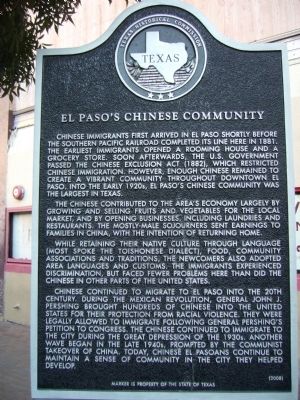
El Paso's Chinese Community. . Chinese immigrants first arrived in El Paso shortly before the Southern Pacific Railroad completed its line here in 1881. The earliest immigrants opened a rooming house and a grocery store. Soon afterwards, the U.S. Government passed the Chinese exclusion act (1882) which restricted Chinese immigration. However, enough Chinese remained to create a vibrant community throughout downtown El Paso. Into the early 1920s, El Paso's Chinese community was the largest in Texas., The Chinese contributed to the area's economy largely by growing and selling fruits and vegetables for the local market, and by opening businesses, including laundries and restaurants. The mostly-male sojourners sent earnings to families in China, with the intention of returning home., While retaining their native culture through language (most spoke the Toishonese Dialect), food, community associations and traditions, the newcomers also adopted area languages and customs. The immigrants experienced discrimination, but faced fewer problems here than did the Chinese in other parts of the United States., Chinese continued to migrate to El Paso into the 20th century. During the Mexican Revolution, General John J. Pershing brought hundreds of Chinese into the United States for their protection from racial violence. They were legally allowed to immigrate following General Pershing's petition to Congress. The Chinese continued to immigrate to the city during the great depression of the 1930s. Another wave began in the late 1940s, prompted by the communist takeover of China. Today, Chinese El Pasoans continue to maintain a sense of community in the city they helped develop.
Chinese immigrants first arrived in El Paso shortly before the Southern Pacific Railroad completed its line here in 1881. The earliest immigrants opened a rooming house and a grocery store. Soon afterwards, the U.S. Government passed the Chinese exclusion act (1882) which restricted Chinese immigration. However, enough Chinese remained to create a vibrant community throughout downtown El Paso. Into the early 1920s, El Paso's Chinese community was the largest in Texas.
The Chinese contributed to the area's economy largely by growing and selling fruits and vegetables for the local market, and by opening businesses, including laundries and restaurants. The mostly-male sojourners sent earnings to families in China, with the intention of returning home.
While retaining their native culture through language (most spoke the Toishonese Dialect), food, community associations and traditions, the newcomers also adopted area languages and customs. The immigrants experienced discrimination, but faced fewer problems here than did the Chinese in other parts of the United States.
Chinese continued to migrate to El Paso into the
Click or scan to see this page online
20th century. During the Mexican Revolution, General John J. Pershing brought hundreds of Chinese into the United States for their protection from racial violence. They were legally allowed to immigrate following General Pershing's petition to Congress. The Chinese continued to immigrate to the city during the great depression of the 1930s. Another wave began in the late 1940s, prompted by the communist takeover of China. Today, Chinese El Pasoans continue to maintain a sense of community in the city they helped develop.
Erected 2008 by Texas Historical Commission. (Marker Number 16051.)
Topics. This historical marker is listed in these topic lists: Asian Americans • Settlements & Settlers. A significant historical year for this entry is 1881.
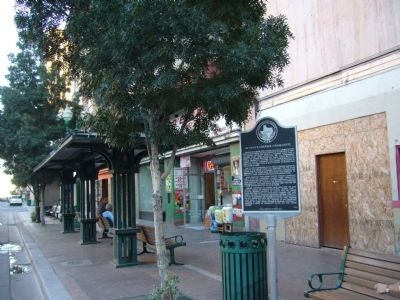
Location. 31° 45.552′ N, 106° 29.291′ W. Marker is in El Paso, Texas, in El Paso County. It is in Downtown El Paso. It is on West Mills Avenue, on the left when traveling west. Touch for map. Marker is at or near this postal address: 110 West Mills Avenue, El Paso TX 79901, United States of America. Touch for directions.
Regionally, this marker is in Texas’ Trans-Pecos & Big Bend
Photographed by Bill Kirchner, November 3, 2010
2. El Paso's Chinese Community Marker
Region. It is also in the American Southwest. Globally, it is in North America, a Gulf of Mexico state, the Western Hemisphere, the Western World, and the Anglosphere. Historically, it finds itself in what was once New Spain, the Republic of Texas, and one of the Confederate States of America.
Credits. This page was last revised on June 16, 2016. It was originally submitted on November 13, 2010, by Bill Kirchner of Tucson, Arizona. This page has been viewed 3,482 times since then and 74 times this year. Photos:1, 2. submitted on November 13, 2010, by Bill Kirchner of Tucson, Arizona. • Syd Whittle was the editor who published this page.