Las Cruces in Doña Ana County, New Mexico — The American Mountains (Southwest)
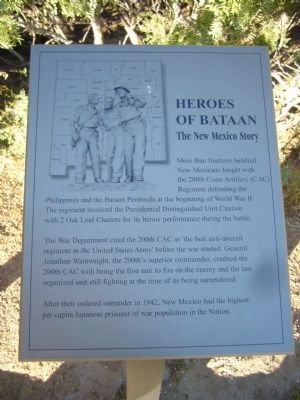
Heroes of Bataan
The New Mexico Story
Photographed by Bill Kirchner, November 5, 2010
1. Heroes of Bataan Marker
More than fourteen hundred New Mexicans fought with the 200th Coast Artillery (CAC) Regiment defending the Philippines and the Bataan Peninsula at the beginning of World War II. The regiment received the Presidential Distinguished Unit Citation with 2 Oak Leaf Clusters for its heroic performance during the battle.
The War Department cited the 200th CAC as 'the best anti-aircraft regiment in the United States Army' before the war started. General Jonathan Wainwright, the 200th's superior commander, credited the 200th CAC with being the first unit to fire on the enemy and the last organized unit still fighting at the time of its being surrendered.
After their ordered surrender in 1942, New Mexico had the highest per capita Japanese prisoner of war population in the Nation.
The Bataan Death March Memorial Walkway
Veterans Park Las Cruces, New Mexico
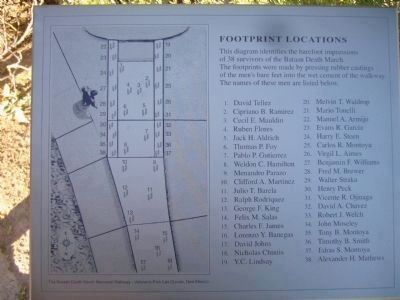
This diagram identifies the barefoot impressions of 38 survivors of the Bataan Death March. The footprints were made by pressing rubber castings of the men's bare feet into the wet cement of the walkway. The names of these men are listed below.
[Numbers coincide with the numbers next to foot prints seen on diagram in photo #2]
1.
this page online
Topics. This historical marker is listed in this topic list: War, World II. A significant historical year for this entry is 1942.
Location. 32° 20.067′ N, 106° 44.983′ W. Marker is in Las Cruces, New Mexico, in Doña Ana County. It can be reached from North Roadrunner Parkway 1.8 miles south of U.S. 70. Marker is at the southeast
Photographed by Bill Kirchner, November 5, 2010
2. Footprint Locations
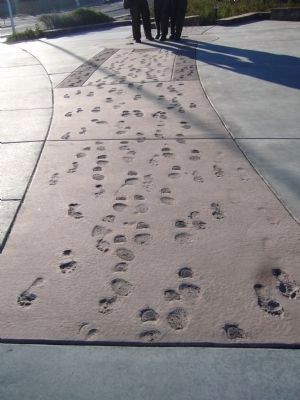
Footprints leading to and from the statue "look back to what has passed, down to what is present and ahead to what might be," according to notes by the sculptor, Kelley Hestir.
"The footprints are symbolic of the many soldiers who began the march and the few who finished. The impressions were made from the feet of those who survived,"
"The footprints are symbolic of the many soldiers who began the march and the few who finished. The impressions were made from the feet of those who survived,"

Regionally, this marker is in the Rio Grande Valley. It is also in the American Borderlands and in the Southwest. Globally, it is in North America, the Western Hemisphere, the Western World, and the Anglosphere. Historically, it finds itself in what was once New Spain, the Gadsden Purchase, and the Republic of Texas.
Other nearby markers. At least 8 other markers are within 3 miles of this marker, measured as the crow flies: America's First Battle of World War II: The Philippines (here, next to this marker); The Branigan Building (approx. 2.3 miles away); Rio Grande Theatre (approx. 2.4 miles away); Votes for Women (approx. 2.6 miles away); Doña Ana County Courthouse (approx. 2.6 miles away); The Centennial Caboose (approx. 2.8 miles away); The Classic Caboose (approx. 2.8 miles away); Las Cruces Railroad Depot (approx. 2.8 miles away). Touch for a list and map of all markers in Las Cruces.
Also see . . . Bataan Death March. Wikipedia entry (Submitted on February 23, 2025, by Larry Gertner of New York, New York.)
Photographed by Bill Kirchner
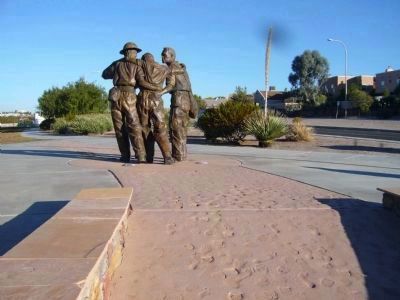
3. The Memorial Walkway Leading to the Statue
Photographed by Bill Kirchner, November 5, 2010
4. The Memorial Walkway
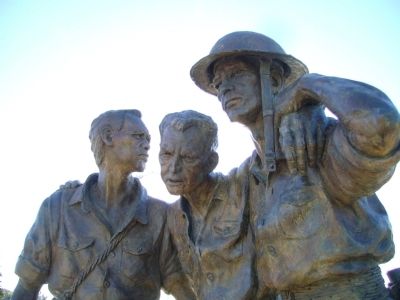
Photographed by Bill Kirchner, November 5, 2010
5. Heroes of Bataan
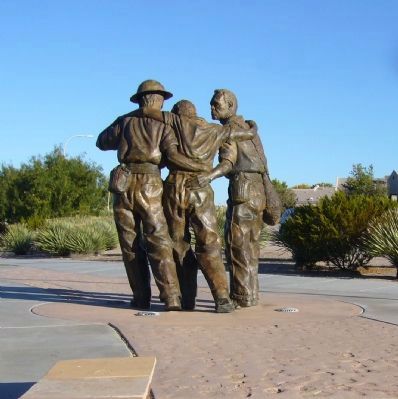
Photographed by Bill Kirchner, November 5, 2010
6. Heroes of Bataan
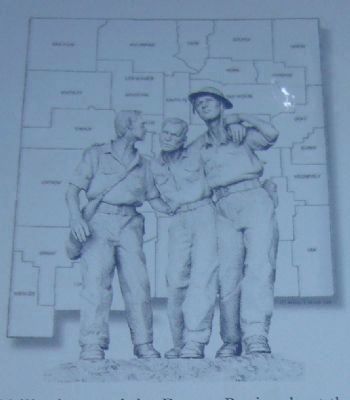
Photographed by Bill Kirchner
7. Close-Up of Artwork on Marker
Credits. This page was last revised on February 23, 2025. It was originally submitted on November 22, 2010, by Bill Kirchner of Tucson, Arizona. This page has been viewed 3,273 times since then and 197 times this year. Photos: 1, 2, 3, 4, 5, 6, 7. submitted on November 22, 2010, by Bill Kirchner of Tucson, Arizona. • Syd Whittle was the editor who published this page.
