Lewes Historic District in Sussex County, Delaware — The American Northeast (Mid-Atlantic)
Life Saving Station
Lewes Maritime History Trail
Photographed by Mike Stroud, October 15, 2010
1. Life Saving Station Marker
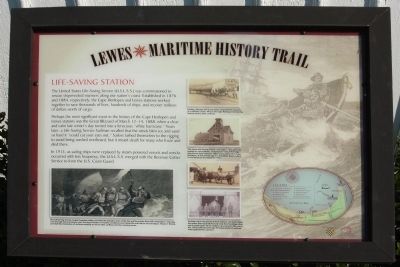
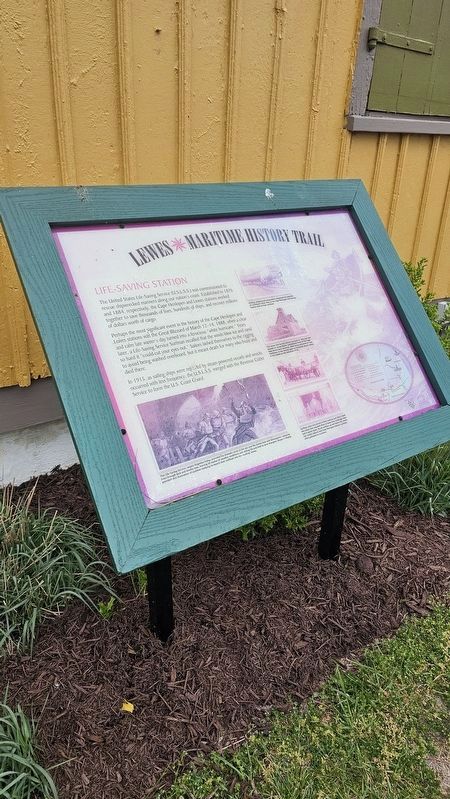
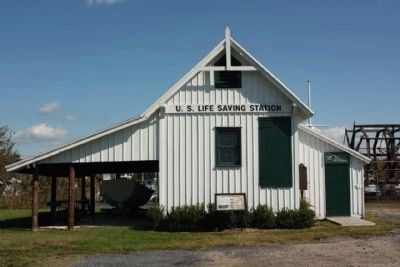
The United States Life Saving Service (U.S.L.S.S.) was commissioned to rescue shipwrecked mariners along our nation's coast. Established in 1876 and 1884, respectively, the Cape Henlopen and Lewes stations worked together to save thousands of lives, hundreds of ships, and recover millions of dollars worth of cargo.
Perhaps the most significant event in the history of the Cape Henlopen and Lewes stations was the Great Blizzard of March 12 -14, 1888, when a clear and calm late winter's day turned into a ferocious "white hurricane". Years later, the Life-Saving Service Surfman recalled that the winds blew ice and sand so hard it "could cut your eyes out." Sailors lashed themselves to the rigging to avoid being washed overboard, but it meant death for many who froze and died there.
In 1915, as sailing ships were replaced by steam-powered vessels and wrecks occurred with less frequency, the U.S.L.S.S. merged with the Revenue Cutter Service to form the U.S. Coast Guard.
Erected by City of Lewes. (Marker Number 2.)
Topics. This historical marker is listed in these topic lists: Charity & Public Work •
this page online
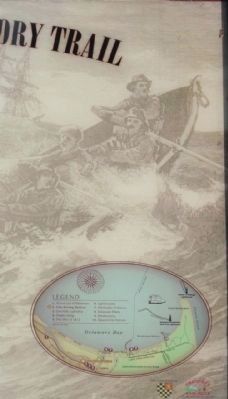
Location. 38° 46.686′ N, 75° 8.486′ W. Marker is in Lewes, Delaware, in Sussex County. It is in the Lewes Historic District. It is on Shipcarpenter Street near Pilottown Road when traveling north. Located at the end of Shipcarpenter Street. Touch for map. Marker is in this post office area: Lewes DE 19958, United States of America. Touch for directions.

Regionally, this marker is on Delaware’s Beaches. It is also in the American Mid-Atlantic, on the Delmarva Peninsula, and on the Eastern Seaboard. Globally, it is in the North Atlantic Region, North America, the Western Hemisphere, the Western World, and the Anglosphere. Historically, it finds itself in what was once New Netherland, one of the original Thirteen Colonies, and the Antebellum South.
Other nearby markers. At least 8 other markers are within walking distance of this marker: Overfalls Lightship (here, next to this marker); The Blizzard of 1888 (a few steps from this marker); The Lightship Overfalls LV-118/WAL-539 (a few steps from this marker); Lightship LV-118 Overfalls (a few steps from this
Photographed by Ian Lefkowitz, May 4, 2024
2. Life Saving Station Marker
Also see . . . The U.S.L.S.S. Living History Association. These poor, plain men, dwellers upon the lonely sands ...took their lives in their hands, and, at the most imminent risk, crossed the most tumultuous sea..., and all for what? That others might live to see home and friends.- Annual Report of the Operations of the United States Live-Saving Service, 1885.... (Submitted on November 28, 2010, by Mike Stroud of Bluffton, South Carolina.)
Photographed by Life Saving Station Marker
3. Life Saving Station Marker
(Lower left picture)
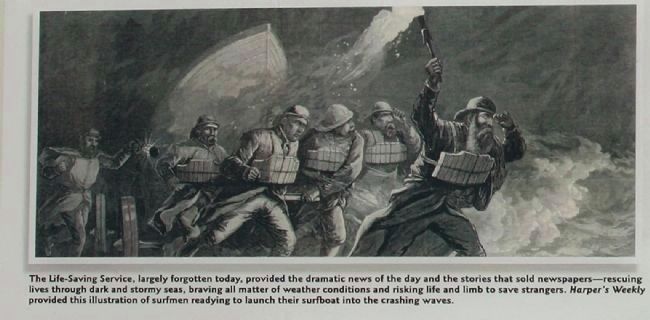
The Life-Saving Service, largely forgotten today, provided the dramatic news of the day and the stories that sold newspapers — rescuing lives through dark and stormy seas, braving all matter of weather conditions and risking life and limb to save strangers.Harper's Weekly provided this illustration of surfmen readying to launch their surfboat into crashing waves.
The Life-Saving Service, largely forgotten today, provided the dramatic news of the day and the stories that sold newspapers — rescuing lives through dark and stormy seas, braving all matter of weather conditions and risking life and limb to save strangers.Harper's Weekly provided this illustration of surfmen readying to launch their surfboat into crashing waves.
Photographed by Life Saving Station Marker, City of Lewes
4. Life Saving Station Marker Background picture
Photographed by Life Saving Station Marker
5. Life Saving Station Marker
(Top right picture)
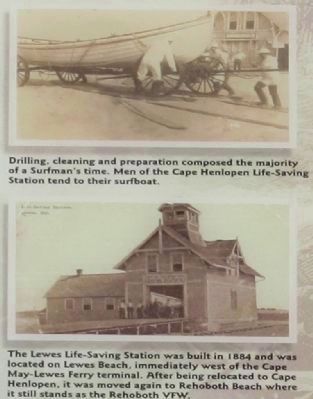
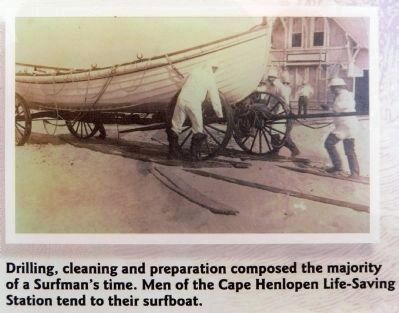
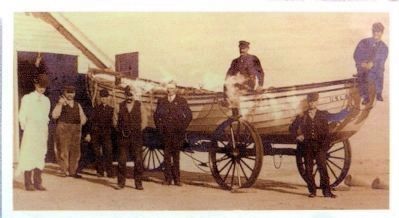
Drilling, cleaning and preparation composed the majority of a Surfman's time. Men of the Cape Henlopen Life-Saving Station tend to their surfboat.
(Top right center picture)
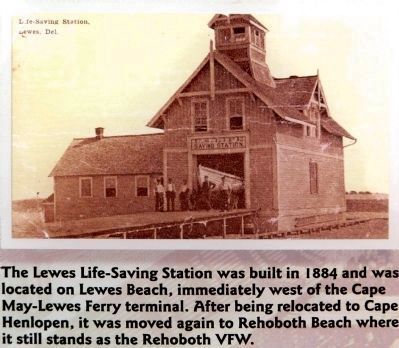
The Lewes Life-Saving Station was built in 1884 and was located on Lewes Beach, immediately west of the Cape May-Lewes Ferry terminal. After being relocated to Cape Henlopen, it was moved again to Rehoboth Beach where it still stands as the Rehoboth VFW.
Drilling, cleaning and preparation composed the majority of a Surfman's time. Men of the Cape Henlopen Life-Saving Station tend to their surfboat.
(Top right center picture)
The Lewes Life-Saving Station was built in 1884 and was located on Lewes Beach, immediately west of the Cape May-Lewes Ferry terminal. After being relocated to Cape Henlopen, it was moved again to Rehoboth Beach where it still stands as the Rehoboth VFW.
Photographed by Life Saving Station Marker
6. Life Saving Station Marker
(Lower right pictures)
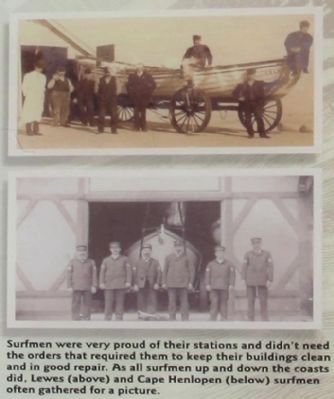
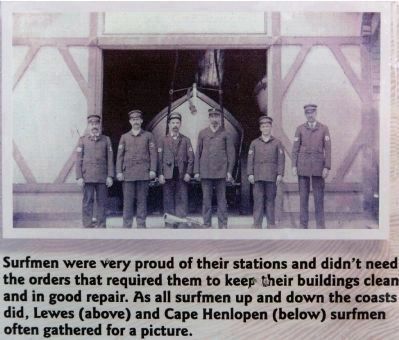
Surfmen were very proud of their stations and didn't need the orders that required them to keep their buildings clean and in good repair. As all surfmen up and down the coasts did, Lewes (above) and Cape Henlopen(below) surfmen often gathered for a picture.
Surfmen were very proud of their stations and didn't need the orders that required them to keep their buildings clean and in good repair. As all surfmen up and down the coasts did, Lewes (above) and Cape Henlopen(below) surfmen often gathered for a picture.
Photographed by Mike Stroud, October 15, 2010
7. Life Saving Station and Marker
Photographed by Allen C. Browne, February 3, 2013
8. Drilling, cleaning and preparation
Drilling, cleaning and preparation composed the majority of a Surfman's time. Men of the Cape of Henlopen Life-Saving Station tend to their surfboat.
Photographed by Allen C. Browne, February 3, 2013
9. Life Saving Station
The Lewes Life-Saving Station was built in 1884 and was located on Lewes Beach immediately west of the Cape May-Lewes Ferry terminal. After being relocated to Cape Henlopen, it was moved againt to Rehoboth Beach where it still stands as the Rehoboth VFW.
Photographed by Allen C. Browne, February 3, 2013
10. Lewes Surfmen
Photographed by Allen C. Browne, February 3, 2013
11. Cape Henlopen Surfmen
Surfmen were very proud of their stations and didn't need the orders that required them to keep their buildings clean and in good repair. As all surfmen up and down the coasts did, Lewes (above) and Cape Henlopen (below) surfmen gathered for a picture.
Photographed by Allen C. Browne, February 3, 2013
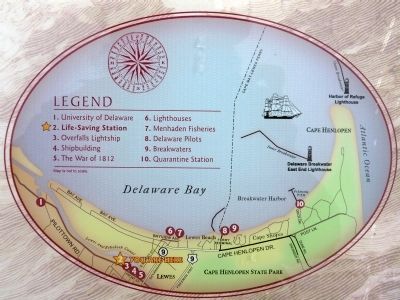
12. You Are Here
Photographed by Allen C. Browne, February 3, 2013
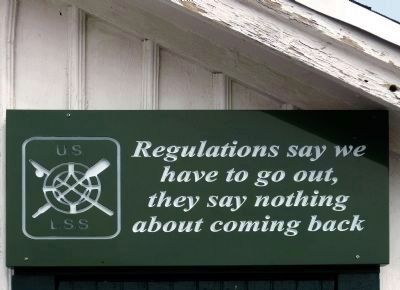
13. Sign over the Door
they say nothing about coming back
Photographed by Ian Lefkowitz, May 4, 2024
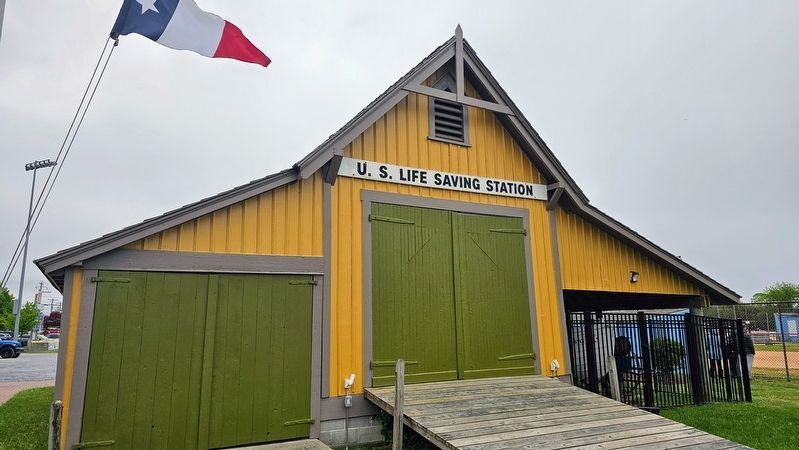
14. The U.S. Life Saving Station
Credits. This page was last revised on April 2, 2025. It was originally submitted on November 28, 2010, by Mike Stroud of Bluffton, South Carolina. This page has been viewed 1,328 times since then and 17 times this year. Photos: 1. submitted on November 28, 2010, by Mike Stroud of Bluffton, South Carolina. 2. submitted on March 17, 2025, by Ian Lefkowitz of New York, New York. 3, 4, 5, 6, 7. submitted on November 28, 2010, by Mike Stroud of Bluffton, South Carolina. 8, 9, 10, 11, 12, 13. submitted on February 18, 2013, by Allen C. Browne of Silver Spring, Maryland. 14. submitted on March 17, 2025, by Ian Lefkowitz of New York, New York.
