Windsor Hill Plantation in North Charleston in Dorchester County, South Carolina — The American South (South Atlantic)
Windsor Hill Plantation
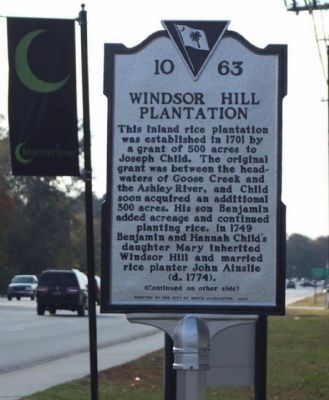
Photographed by Mike Stroud, 2010
1. Windsor Hill Plantation Marker
This inland rice plantation was established in 1701 by a grant of 500 acres to Joseph Child. The original grant was between the headwaters of Goose Creek and the Ashley River, and Child soon acquired an additional 300 acres. His son Benjamin added acreage and continued planting rice. In 1749 Benjamin and Hannah Child's daughter Mary inherited Windsor Hill and married rice planter John Ainslie (d. 1774).
(Reverse text)
John and Mary Ainslie built a two-story house here about 1750. In 1776 their daughter Hannah married William Moultrie, Jr. (1752-1796). The plantation declined by the 1830s, and the house burned in 1857. Gen. William Moultrie (1730-1805), victor at the Battle of Sullivan's Island in 1776 and governor 1785-1787 and 1792-94, was first buried here but later reburied on Sullivan's Island, at Fort Moultrie, in 1977.
Erected 2010 by The City of North Charleston. (Marker Number 10-63.)
Topics and series. This historical marker is listed in this topic list: Notable Places. In addition, it is included in the South Carolina Historical Markers series list. A significant historical year for this entry is 1701.
Location. 32° 55.432′ N,
this page online

Regionally, this marker is in the Lowcountry. It is also in the American South, specifically in the Deep South, and on the Eastern Seaboard. Globally, it is in the North Atlantic Region, North America, the Western Hemisphere, the Western World, and the Anglosphere. Historically, it finds itself in what was once the territory of the Mississippian Culture, one of the original Thirteen Colonies, one of the Confederate States of America, and the Antebellum South.
Other nearby markers. At least 8 other markers are within 4 miles of this marker, measured as the crow flies: A different marker also named Windsor Hill Plantation (within shouting distance of this marker); Inland Rice Fields (approx. 1.4 miles away); Archdale Hall (approx. 1.8 miles away); Camellias: Up on a Pedestal
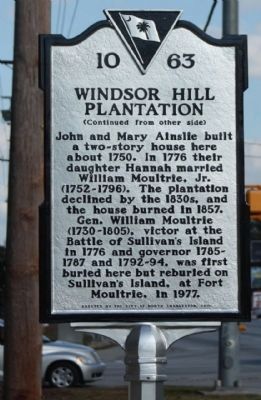
Photographed by Mike Stroud, 2010
2. Windsor Hill Plantation Marker, reverse side
More about this marker. This marker, numbered “10-” to indicate Charleston County, is actually located in Dorchester County. The county line is a ways east from this point.
Regarding Windsor Hill Plantation. Windsor Hill Plantation, steeped in the history and traditions of the South of another day, was for a time the home of one of the best known and highly respected heroes of the American Revolution, General William Moultrie.
General William Moultrie was born in Charleston in 1731, and entered the Continental Army at the start of the Revolution. His military history was impressive; he was made Brigadier General following his brilliant defense of Charleston against the British fleet on June 28th, 1776. It was this event, neglected in American History, that, when reported to Continental Congress on July 19, 1776, gave heart to those forefathers of the nation to sign
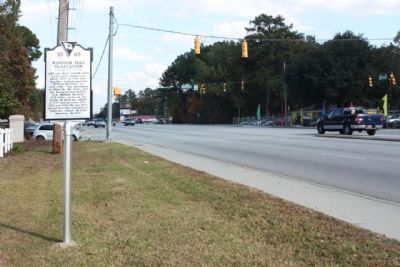
Photographed by Mike Stroud, 2010
3. Windsor Hill Plantation Marker, looking east along Ashley Phosphate Road
When Charleston fell to the British in 1780, he was taken prisoner, to later be exchanged for a distinguished British General, John Burgoyne.
General Moultrie received many recognitions during his military career, among them being the re-naming of Fort Sullivan to Fort Moultrie. He was elected Governor of South Carolina in 1785, and again in 1789.
When he died, on September 27, 1805, he was buried in the family burial ground at Windsor Hill Plantation. In 1977 his remains were reinterred at Fort Moultrie, the historical fort which was also renamed in his honor. But Windsor Hill Plantation will remain a living memorial to the man who served with distinction and honor during the formative years of a great nation - the United States of America. (Windsor Hill Plantation)
Also see . . .
1. "Dedication Video" - - Part One ::. (Submitted on June 11, 2011.)
2. "Dedication Video" - - Part Two ::. (Submitted on June 11, 2011.)
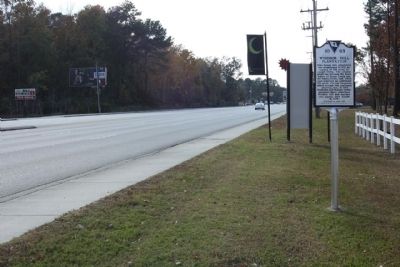
Photographed by Mike Stroud, 2010
4. Windsor Hill Plantation Marker looking west
Credits. This page was last revised on January 11, 2025. It was originally submitted on December 12, 2010, by Mike Stroud of Bluffton, South Carolina. This page has been viewed 3,847 times since then and 222 times this year. Photos: 1, 2, 3, 4. submitted on December 13, 2010, by Mike Stroud of Bluffton, South Carolina.
