Near Bison in Garfield County, Oklahoma — The American South (West South Central)
Run of '89 North Boundary
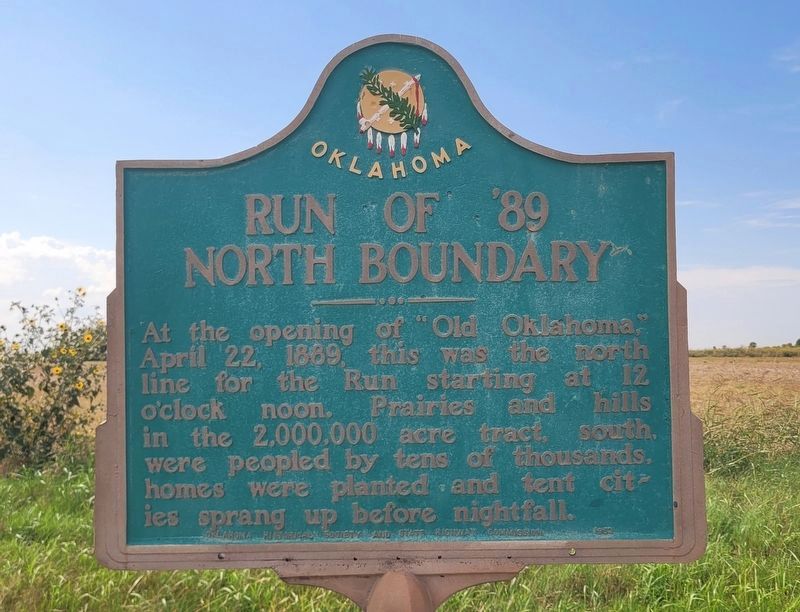
Photographed by James Hulse, September 15, 2025
1. Run of '89 North Boundary Marker
Erected by Oklahoma Historical Society and State Highway Commission.
Topics and series. This historical marker is listed in this topic list: Settlements & Settlers. In addition, it is included in the Oklahoma Historical Society series list. A significant historical date for this entry is April 22, 1864.
Location. 36° 9.859′ N, 97° 53.408′ W. Marker is near Bison, Oklahoma, in Garfield County. It is on U.S. 81 0.4 miles north of County Road E0590, on the right when traveling south. Touch for map. Marker is at or near this postal address: 140 US-81, Bison OK 73720, United States of America. Touch for directions.

Regionally, this marker is in Northwest Oklahoma — Red Carpet Country and specifically in Central Oklahoma—Frontier Country. It is also in the American South, specifically on the prairies, and on the Southern Plains. Globally, it is in North America,
this page online
Other nearby markers. At least 8 other markers are within 4 miles of this marker, measured as the crow flies: Cherokee Strip (here, next to this marker); Buffalo Springs (approx. 3½ miles away); Massacre of Pat Hennessey (approx. 3.7 miles away); Lest We Forget (approx. 3.7 miles away); Roy V. Cashion (approx. 3.7 miles away); Tribute to Patriotism and Valor (approx. 3.7 miles away); Pat Hennessey (approx. 3.7 miles away); First Rural Mail Route (approx. 3.7 miles away). Touch for a list and map of all markers in Bison.

Photographed by James Hulse, September 15, 2025
2. Run of '89 North Boundary Marker
The view of the marker next to the Cherokee Strip marker
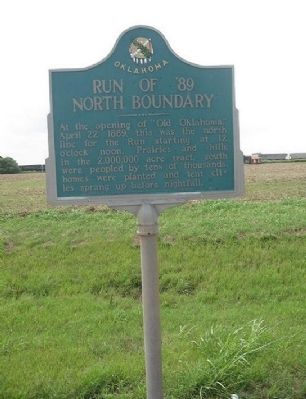
3. Run of '89 North Boundary Marker
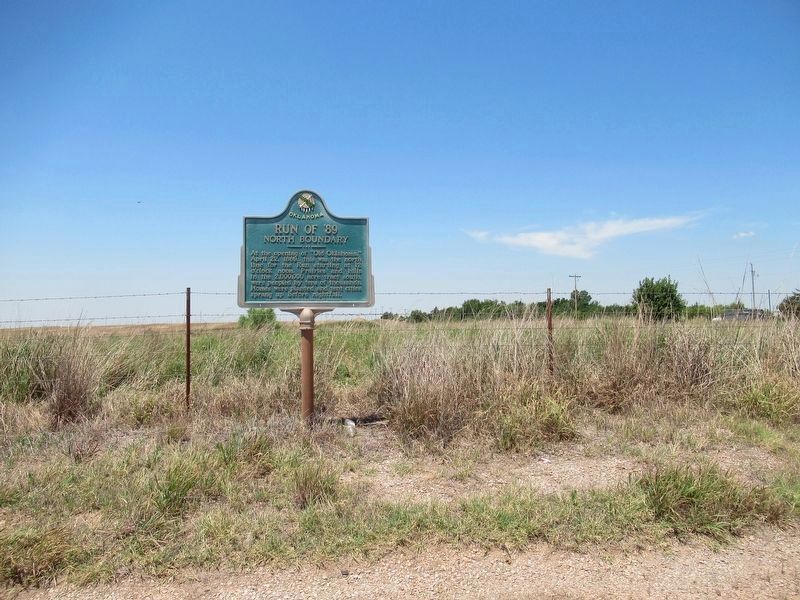
Photographed by Jason Armstrong, July 1, 2022
4. Run of '89 North Boundary Marker
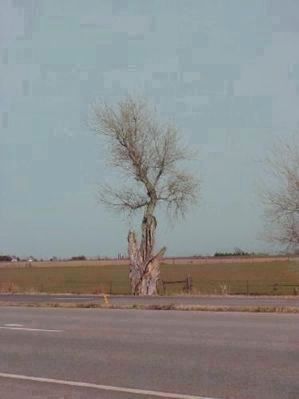
5. "Marrying Tree" stump and new growth.
The "Marrying Tree", across the road from the marker, was used as a visual marker for both the Cherokee Strip land run of 1893 and the Land Run of 1889.
The story behind this tree revolves around an Oklahoma law that said if you received a marriage license in a particular county you had to get married in that same county. Back in the day people would get on a train from Kingfisher or Hennessey and they would go to Enid to shop. After a day of shopping they would go down to the courthouse to get a marriage license. Then they would travel back to the site of this tree, meet their family and friends and get married under the umbrella of the tree.
The story behind this tree revolves around an Oklahoma law that said if you received a marriage license in a particular county you had to get married in that same county. Back in the day people would get on a train from Kingfisher or Hennessey and they would go to Enid to shop. After a day of shopping they would go down to the courthouse to get a marriage license. Then they would travel back to the site of this tree, meet their family and friends and get married under the umbrella of the tree.
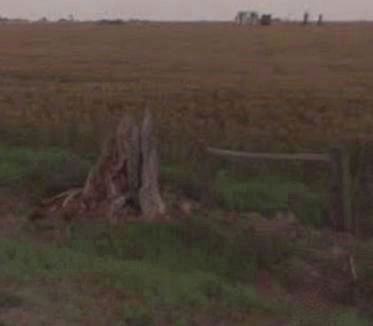
6. Remains of the "Marrying Tree"
The "Marrying Tree" was destroyed in a wind storm in 2007; only the stump remains along a fenceline along the north boundary line of the Land Run of 1889.
It has also been speculated that between 1867 and 1877, the "Marrying Tree" was witness to millions of head of longhorns headed north on the Chisholm Trail, which is just off to the west of Hwy 81.
It has also been speculated that between 1867 and 1877, the "Marrying Tree" was witness to millions of head of longhorns headed north on the Chisholm Trail, which is just off to the west of Hwy 81.

7. Map of Run of '89 North Boundary Marker
The yellow dot shows the location of this marker on a map of the Unassigned Lands (outlined in red).
Credits. This page was last revised on September 18, 2025. It was originally submitted on January 18, 2011. This page has been viewed 1,816 times since then and 33 times this year. Photos: 1, 2. submitted on September 18, 2025, by James Hulse of Medina, Texas. 3. submitted on January 18, 2011. 4. submitted on January 28, 2023, by Jason Armstrong of Talihina, Oklahoma. 5, 6. submitted on January 18, 2011. 7. submitted on January 18, 2011, by Christopher Suttle of Norman, Oklahoma. • Bernard Fisher was the editor who published this page.
