Stafford in Stafford County, Virginia — The American South (Mid-Atlantic)
Native American Presence
Photographed by Kevin W., November 27, 2010
1. Native American Presence Marker
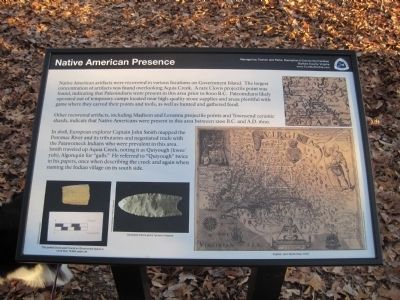
Other recovered artifacts, including Madison and Levanna projectile points and Townsend ceramic shards, indicate that Native Americans were present in this area between 1200 B.C. and A.D. 1600.
In 1608, European explorer Captain John Smith mapped the Potomac River and its tributaries and negotiated trade with the Patawomeck Indians who were prevalent in this area. Smith traveled up Aquia Creek, noting it as Quiyough (kwee' yuh), Algonquin for "Gulls." He referred to "Quiyough" twice in his papers, once when describing the creek and again when naming the Indian village on its south side.
Erected 2010 by Tourism and Parks, Recreation & Community
this page online
Topics. This historical marker is listed in this topic list: Indigenous Peoples and Communities.
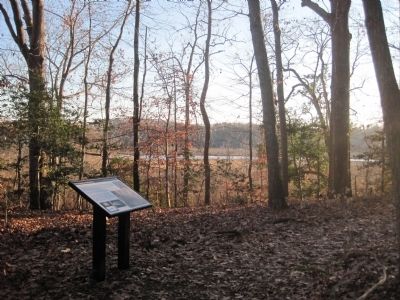
Location. 38° 26.926′ N, 77° 22.798′ W. Marker is in Stafford, Virginia, in Stafford County. It can be reached from Coal Landing Road (County Road 631). Touch for map. Marker is in this post office area: Stafford VA 22554, United States of America. Touch for directions.

Regionally, this marker is in the Washington Metropolitan Area, in Northern Virginia, and in the Piedmont. It is also in the American South, specifically in the Upper South, in the Mid-Atlantic, and on the Eastern Seaboard. Globally, it is in the North Atlantic Region, North America, the Western Hemisphere, the Western World, and the Anglosphere. Historically, it finds itself in what was once the territory of the Mississippian Culture, one of the original Thirteen Colonies, one of the Confederate States of America, and the Antebellum South.
Other nearby markers. At least 8 other markers are within 2 miles of this marker, measured as the crow flies: Site Selection / Architectural Features
Photographed by Kevin W., November 27, 2010
2. Native American Presence Marker
More about this marker. Two small pictures in the lower left of this marker are of partial and complete Clovis points found in Virginia. The partial Clovis point was found on Government Island, and is more than 10,000 years old.
Also on the marker is a photograph of Captain John Smith's map of 1610, featuring the Indian village of Quiyough.
Photographed by Kevin W., November 27, 2010
3. Native American Presence Marker
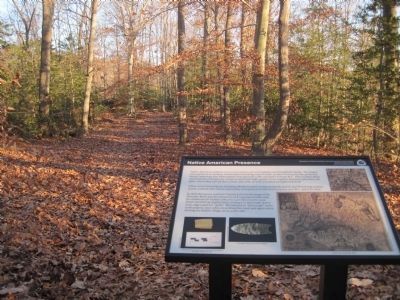
A trail leads to the southern tip of Government Island.
Credits. This page was last revised on June 16, 2016. It was originally submitted on January 28, 2011, by Kevin W. of Stafford, Virginia. This page has been viewed 1,366 times since then and 32 times this year. Photos: 1, 2, 3. submitted on January 28, 2011, by Kevin W. of Stafford, Virginia.
