Wraggborough in Charleston in Charleston County, South Carolina — The American South (South Atlantic)
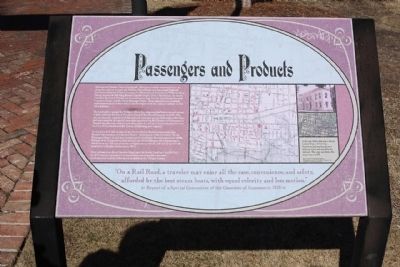
Passengers and Products
Photographed by Mike Stroud, January 2011
1. Passengers and Products Marker
The landmark is named for William Aiken,Sr., who provided both men and money to help establish the South Carolina Canal & Rail Company in 1827. He was an outspoken proponent of the railroad's economic and social benefits to the City, and was a member of a special committee appointed by the Chamber of Commerce to"inquire into the cost, revenue, and advantages of a rail road communication between the City of Charleston and the Towns of Hamburg and Augusta."
At the far end of this courtyard are two Gothic Revival-style towers that flanked the entrance to Camden Depot. Behind
this page online
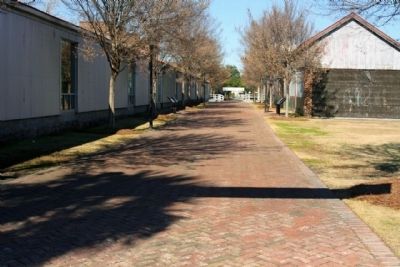
More information about Camden Depot and the South Carolina Canal & Rail Road Company is presented at several locations along the courtyard.
An alternate version of the text is available at the Visitors Center.
"On a Rail Road, a traveler may enjoy all the ease, convience, and safety, afforded by the best steam boats, with equal celerity and less motion."
* Report of a Special Committee of the Chamber of Commerce, 1828*
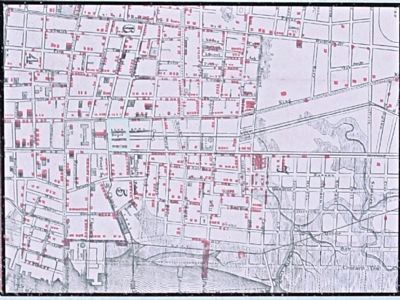
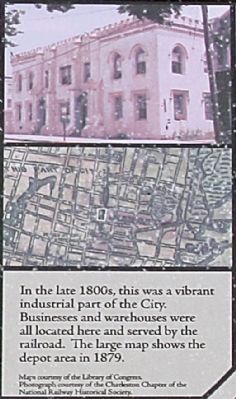
(Maps courtesy of the Library of Congress, Photograph courtesy of the Charleston Chapter of the National Railway Historical Society )
Topics. This historical marker is listed in these topic lists: Industry & Commerce • Railroads & Streetcars. A significant historical year for this entry is 1827.
Location. 32° 47.322′ N, 79° 56.222′ W. Marker is in Charleston, South Carolina, in Charleston County. It
Passengers and Products Marker, courtesy of the Library of Congress
2. Passengers and Products Marker

Regionally, this marker is in Historic Charleston and in the Lowcountry. It is also in the American South, specifically in the Deep South, and on the Eastern Seaboard. Globally, it is in the North Atlantic Region, North America, the Western Hemisphere, the Western World, and the Anglosphere. Historically, it finds itself in what was once the territory of the Mississippian Culture, one of the original Thirteen Colonies, one of the Confederate States of America, and the Antebellum South.
Other nearby markers. At least 8 other markers are within walking distance of this marker: The Railroad Comes To Charleston (within shouting distance of this marker); The Best Friend of Charleston (within shouting distance of this marker); Building a Nation (within shouting distance of this marker); Bound For Glory (within shouting distance of this marker); Camden Depot
courtesy of the Charleston Chapter of the National Railway Historical Society, January 23, 2011
3. Passengers and Products Marker
In the late 1800s, this was a vibrant industrial part of the City. Businesses and warehouses were all located here and served the railroad. The large map shows the depot area in 1879.
Regarding Passengers and Products. National Register of Historic Places:
Aiken, William, House and Associated Railroad Structures *** (added 1966 - District - #66000698)
456 King St., Charleston
•Historic Significance: Event
•Area of Significance: Transportation
•Period of Significance: 1800-1824, 1825-1849, 1850-1874
•Owner: Private
•Historic Function: Commerce/Trade,
•Domestic,Transportation Historic Sub-function: Rail-Related, Secondary Structure, Single Dwelling, Warehouse
•Current Function: Commerce/Trade, Recreation And Culture, Transportation
• Current Sub-function: Museum, Professional, Rail-Related
Related markers. Click here for a list of markers that are related to this marker. the relationship, study markers shown.
Photographed by Mike Stroud, January 2011
4. Passengers and Products Marker, at the Camden Depot Courtyard
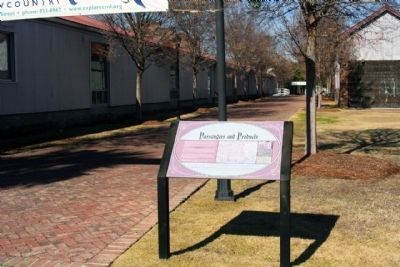
Photographed by Mike Stroud, January 2011
5. Passengers and Products Marker, along John Street, at the Camden Depot Courtyard
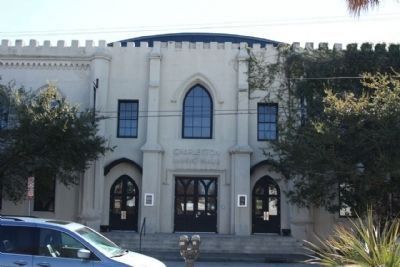
Photographed by Mike Stroud, January 2011
6. Passengers and Products Marker, The Tower Passenger Depot, as mentioned
37 John Street was originally named The Tower Depot, designed by Charleston architect Edward C. Jones and built between 1849 and 1850. The Gothic Revival style building originally had a three-story tower, which projected into John Street and served as the main entrance for a passenger depot for the South Carolina Railroad. Sadly, the original tower was destroyed in the earthquake of 1886 and subsequently, The Tower Depot became part of the Charleston Bagging & Manufacturing Company plant and was used as a warehouse for many years. Finally, the Bennett Hofford Company facilitated its’ amazing transformation into the Charleston Music Hall in 1995.
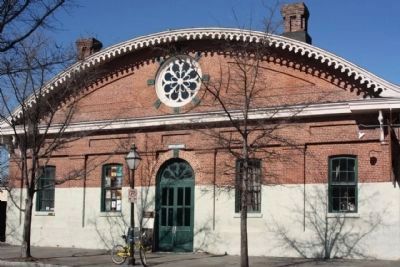
Photographed by Mike Stroud, January 23, 2011
7. Passengers and Products , SC RR Warehouse
as mentioned, on Ann Street
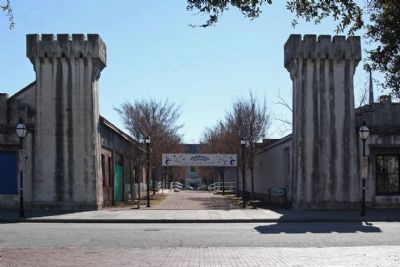
Photographed by Mike Stroud, January 23, 2011
8. Passengers and Products , Camden Depot entrance, as mentioned
Credits. This page was last revised on February 16, 2023. It was originally submitted on February 1, 2011, by Mike Stroud of Bluffton, South Carolina. This page has been viewed 1,018 times since then and 36 times this year. Photos: 1, 2, 3, 4, 5, 6, 7, 8. submitted on February 1, 2011, by Mike Stroud of Bluffton, South Carolina.
