Spartanburg in Spartanburg County, South Carolina — The American South (South Atlantic)
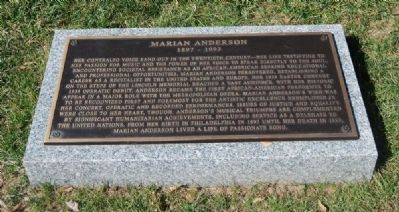
Marian Anderson
1897-1993
Photographed by Brian Scott, February 14, 2011
1. Marian Anderson Marker
Erected 2006.
Topics. This historical marker is listed
this page online
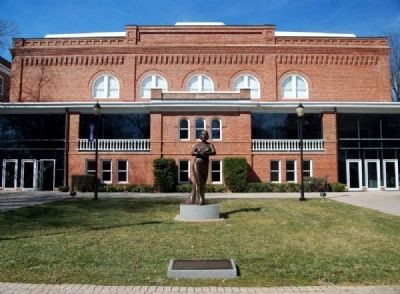
Location. 34° 57.317′ N, 81° 55.017′ W. Marker is in Spartanburg, South Carolina, in Spartanburg County. It can be reached from East Main Street (U.S. 29). Marker and statue are located in front of the southeast entrance of the Twichell Auditorium. Touch for map. Marker is at or near this postal address: 580 East Main Street, Spartanburg SC 29302, United States of America. Touch for directions.

Regionally, this marker is in Upstate. It is also in the American South, specifically in the Deep South, in Appalachia, and specifically in Southern Appalachia. Globally, it is in North America, the Western Hemisphere, the Western World, and the Anglosphere. Historically, it finds itself in what was once the original Cherokee Nation, the territory of the Mississippian Culture, one of the original Thirteen Colonies, one of the Confederate States of America, and the Antebellum South.
Other nearby markers. At least 10 other markers are within walking distance of this marker: Converse College (about 300 feet away, measured
Photographed by Brian Scott, February 14, 2011
2. Marian Anderson Marker and Statue -
Twichell Auditorium in Background
Twichell Auditorium in Background
Also see . . . Marian Anderson. Marian Anderson (February 27, 1897 – April 8, 1993) was an American contralto and one of the most celebrated singers of the twentieth century. (Submitted on February 20, 2011, by Brian Scott of Anderson, South Carolina.)
Photographed by Brian Scott, February 14, 2011
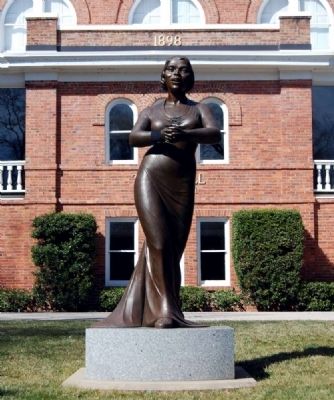
3. Marian Anderson Statue -
Meredith Bergman (1955-) 2006
Meredith Bergman (1955-) 2006
Photographed by Brian Scott, February 14, 2011
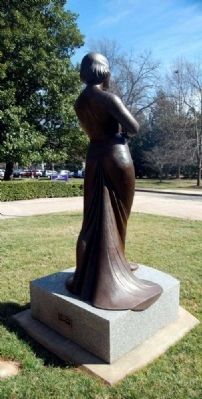
4. Marian Anderson Statue
Sculptor
Meredith Bergman
(1955-)
2006
Sculptor
Meredith Bergman
(1955-)
2006
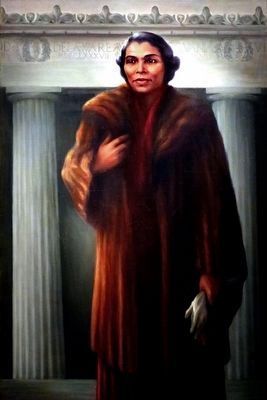
Photographed by Allen C. Browne, February 16, 2015
5. Marian Anderson
This portrait of Marian Anderson by Betsy Graves Reyneau hangs in the National Portrait Gallery in Washington, DC.
“Arturo Toscanini said that Marian Anderson had a voice that came along ‘once in a hundred years.’ When one of Anderson's teachers first heard her sing, the magnitude of her talent moved him to tears. Because she was black, however, her initial prospects as a concert singer in this country were sharply limited, and her early professional triumphs took place mostly in Europe. The magnitude of her musical gifts ultimately won her recognition in the United States as well. Despite that acclaim, in 1939 the Daughters of the American Revolution banned her from performing at Constitution Hall. First Lady Eleanor Roosevelt ultimately intervened and facilitated Anderson's Easter Sunday outdoor concert at the Lincoln Memorial—an event witnessed by 75,000 and broadcast to a radio audience of millions. The affair generated great sympathy tor Anderson and became a defining moment in America's civil rights movement.” — National Portrait Gallery
“Arturo Toscanini said that Marian Anderson had a voice that came along ‘once in a hundred years.’ When one of Anderson's teachers first heard her sing, the magnitude of her talent moved him to tears. Because she was black, however, her initial prospects as a concert singer in this country were sharply limited, and her early professional triumphs took place mostly in Europe. The magnitude of her musical gifts ultimately won her recognition in the United States as well. Despite that acclaim, in 1939 the Daughters of the American Revolution banned her from performing at Constitution Hall. First Lady Eleanor Roosevelt ultimately intervened and facilitated Anderson's Easter Sunday outdoor concert at the Lincoln Memorial—an event witnessed by 75,000 and broadcast to a radio audience of millions. The affair generated great sympathy tor Anderson and became a defining moment in America's civil rights movement.” — National Portrait Gallery
Credits. This page was last revised on June 16, 2016. It was originally submitted on February 20, 2011, by Brian Scott of Anderson, South Carolina. This page has been viewed 1,665 times since then and 17 times this year. Photos: 1, 2, 3, 4. submitted on February 20, 2011, by Brian Scott of Anderson, South Carolina. 5. submitted on October 1, 2015, by Allen C. Browne of Silver Spring, Maryland.
