Fairmont in Marion County, West Virginia — The American South (Appalachia)
The Colonel George S. “Spanky” Roberts, USAF Memorial Bridge
Photographed by J. J. Prats, June 23, 2009
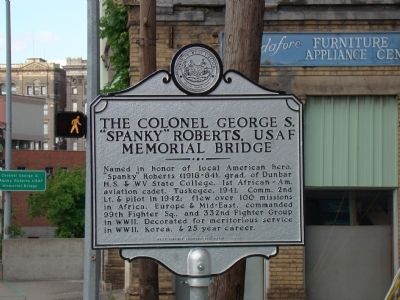
1. The Colonel George S. “Spanky” Roberts, USAF Memorial Bridge Marker
Named in honor of local American hero, “Spanky” Roberts (1918–84), graduate of Dunbar H.S. & WV State College, 1st African-American aviation cadet, Tuskegee, 1941. Commissioned 2nd Lieutenant & pilot in 1942; flew over 100 missions in Africa, Europe & Middle East, commanded 99th Fighter Sq., and 332nd Fighter Group in WWII. Decorated for meritorious service in WWII, Korea, & 25 year career.
Erected 1999 by West Virginia Archives and History.
Topics and series. This historical marker is listed in these topic lists: African Americans • War, Korean • War, World II. In addition, it is included in the Tuskegee Airmen, and the West Virginia Archives and History series lists. A significant historical year for this entry is 1941.
Location. 39° 28.952′ N, 80° 8.766′ W. Marker is in Fairmont, West Virginia, in Marion County. It is at the intersection of Fairmont Avenue (U.S. 250) and 1st Street, on the right when traveling north on Fairmont Avenue. Touch for map. Marker is in this post office area: Fairmont WV 26554, United States of America. Touch for directions.

Regionally, this marker is in North Central West Virginia.
this page online
Other nearby markers. At least 8 other markers are within walking distance of this marker: A different marker also named The Colonel George S. "Spanky" Roberts, USAF Memorial Bridge (about 600 feet away, measured in a direct line); Attacking Fairmont (about 600 feet away); First Father's Day Service (about 700 feet away); Francis H. Pierpont (about 700 feet away); Julia Robertson Pierpont (about 700 feet away); a different marker also named First Father’s Day Service (about 800 feet away); David Morgan / Patriot, Defender (approx. 0.2 miles away); Jacobs-Hutchinson Block (approx. 0.2 miles away). Touch for a list and map of all markers in Fairmont.
Regarding The Colonel George S. “Spanky” Roberts, USAF Memorial Bridge. Please note, while the marker indicates Colonel Roberts' career had a 25 year career, he was
Photographed by J. J. Prats, June 23, 2009
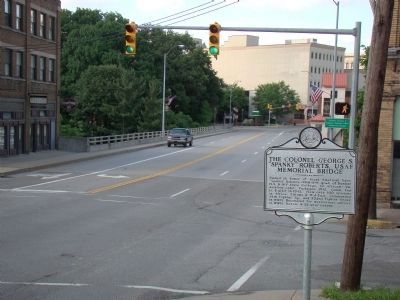
2. The Colonel George S. “Spanky” Roberts, USAF, Memorial Bridge and Marker
Also see . . . Black Wings of Tuskegee. Academia website entry:
1993 article by Jerry A Davis in Alabama Heritage with photograph of Colonel Roberts (page 40). “The Tuskegee airmen, however, had every reason to celebrate. They had proven to American society that no discrepancy existed between the effectiveness of properly trained black and white soldiers. Perhaps their success in action during World War II helped change attitudes towards integration in the American military; certainly their success brought about a strong sense of pride among those who served. Two years after the last Tuskegee airman graduated, President Truman ordered the desegregation of the armed forces, and the Defense Department announced the end of mandated segregation in the U.S. military. Wherever they were, the Tuskegee airmen must have cheered.” (Submitted on August 1, 2009.)
Additional keywords. Tuskegee Airmen
Photographed by U.S. Air Force
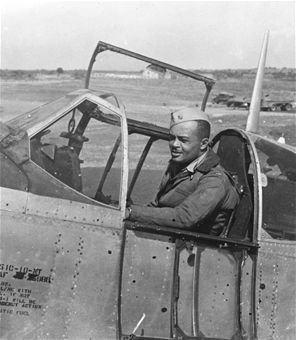
3. Colonel George S. “Spanky” Roberts, USAF
Credits. This page was last revised on January 29, 2022. It was originally submitted on August 1, 2009, by J. J. Prats of Powell, Ohio. This page has been viewed 3,271 times since then and 58 times this year. Last updated on February 25, 2011, by Lanelle Roberts Brent of Sacramento, California. Photos: 1, 2. submitted on August 1, 2009, by J. J. Prats of Powell, Ohio. 3. submitted on November 21, 2009, by Richard E. Miller of Oxon Hill, Maryland. • Kevin W. was the editor who published this page.
