Quincy in Norfolk County, Massachusetts — The American Northeast (New England)
Adams National Historical Park
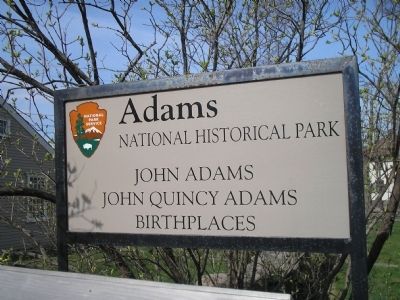
Photographed by Bill Coughlin, April 18, 2008
1. Adams National Historical Park Marker
John Quincy Adams
Birthplaces
Erected by National Park Service, U.S. Department of the Interior.
Topics and series. This historical marker is listed in this topic list: Notable Buildings. In addition, it is included in the Former U.S. Presidents: #02 John Adams, and the Former U.S. Presidents: #06 John Quincy Adams series lists.
Location. 42° 14.352′ N, 71° 0.202′ W. Marker is in Quincy, Massachusetts, in Norfolk County. It is on Franklin Street, on the right when traveling south. Touch for map. Marker is in this post office area: Quincy MA 02169, United States of America. Touch for directions.

Regionally, this marker is in Historic Boston and specifically in Greater Boston. It is also in the American Northeast, in New England, and on the Eastern Seaboard. Globally, it is in the North Atlantic Region, North America, the Western Hemisphere, the Western World, and the Anglosphere. Historically, it finds itself in what was once one of the original Thirteen Colonies.
Other nearby markers. At least 8 other markers are within walking distance of this
this page online
Also see . . .
1. Adams National Historical Park. National Park Service website. (Submitted on March 4, 2011, by Bill Coughlin of Woodland Park, New Jersey.)
2. Explore the Adams National Historical Park.
From the sweet little farm at the foot of Penn’s Hill to the gentleman’s country estate at Peace field, Adams National Historical Park is the story of “heroes, statesman, philosophers … and learned women” whose ideas and actions helped to transform thirteen disparate colonies into one united nation. Learn about this National Historical Park with Supervisory Park Ranger Jessica Pilkington.(Submitted on May 5, 2026, by G.W.Bartlett of Hingham, Massachusetts.)
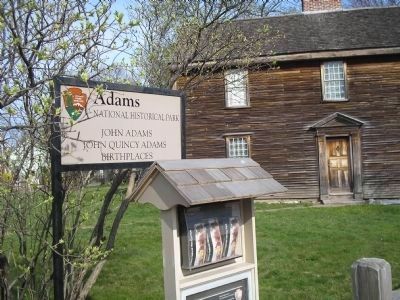
Photographed by Bill Coughlin, April 18, 2008
2. Marker in Quincy, Mass.
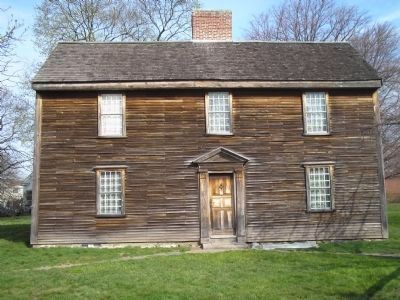
Photographed by Bill Coughlin, April 18, 2008
3. Birth House of President John Adams
John Adams was born in this "salt box" house in 1735.
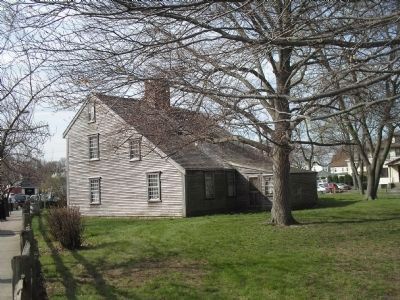
Photographed by Bill Coughlin, April 18, 2008
4. John Adams Birth House
The birthplaces of John Adams and John Quincy Adams are the oldest presidential birthplaces in the United States.
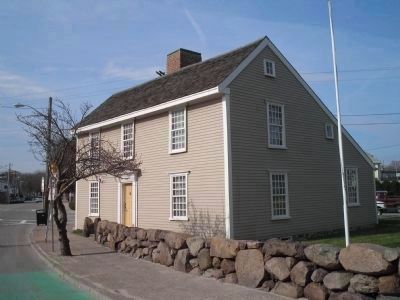
Photographed by Bill Coughlin, April 18, 2008
5. President John Quincy Adams Birthhouse
John Quincy Adams was born in this house, located 75 feet south of the birthplace of his father John Adams.
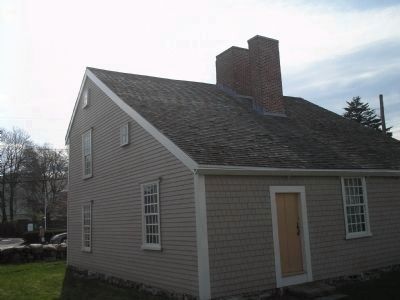
Photographed by Bill Coughlin, April 18, 2008
6. JQ Adams Birthplace
John Adams' law office was in the house. Along with Samuel Adams and James Bowdoin, he wrote the Massachusetts Constitution here.
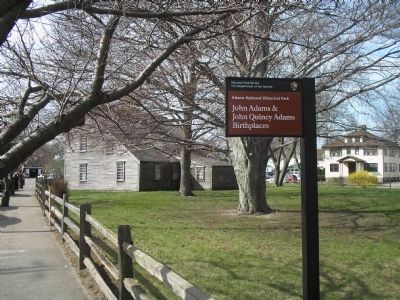
Photographed by Bill Coughlin, April 18, 2008
7. Secondary Marker at Adams Birthplace
Photographed by Allen C. Browne, February 16, 2015
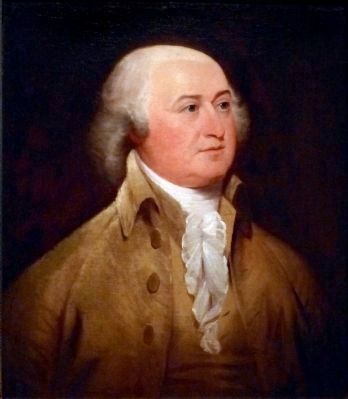
8. John Adams
This 1793 portrait of John Adams by John Trumbull hangs in the National Portrait Gallery in Washington DC.
“In 1789, after performing invaluable service o his country both during and after the Revolution, Adams became George Washington's vice president and the first to discover how insignificant that office could be. The position, however, yielded one important compensation: it became the springboard for his election to the presidency in 1796.
Chief among Adams's presidential successes was the avoidance of hostilities over France's infringement on American neutrality in the war between France and Great Britain. Unfortunately, Adams pleased no one in doing so, and he left the White House in 1801 largely discredited on all sides. Recalling his administration years later, he noted, ‘No man who ever held the office of president would ever congratulate a friend on obtaining it.’
This portrait was derived from sittings that occurred during Adams's vice presidency. By then, John Trumbull had painted two other likenesses of Adams, including one that was eventually incorporated into Trumbull's picture depicting the signing of the Declaration of Independence, which now resides in the U.S. Capitol rotunda.” — National Portrait Gallery
“In 1789, after performing invaluable service o his country both during and after the Revolution, Adams became George Washington's vice president and the first to discover how insignificant that office could be. The position, however, yielded one important compensation: it became the springboard for his election to the presidency in 1796.
Chief among Adams's presidential successes was the avoidance of hostilities over France's infringement on American neutrality in the war between France and Great Britain. Unfortunately, Adams pleased no one in doing so, and he left the White House in 1801 largely discredited on all sides. Recalling his administration years later, he noted, ‘No man who ever held the office of president would ever congratulate a friend on obtaining it.’
This portrait was derived from sittings that occurred during Adams's vice presidency. By then, John Trumbull had painted two other likenesses of Adams, including one that was eventually incorporated into Trumbull's picture depicting the signing of the Declaration of Independence, which now resides in the U.S. Capitol rotunda.” — National Portrait Gallery
Photographed by Allen C. Browne, February 16, 2015
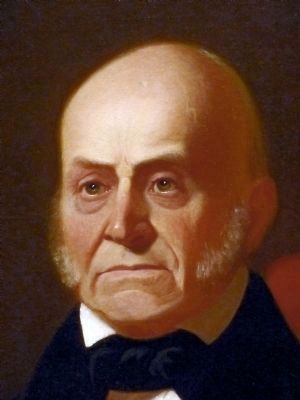
9. John Quincy Adams
This 1850 portrait of John Quincy Adams by George Caleb Bingham (after an 1844 original) hangs in the National Portrait Gallery in Washington, DC.
“John Quincy Adams's tenure as James Monroe's secretary of state ranks among the most productive In the history of that office. But Adams's often tactless ways were ill-suited for the presidency, and when his vision for such items as a comprehensive national transportation system met with hostility in Congress, he would not compromise. As a result, his administration's accomplishments were meager. But Adams was not through with political life. Elected to the House of Representatives in 1830, he served there until his death. In his prolonged and successful struggle defending the antislavery movement's right to petition Congress, ‘Old Man Eloquent‘ had gained a circle of admirers that extended well beyond his Massachusetts constituency.
When Adams sat for this portrait, he doubted that artist George Caleb Bingham could produce ‘a strong likeness.’ But Bingham did just that, and the portrait's vitality seems to echo Ralph Waldo Emerson's comment that the aging Adams was ‘like one of those old cardinals, who as quick as he is chosen Pope, throws away his crutches and his crookedness, and is as straight as a boy.’” — National Portrait Gallery
“John Quincy Adams's tenure as James Monroe's secretary of state ranks among the most productive In the history of that office. But Adams's often tactless ways were ill-suited for the presidency, and when his vision for such items as a comprehensive national transportation system met with hostility in Congress, he would not compromise. As a result, his administration's accomplishments were meager. But Adams was not through with political life. Elected to the House of Representatives in 1830, he served there until his death. In his prolonged and successful struggle defending the antislavery movement's right to petition Congress, ‘Old Man Eloquent‘ had gained a circle of admirers that extended well beyond his Massachusetts constituency.
When Adams sat for this portrait, he doubted that artist George Caleb Bingham could produce ‘a strong likeness.’ But Bingham did just that, and the portrait's vitality seems to echo Ralph Waldo Emerson's comment that the aging Adams was ‘like one of those old cardinals, who as quick as he is chosen Pope, throws away his crutches and his crookedness, and is as straight as a boy.’” — National Portrait Gallery
Credits. This page was last revised on May 20, 2026. It was originally submitted on March 4, 2011, by Bill Coughlin of Woodland Park, New Jersey. This page has been viewed 1,593 times since then and 71 times this year. Photos: 1, 2, 3, 4, 5, 6, 7. submitted on March 4, 2011, by Bill Coughlin of Woodland Park, New Jersey. 8, 9. submitted on July 21, 2015, by Allen C. Browne of Silver Spring, Maryland.
