Near Bumble Bee in Yavapai County, Arizona — The American Mountains (Southwest)
Mining in Arizona
Photographed by William Fischer, Jr., November 7, 2010
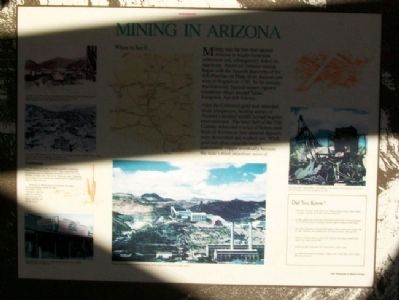
1. Mining in Arizona Marker
Mining was the lure that opened Arizona to Anglo-American settlement and, subsequently, led to its statehood. However, Arizona mining began with the Spanish discovery of the rich Planchas de Plata silver deposits just west of Nogales in 1736. In the century that followed, Spanish miners opened numerous mines around Tubac, Patagonia, Ajo and Arivaca.
After the California gold rush subsided, many prospectors, hearing stories of Arizona's mineral wealth, turned hopeful eyes eastward. The latter half of the 19th Century witnessed a series of booms and busts in Arizona as new mineral deposits were discovered and worked out. While gold and silver were the initial enticement, copper eventually became the state's most important mineral.
Tombstone
The richest silver strike in Arizona occurred in southeastern Arizona, east of Fort Huachuca, in 1877. Here, a short time later, the boisterous town of Tombstone was founded, later the site of the legendary gunfight at the O.K. Corral. Within two years, Tombstone was the largest town in the territory and had several neighboring mill towns to support the mines.
However, by 1888 the
this page online
Did You Know?
• The name "Arizona" comes from a tiny Tohono O'odam Indian village named "Arizonac", near the site of the 1736 silver discovery.
• In 1863, miners near present-day Wickenburg reported they found gold nuggets worth $500,000 per acre in surface soil that could be stirred up with a knife.
• The richest gold mines, the Tom Reed and the United Eastern, were located side by side in Oatman, and yielded nearly $27 million between 1908 and 1933.
• Nearly six million ounces of silver were extracted from mines around Tombstone in the single year of 1882.
• Arizona produces more than 15% of the world's copper output.
• Over half the mining and smelting of copper in the United States occurs within 200 miles of Tucson.
Erected by Arizona Department of Transportation.
Topics. This historical marker is listed in these topic lists: Exploration • Industry & Commerce • Settlements & Settlers. A significant historical year for this entry is 1736.
Location. 34° 11.132′ N,
Photographed by William Fischer, Jr., November 7, 2010
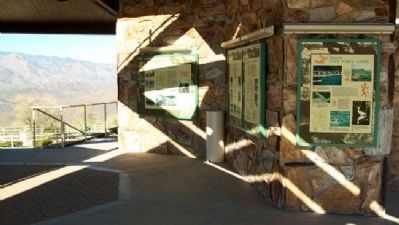
2. Mining in Arizona Marker
Left most marker on wall

Regionally, this marker is on the Mogollon Rim and in the Prescott Area. It is also in the American Southwest and in the Mountain West. Globally, it is in North America, the Western Hemisphere, the Western World, and the Anglosphere. Historically, it finds itself in what was once New Spain and also Mexico’s Alta California.
Other nearby markers. At least 2 other markers are within 9 miles of this marker, measured as the crow flies: The Sunset Point Rest Area (a few steps from this marker); Cleator, Arizona (approx. 8.6 miles away).
Photographed by Unknown, undated
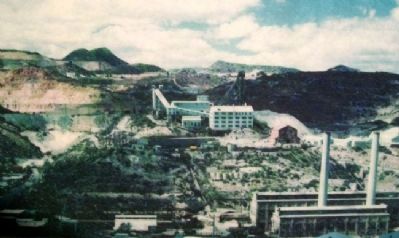
3. Photo on Mining in Arizona Marker
[Caption reads] Mining is still an important industry in Arizona, as this copper mine clay pool in Miami attests.
Photographed by Unknown, undated
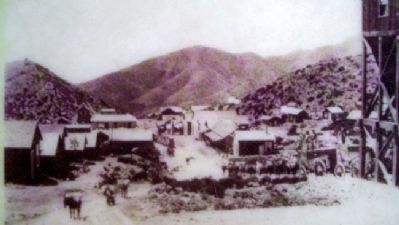
4. Photo on Mining in Arizona Marker
[Caption reads] The Silver King Mine, located in the Superstition Mountains near the mining town of Goldfield, was one of the richest silver veins in Arizona history. Photo Courtesy of Arizona State Historical Society
Photographed by Unknown, undated
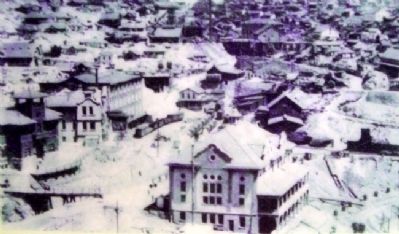
5. Photo on Mining in Arizona Marker
[Caption reads] In the early 1900s Morenci was a booming town that has since been swallowed up by a huge open pit copper mine straddling U.S. Highway 191. Photo Courtesy of Arizona State Historical Society
Photographed by Unknown, undated
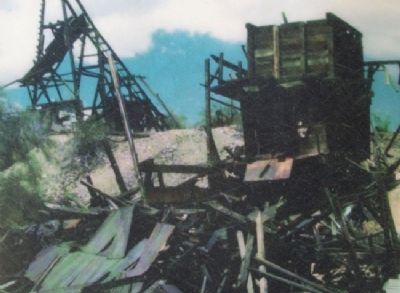
6. Photo on Mining in Arizona Marker
[Caption reads] The ruins of the Vulture Mine at Wickenburg is one of many stark reminders of Arizona's mining heritage still found throughout the state.
Credits. This page was last revised on June 16, 2016. It was originally submitted on March 9, 2011, by William Fischer, Jr. of Reynoldsburg, Ohio. This page has been viewed 1,821 times since then and 139 times this year. Photos: 1, 2, 3, 4, 5, 6. submitted on March 9, 2011, by William Fischer, Jr. of Reynoldsburg, Ohio.
