New Britain in Capitol Region, Connecticut — The American Northeast (New England)
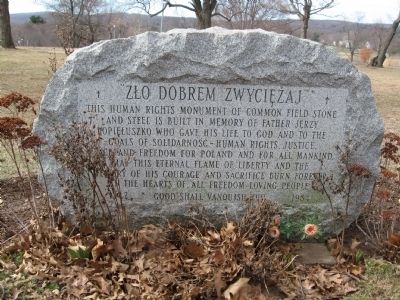
Zlo Dobrem Zwyciezaj
Photographed by Michael Herrick, March 29, 2011
1. Zlo Dobrem Zwyciezaj Marker
Erected 1989.
Topics. This historical marker is listed in this topic list: Peace. A significant historical year for this entry is 1947.
Location. 41° 39.771′ N, 72° 47.316′ W. Marker is in New Britain in Capitol Region, Connecticut. It can be reached from the intersection of Grand Street and Linwood Street, on the right when traveling west. Located in Walnut Hill Park. Touch for map. Marker is in this post office area: New Britain CT 06052, United States of America. Touch for directions.

Regionally, this marker is in the Connecticut River Valley, in Greater Hartford, and in the Knowledge Corridor. It is also in the American Northeast and in New England. Globally, it is in North
this page online
Other nearby markers. At least 8 other markers are within walking distance of this marker: History of the Hospital / The Rose Garden (within shouting distance of this marker); Salute To Women (about 500 feet away, measured in a direct line); World War Monument / A Monumental Landscape (about 500 feet away); Ye Old State House Step (about 500 feet away); 100 Birthday of Freedom Tree (about 500 feet away); City of New Britain Sesquicentennial Anniversary (about 500 feet away); Hamilton's Flight / Urban Escapes (about 600 feet away); Frederick "Doc" Mirliani (about 600 feet away). Touch for a list and map of all markers in New Britain.
Also see . . . Jerzy Popieluszko on Wikipedia. (Submitted on April 4, 2011, by Michael Herrick of Southbury, Connecticut.)
Photographed by Michael Herrick, March 29, 2011
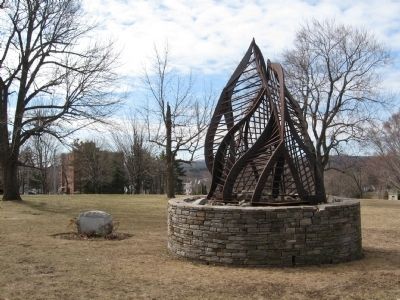
2. Zlo Dobrem Zwyciezaj Marker and Human Rights Monument
Photographed by Michael Herrick, March 29, 2011
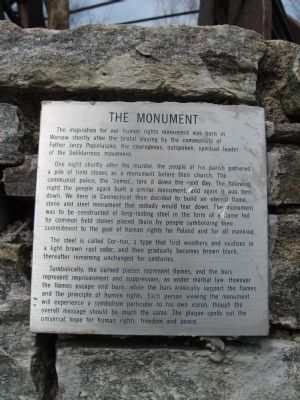
3. Small Plaque on the Base of the Monument
The inspiration for our human rights monument was born in Warsaw shortly after the brutal slaying by the communists of Father Jerzy Popieluszko, the courageous, outspoken, spiritual leader of the Solidarosc movement.
One night shortly after his murder the people of his parish gathered a pile of field stones as a monument before their church. The communist police, the 'zomos', tore it down the next day. The following night the people again built a similar monument, and again it was torn down. We here in Connecticut then decided to build an eternal flame, stone and steel monument that nobody would tear down. The monument was to be constructed of long-lasting steel in the form of a flame fed by common field stones placed there by people symbolizing their commitment to the goal of human rights for Poland and for all mankind.
The steel is caller Cor-ten, a type that first weathers and oxidizes to a light brown rust color, and then gradually becomes brown black, thereafter remaining unchanged for centuries.
Symbolically, the curved pieces represent flames, and the bars represent imprisonment and suppression, as under martial law. However the flames escape and burn, while the bars ironically support the flames and the principle of human rights. Each person viewing the monument will experience a symbolism particular to his own vision, though the overall message should be much the same. The plaque spells out the universal hope for human rights, freedom and peace.
One night shortly after his murder the people of his parish gathered a pile of field stones as a monument before their church. The communist police, the 'zomos', tore it down the next day. The following night the people again built a similar monument, and again it was torn down. We here in Connecticut then decided to build an eternal flame, stone and steel monument that nobody would tear down. The monument was to be constructed of long-lasting steel in the form of a flame fed by common field stones placed there by people symbolizing their commitment to the goal of human rights for Poland and for all mankind.
The steel is caller Cor-ten, a type that first weathers and oxidizes to a light brown rust color, and then gradually becomes brown black, thereafter remaining unchanged for centuries.
Symbolically, the curved pieces represent flames, and the bars represent imprisonment and suppression, as under martial law. However the flames escape and burn, while the bars ironically support the flames and the principle of human rights. Each person viewing the monument will experience a symbolism particular to his own vision, though the overall message should be much the same. The plaque spells out the universal hope for human rights, freedom and peace.
Photographed by Michael Herrick, March 29, 2011
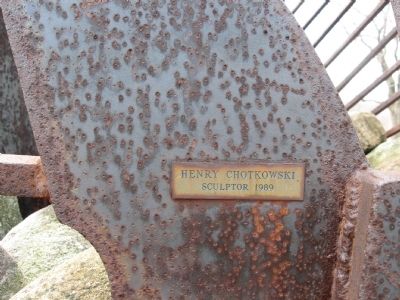
4. Sculptor's Plate
Sculptor 1989
Credits. This page was last revised on May 19, 2026. It was originally submitted on April 4, 2011, by Michael Herrick of Southbury, Connecticut. This page has been viewed 1,051 times since then and 13 times this year. Photos: 1, 2, 3, 4. submitted on April 4, 2011, by Michael Herrick of Southbury, Connecticut.
