Hudson Heights in Manhattan in New York County, New York — The American Northeast (Mid-Atlantic)
Plaza Lafayette
.092 acre
Photographed by Bill Coughlin, April 9, 2011
1. Plaza Lafayette Marker
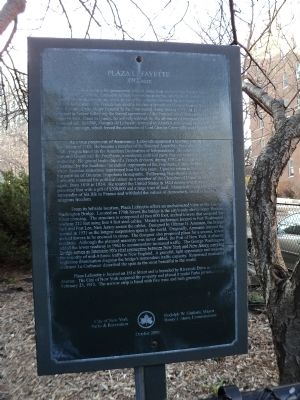
This plaza honors the prominent French statesman and military leader Marquis de Lafayette (1757-1834). Lafayette is best remembered for his role in the Revolutionary War. Sympathetic to the American cause, he aided the colonists through the provision of experienced military leadership. The Frenchman quickly became a favorite of General George Washington, who appointed him Major General in the Continental Army during 1777. In 1778, Lafayette returned to France following the formal agreement of the France/United States alliance against Great Britain. Once in France, he actively lobbied for the allotment of increased military and financial aid. In 1780, Marquis de Lafayette returned to America and served valorously in the Virginia campaign, which forced the surrender of Lord Charles Cornwallis and Great Britain in 1781.
As a true proponent of democracy, Lafayette assumed a leading role in the French Revolution of 1789. He became a member of the National Assembly, from which he propagated a bill of rights based on the American Declaration of Independence. He commanded the French National Guard and the Feuillants, a moderate
this page online
From its hillside location, Plaza Lafayette offers an unobstructed view of the George Washington Bridge. Located on 179th Street, the bridge is the city’s only above-water Hudson River crossing. The structure is composed of two 600 foot, arched towers that suspend the roadway 212 feet using four 4 foot steel cables. Massive anchorages located in
Photographed by Bill Coughlin, April 9, 2011
2. Plaza Lafayette Marker
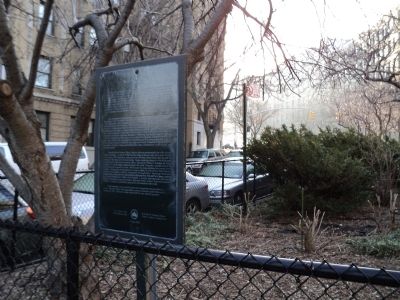
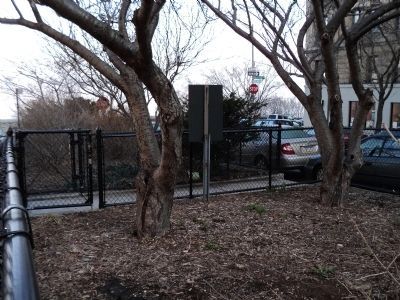
Plaza Lafayette is located on 181st Street and is bounded by Riverside Drive and Haven Avenue. The City of New York acquired the property and placed it under Parks jurisdiction on February 23, 1918. The narrow strip is lined with five trees and lush greenery.
Erected 2000 by New York City Department of Parks & Recreation.
Topics and series.
Photographed by Bill Coughlin, April 9, 2011
3. Plaza Lafayette Marker (looking west)
Location. Marker has been permanently removed. It was located near 40° 51.098′ N, 73° 56.503′ W. Marker was in Manhattan, New York, in New York County. It was in Hudson Heights. It was on 181st Street / Plaza Lafayette, in the median. Touch for map. Marker was in this post office area: New York NY 10033, United States of America.
We have been informed that this marker is no longer there and will not be replaced. This page is an archival view of what was.
Regionally, this marker was in New York City. It was also in the American Northeast, in the Mid-Atlantic, and on the Eastern Seaboard. Globally, it was in the North Atlantic Region, North America, the Western Hemisphere, the Western World, and the Anglosphere. Historically, it found itself in what was once New Netherland and also one of the original Thirteen Colonies.

Other nearby markers. At least 8 other markers are within walking distance of this location: A Work of Art (about 600 feet away, measured in a direct line); Maintaining the Bridge (about 600 feet away); Modern Updates (about 600 feet away); Next Level (about 600 feet away); Making History (about 600 feet away); Opening Celebration (about 600 feet away); Building the Bridge (about 600 feet away); a different marker also named Building the Bridge (about 600 feet away). Touch for a list and map of all markers in Manhattan.
Also see . . . Plaza Lafayette. Wikipedia entry. (Submitted on April 12, 2020, by Larry Gertner of New York, New York.)
Credits. This page was last revised on July 3, 2025. It was originally submitted on April 10, 2011, by Bill Coughlin of Woodland Park, New Jersey. This page has been viewed 1,028 times since then and 55 times this year. Photos: 1, 2, 3. submitted on April 10, 2011, by Bill Coughlin of Woodland Park, New Jersey.
