Milford Hundred in Kent County, Delaware — The American Northeast (Mid-Atlantic)
The Towers
20 Church Street
Photographed by Nate Davidson, April 21, 2011
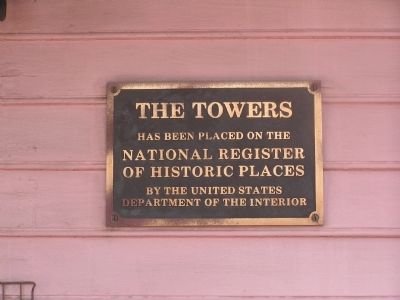
1. The Towers Marker
has been placed on the
National Register
of Historic Places
by the United States
Department of the Interior
Topics and series. This historical marker is listed in this topic list: Architecture. In addition, it is included in the National Register of Historic Places (NRHP) series list.
Location. 38° 54.867′ N, 75° 25.767′ W. Marker is in Milford, Delaware, in Kent County. It is in Milford Hundred. It is at the intersection of NE Front Street and North Street on NE Front Street. Touch for map. Marker is at or near this postal address: 20 Church Street, Milford DE 19963, United States of America. Touch for directions.

Regionally, this marker is in the American Mid-Atlantic, on the Delmarva Peninsula, and on the Eastern Seaboard. Globally, it is in the North Atlantic Region, North America, the Western Hemisphere, the Western World, and the Anglosphere. Historically, it finds itself in what was once New Netherland, one of the original Thirteen Colonies, and the Antebellum South.
Other nearby markers. At least 8 other markers are within walking
this page online
Another marker is no longer nearby. Liberty Tree Memorial (was approx. 0.2 miles away but has been confirmed missing).
Also see . . . North Milford Historic District - National Register of Historic Places Nomination Form.
A further example of the remodelling of existing structures is the "Towers" (K-1694.43), which is an outstanding example of a radical late-nineteenth-century alteration. It was built as a late-eighteenth-century, Georgian-plan frame building, but was converted in 1893 to conform to the Queen Anne variation of late-Victorian architecture,(Submitted on April 24, 2025, by Pete Skillman of Wilmington, Delaware.)while still retaining its original plan. The decoration, including cut shingle patterns and additional dormers and the tower, were added to the original frame.Photographed by Nate Davidson, April 21, 20112. The Towers
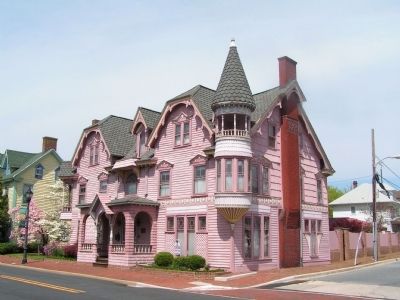
Photographed by Nate Davidson, April 21, 2011
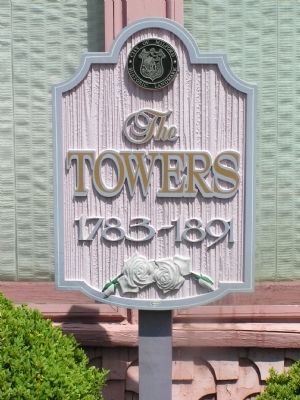
3. Sign in front with City of Milford Historic Landmarks seal.
Photographed by Nate Davidson, April 21, 2011
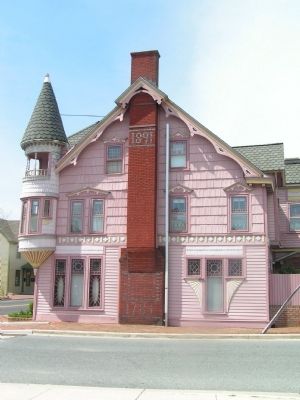
4. Side view with 1891 and 1783 visible in brick.
Credits. This page was last revised on May 15, 2026. It was originally submitted on April 21, 2011, by Nathan Davidson of Salisbury, Maryland. This page has been viewed 813 times since then and 22 times this year. Photos: 1, 2, 3, 4. submitted on April 21, 2011, by Nathan Davidson of Salisbury, Maryland. • Bill Pfingsten was the editor who published this page.
