Near Diamond in Newton County, Missouri — The American Midwest (Upper Plains)
George Washington Carver National Monument
Photographed by William Fischer, Jr., January 22, 2011
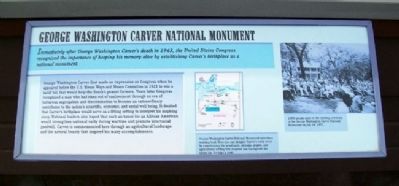
1. George Washington Carver National Monument Marker
Immediately after George Washington Carver’s death in 1943, the United States Congress recognized the importance of keeping his memory alive by establishing Carver’s birthplace as a national monument.
George Washington Carver first made an impression on Congress when he appeared before the U.S. House Ways and Means Committee in 1921 to win a tariff bill that would help the South’s peanut farmers. Years later Congress recognized a man who had risen out of enslavement through an era of torturous segregation and discrimination to become an extraordinary contributor to the nation’s scientific, economic, and social well-being. It decided that Carver’s birthplace would serve as a fitting setting to interpret his inspiring story. National leaders also hoped that such an honor for an African American would strengthen national unity during wartime and promote interracial goodwill. Carver is commemorated here through an agricultural landscape and the natural beauty that inspired him many accomplishments.
Erected by National Park Service.
Topics and series. This historical marker and monument is listed in this topic list:
this page online
Location. This marker has been replaced by another marker nearby. It was located near 36° 59.172′ N, 94° 21.306′ W. Marker was near Diamond, Missouri, in Newton County. It could be reached from Carver Road. Marker was on the George Washington Carver National Monument Visitor Center viewing porch. Touch for map. Marker was at or near this postal address: 5646 Carver Road, Diamond MO 64840, United States of America. Touch for directions.

Regionally, this marker and monument was in Southwest Missouri. It was also in the American Ozarks, in the Lewis & Clark Corridor, and in the Corn Belt. Globally, it was in North America, the Western Hemisphere, the Western World, and the Anglosphere. Historically, it found itself in what was once the territory of the Mississippian Culture, the Louisiana Purchase, and the Antebellum South.
Other nearby markers. At least 8 other markers are within walking distance of this location: A different marker also named George Washington Carver National Monument
Photographed by William Fischer, Jr., January 22, 2011
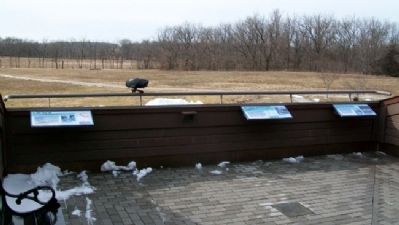
2. George Washington Carver NM Marker
In center
Other markers no longer nearby. George Washington Carver's Birthplace (was here, next to this marker but has been replaced with another marker now near it); a different marker also named The Moses Carver Farm (was here, next to this marker but has been replaced with another marker now near it).
More about this marker. Marker was replaced with a similar one (same title) with alternate text.
Also see . . .
1. George Washington Carver National Monument. National Park Service website
Photographed by Unknown, July 14, 1953
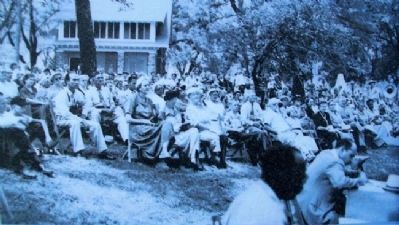
3. Photo on Geo Washington Carver NM Marker
[Caption reads] 2,000 people came to the opening ceremony of the George Washington Caver National Monument on July 14, 1953.
2. George Washington Carver. Famous Missourians website entry (Submitted on April 26, 2011, by William Fischer, Jr. of Reynoldsburg, Ohio.)
3. Tuskegee Institute National Historic Site. National Park Service website entry (Submitted on April 26, 2011, by William Fischer, Jr. of Reynoldsburg, Ohio.)
Photographed by National Park Service, undated
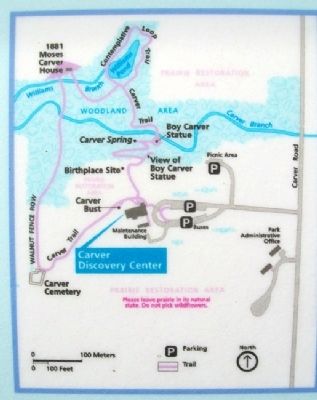
4. Map on George Washington Carver NM Marker
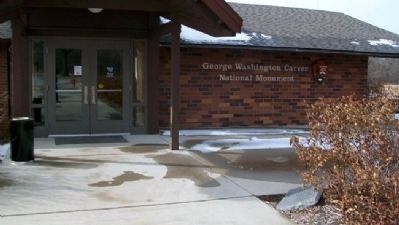
Photographed by William Fischer, Jr., January 22, 2011
5. George Washington Carver National Monument
Visitor Center entrance
Photographed by William Fischer, Jr., January 22, 2011
6. George Washington Carver National Monument
Credits. This page was last revised on September 25, 2026. It was originally submitted on April 26, 2011, by William Fischer, Jr. of Reynoldsburg, Ohio. This page has been viewed 1,181 times since then and 33 times this year. Photos: 1, 2, 3, 4. submitted on April 26, 2011, by William Fischer, Jr. of Reynoldsburg, Ohio. 5, 6. submitted on April 27, 2011, by William Fischer, Jr. of Reynoldsburg, Ohio.
