Locust Grove in Orange County, Virginia — The American South (Mid-Atlantic)
The Mine Run Campaign
The Battle of Payne’s Farm
Photographed by Bernard Fisher, April 30, 2011
1. The Mine Run Campaign Marker
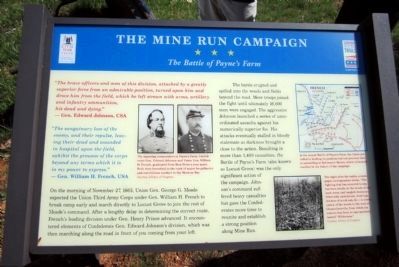
“The sanguinary loss of the enemy, and their repulse, leaving their dead and wounded in hospital upon the field, exhibit the prowess of the corps beyond any terms which it is in my power to express.” — Gen. William H. French, USA
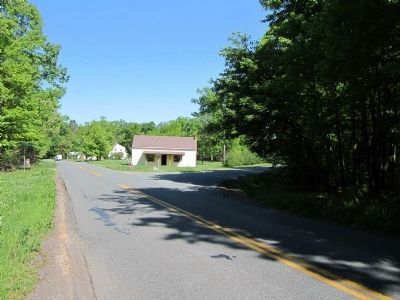
On the morning of November 27, 1863, Union Gen. George G. Meade expected the Union Third Army Corps under Gen. William H. French to break camp early and march directly to Locust Grove to join the rest of Meade’s command. After a lengthy delay in determining the correct route, French’s leading division under Gen. Henry Prince advanced. It encountered elements of Confederate Gen. Edward Johnson’s division, which was then marching along the road in front of you coming from your left.
The battle erupted and spilled into the woods and fields beyond the road. More troops joined the fight until ultimately 16,000 men were engaged.
this page online
Erected 2011 by The Civil War Trust and Virginia Civil War Trails.
Topics and series. This historical marker is listed in this topic list: War, US Civil. In addition, it is included in the Virginia Civil War Trails series list. A significant historical date for this entry is November 27, 1878.
Location. Marker has been reported permanently removed. It was located near 38° 19.936′ N, 77° 49.708′ W. Marker was in Locust Grove, Virginia, in Orange County. It was at the intersection of Zoar Road (Virginia Route 611) and Zoar School Road, on the left when traveling north on Zoar Road. Touch for map. Marker was at or near this postal address: 31334 Zoar Road, Locust Grove
2. The Mine Run Campaign Marker
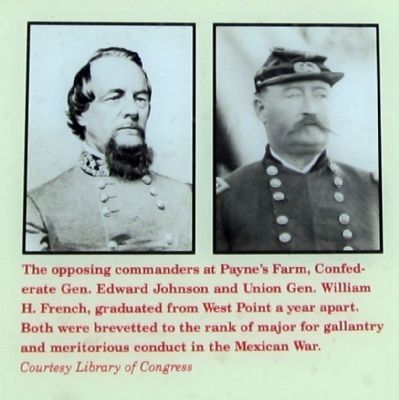
The opposing commanders at Payne’s Farm, Confederate Gen. Edward Johnson and Union Gen. William
H. French, graduated from West Point a year apart. Both were brevetted to the rank of major for gallantry and meritorious conduct In the Mexican War. Courtesy Library of Congress
We have been informed that this marker is no longer there and will not be replaced. This page is an archival view of what was.
Regionally, this marker was in Northern Virginia and in the Piedmont. It was also in the American South and specifically in the Upper South. Globally, it was in North America, the Western Hemisphere, the Western World, and the Anglosphere. Historically, it found itself in what was once the territory of the Mississippian Culture, one of the original Thirteen Colonies, one of the Confederate States of America, and the Antebellum South.

Other nearby markers. At least 8 other markers are within walking distance of this location: A different marker also named The Mine Run Campaign (here, next to this marker); The Battle of Payne’s Farm (a few steps from this marker); a different marker also named The Mine Run Campaign (about 500 feet away, measured in a direct line); a different marker also named The Mine Run Campaign (about 500 feet away); a different marker also named The Battle of Payne’s Farm (approx. 0.2 miles away); a different marker also named The Battle of Payne’s Farm
3. The Mine Run Campaign Marker
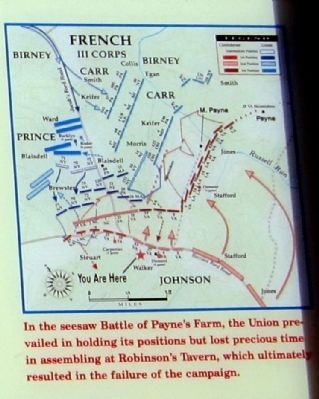
In the seesaw Battle of Payne’s Farm, the Union prevailed in holding its positions but lost precious time in assembling at Robinson’s Tavern, which ultimately resulted in the failure of the campaign.
Related marker. Click here for another marker that is related to this marker. It replaced this marker in a new parking area for the battlefield across the road.
Also see . . .
1. Mine Run (Payne's Farm). American Battlefield Trust (Submitted on November 11, 2021.)
2. The Mine Run Campaign by James K. Bryant II. Essential Civil War Curriculum, Virginia Center for Civil War Studies at Virginia Tech (Submitted on November 11, 2021.)

1864
4. Battlefield of the "Wilderness"
Views in the woods in the Federal lines on north side of Orange Plank Road. Library of Congress [LC-USZC4-7957]
The night after the battle, a newspaper correspondent wrote “The fighting that has occurred to-day has been wholly in the woods of the most dense and tangled character, filled with underbrush, dead logs, thickets of scrub oak, &c. — a continuation of the woods to the west of Chancellorsville, from which the country has been so appropriate named “Wilderness.”
The night after the battle, a newspaper correspondent wrote “The fighting that has occurred to-day has been wholly in the woods of the most dense and tangled character, filled with underbrush, dead logs, thickets of scrub oak, &c. — a continuation of the woods to the west of Chancellorsville, from which the country has been so appropriate named “Wilderness.”
Photographed by Bernard Fisher, April 30, 2011
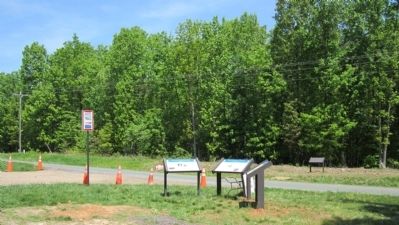
5. The Mine Run Campaign Markers
Photographed by Bernard Fisher, April 30, 2011
6. The armies collide at Payne's Farm
Johnson's Confederate Division approached Locust Grove from Raccoon Ford Rd (Zoar Rd on left) while French's Union III Corps advanced down Jacob's Ford Rd (Indiantown Rd on right).
Photographed by Bernard Fisher, April 30, 2011
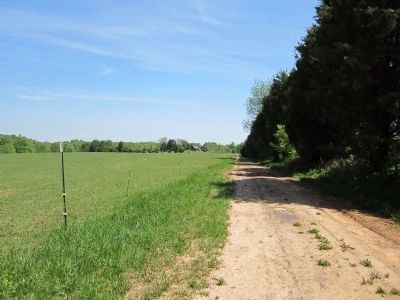
7. Payne Farm Lane
Photographed by Bernard Fisher, April 30, 2011
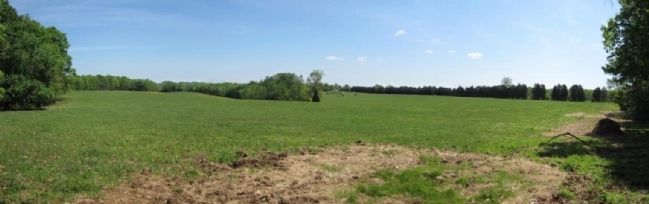
8. Payne's Farm Battlefield
Union troops were positioned in the near treeline (left), while Confederate forces advanced from the distant Payne Farm Lane (far right).
Photographed by Bernard Fisher, April 30, 2011
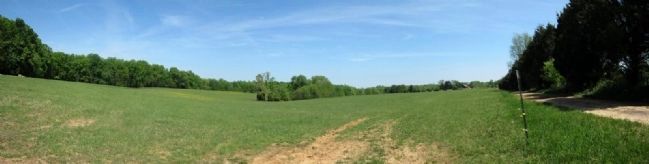
9. Payne's Farm Battlefield
Confederate forces aligned on the farm lane (right) before advancing toward the Union position in the distance.
Credits. This page was last revised on February 25, 2026. It was originally submitted on May 1, 2011, by Bernard Fisher of Richmond, Virginia. This page has been viewed 2,306 times since then and 76 times this year. Last updated on February 24, 2026, by Evan Dwyer of Richmond, Virginia. Photos: 1, 2, 3, 4, 5. submitted on May 1, 2011, by Bernard Fisher of Richmond, Virginia. 6, 7, 8, 9. submitted on May 2, 2011, by Bernard Fisher of Richmond, Virginia.
