Columbus in Muscogee County, Georgia — The American South (South Atlantic)
He Helped Bring And Keep Fort Benning
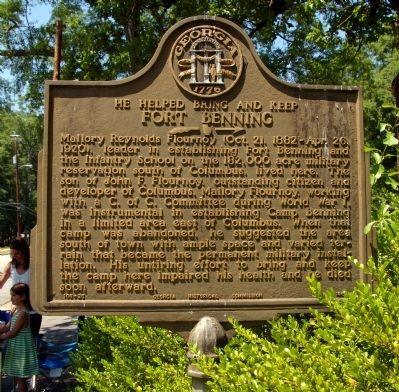
Photographed by David Seibert, April 30, 2011
1. He Helped Bring and Keep Fort Benning Marker
Erected 1956 by Georgia Historical Commission. (Marker Number 106-25.)
Topics and series. This historical marker is listed in this topic list: Military. In addition, it is included in the Georgia Historical Society series list. A significant historical month for this entry is April 1851.
Location. 32° 28.576′ N, 84° 57.476′ W. Marker is in Columbus, Georgia, in Muscogee County. It is at the intersection of Wildwood Avenue and 16th Street, on the right when traveling
this page online

Regionally, this marker is in the Piedmont. It is also in the American South and specifically in the Deep South. Globally, it is in North America, the Western Hemisphere, the Western World, and the Anglosphere. Historically, it finds itself in what was once the territory of the Mississippian Culture, one of the original Thirteen Colonies, one of the Confederate States of America, and the Antebellum South.
Other nearby markers. At least 8 other markers are within one mile of this marker, measured as the crow flies: Carson McCullers (about 700 feet away, measured in a direct line); The Cedars (approx. 0.4 miles away); Wynnton School Library (approx. 0.4 miles away); Camp Benning (approx. half a mile away); “Wildwood” (approx. half a mile away); Leonard Spring (approx. 0.7 miles away); The Elms (approx. 0.8 miles away); St. Elmo (approx. one mile away). Touch for a list and map of all markers in Columbus.
Another marker is no longer nearby. 1918 Diamond Jubilee 1993 Camp Benning / Fort Benning
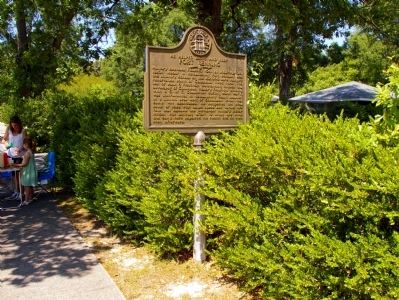
Photographed by David Seibert, April 30, 2011
2. He Helped Bring and Keep Fort Benning Marker
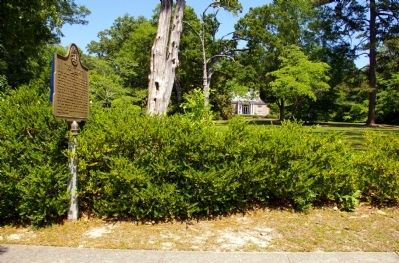
Photographed by David Seibert, April 30, 2011
3. He Helped Bring and Keep Fort Benning Marker
The marker and Flournoy home from Wildwood Avenue
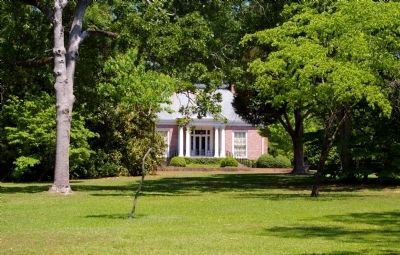
Photographed by David Seibert, April 30, 2011
4. He Helped Bring and Keep Fort Benning Marker
The Mallory Reynolds Flournoy home remains in the family.
Credits. This page was last revised on June 16, 2016. It was originally submitted on May 17, 2011, by David Seibert of Sandy Springs, Georgia. This page has been viewed 998 times since then and 40 times this year. Photos: 1, 2, 3, 4. submitted on May 17, 2011, by David Seibert of Sandy Springs, Georgia. • Bernard Fisher was the editor who published this page.
