MLK-183 in Austin in Travis County, Texas — The American South (West South Central)
First Colored Baptist Church
Photographed by Keith Peterson, May 31, 2011
1. First Colored Baptist Church Marker
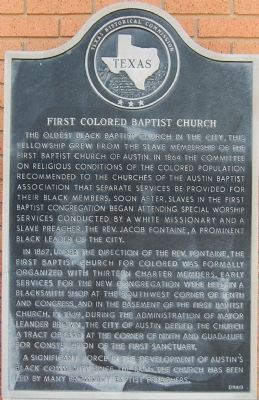
The oldest black Baptist church in the city, the fellowship grew from the slave membership of the First Baptist Church of Austin. In 1854 the committee on religious conditions of the colored population recommended to the churches of the Austin Baptist Association that separate services be provided for their black members, soon after, slaves in the First Baptist congregation began attending special worship services conducted by a white missionary and a slave preacher, the Rev. Jacob Fontaine, a prominent black leader of the city.
In 1867 under the direction of the Rev. Jacob Fontaine, the First Baptist Church for Colored was formally organized with thirteen charter members. Early services for the new congregation were held in a blacksmith shop at the southwest corner of Tenth and Congress, and in the basement of the First Baptist Church. In 1869, during the administration of Mayor Leander Brown, the city of Austin deeded the church a tract of land at the corner of Ninth and Guadalupe for construction of the first sanctuary.
A significant force in the development of Austin's black community since the 1860s, the church has been led by many prominent Baptist preachers.
Erected 1981 by Texas Historical Commission. (Marker Number 15362.)
Topics. This historical marker is listed in these topic lists: African Americans • Religion & Religious Structures. A significant historical year for this entry is 1854.
Location. 30° 17.077′ N, 97° 40.828′ W. Marker is in Austin, Texas, in Travis County. It is in MLK-183. It is on Heflin Lane east of East Martin Luther King, Jr. Boulevard, on the right when traveling east. Touch for map. Marker is at or near this postal address: 4805 Heflin Lane, Austin TX 78721, United States of America. Touch for directions.

Regionally, this marker is in Central Texas. It is
this page online
Other nearby markers. At least 8 other markers are within 2 miles of this marker, measured as the crow flies: Site of Fort Colorado (approx. 0.4 miles away); The Texas Centennial Historic Marker & Fort Colorado (approx. 0.4 miles away); Bethany Cemetery (approx. half a mile away); Mueller Airport (approx. 1.2 miles away); Evergreen Cemetery (approx. 1.2 miles away); Annie Webb Blanton (approx. 1.7 miles away); Downs Field (approx. 1.8 miles away); The Original Townsite of Montopolis (approx. 1.9 miles away). Touch for a list and map of all markers in Austin.
Another marker is no longer nearby. Site of Pecan Springs School (was approx. one mile away but has been confirmed missing).
Photographed by Keith Peterson, May 31, 2011
2. First Colored Baptist Church
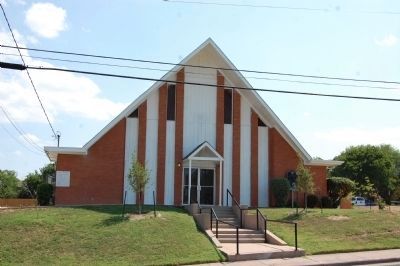
The marker is located behind the tree to the right of the entrance.
Credits. This page was last revised on February 1, 2023. It was originally submitted on May 30, 2011, by Keith Peterson of Cedar Park, Texas. This page has been viewed 2,305 times since then and 148 times this year. Photos: 1, 2. submitted on May 30, 2011, by Keith Peterson of Cedar Park, Texas. • Syd Whittle was the editor who published this page.
