Downtown Springfield in Greene County, Missouri — The American Midwest (Upper Plains)
First Post Office in Springfield
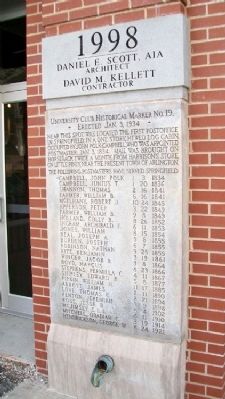
Photographed by William Fischer, Jr., February 12, 2011
1. First Post Office in Springfield Marker
Near this spot was located the first post office in Springfield, in a one story, hewed log cabin, occupied by John Polk Campbell, who was appointed postmaster, Jan. 3, 1834. Mail was brought on horseback twice a month from Harrison's Store, on Little Piney, near the present town of Arlington.
The following postmasters have served Springfield:
Campbell, John Polk 1 3 1834
Campbell, Junius T. 1 20 1836
Shannon, Thomas 2 16 1841
Farmer, William B. 6 16 1841
McElhany, Robert J. 10 24 1845
Apperson, Peter 3 22 1849
Farmer, William B. 9 8 1849
Holland, Colly B. 8 26 1852
Ingram, Archibald F. 6 11 1853
Jones, William 8 15 1854
Beal, Joseph A. 5 8 1855
Burden, Joseph 6 7 1855
Robinson, Nathan 9 25 1855
Kite, Benjamin 3 19 1861
Winger, Jacob B. 3 8 1864
Boyd, Marcus 8 23 1866
Stephens, Permilla C. 4 11 1867
Shipley, Edward R. 5 8 1877
Pipkin, William H. 11 7 1885
Abbott, James 2 11 1890
Love, Thomas C. 2 21 1894
Fenton, Jeremiah 3 9 1898
Ross, Jesse B. 8 4 1902
McJimsey, E. E. E. 4 11 1910
Mitchell, Obadiah C. 3 19 1914
Hendrickson, George W. 8 24 1921
Erected 1934 by University Club. (Marker Number 19.)
Topics and series. This historical marker is listed in these topic lists: Communications • Industry & Commerce • Settlements & Settlers. In addition, it is included in the Postal Mail and Philately series list. A significant historical date for this entry is January 3, 1833.
Location. 37° 12.428′ N, 93° 17.404′ W. Marker is in Springfield, Missouri, in Greene County. It is in Downtown Springfield. It is at the intersection of Jefferson Avenue and Walnut Street, on the right when traveling south on Jefferson Avenue. Touch for map. Marker is at or near this postal address: 333 East Walnut Street, Springfield MO 65806, United States of America. Touch for directions.

Regionally, this marker
this page online
Other nearby markers. At least 8 other markers are within walking distance of this marker: St. Paul United Methodist Church (within shouting distance of this marker); The Landers Theatre (within shouting distance of this marker); 221 East Walnut Street (about 400 feet away, measured in a direct line); Keet-McElhany House (about 400 feet away); Jewell Theater (about 600 feet away); The Colonial Hotel (about 600 feet away); Rotary, Springfield, and the Birth of Route 66 (about 600 feet away); John T. Woodruff (about 700 feet away). Touch for a list and map of all markers in Springfield.
Also see . . .
1. Springfield-Greene County Local History. (Submitted on June 4, 2011, by William Fischer, Jr. of Reynoldsburg, Ohio.)
2. This Week in the Ozarks - Springfield News-Leader History Column (12/28/2015).
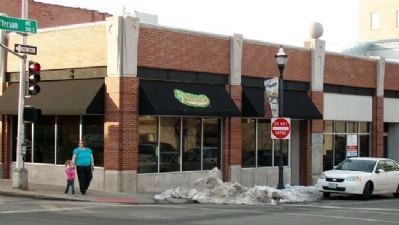
Photographed by William Fischer, Jr., February 12, 2011
2. First Post Office in Springfield Marker
Along Jefferson Avenue, on wall behind front of car
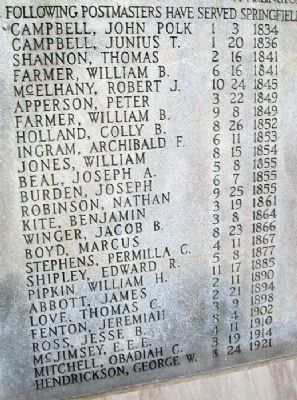
Photographed by William Fischer, Jr., February 12, 2011
3. First Post Office in Springfield Marker
Postmasters
Credits. This page was last revised on February 16, 2023. It was originally submitted on June 4, 2011, by William Fischer, Jr. of Reynoldsburg, Ohio. This page has been viewed 1,375 times since then and 52 times this year. Photos: 1, 2, 3. submitted on June 4, 2011, by William Fischer, Jr. of Reynoldsburg, Ohio.
