Downtown in Tampa in Hillsborough County, Florida — The American South (South Atlantic)
First United Methodist Church
Tampa, Florida
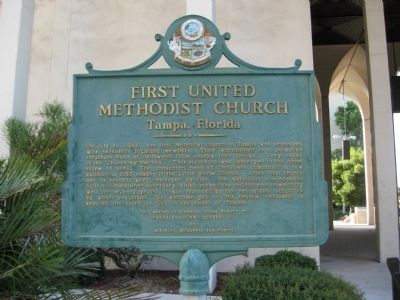
Photographed by AGS Media, September 20, 2010
1. First United Methodist Church Marker
FRANK Von LUDWIG SIEVER, Jr.
By:
his wife, Elizabeth and Family
Topics. This historical marker is listed in this topic list: Religion & Religious Structures. A significant historical month for this entry is July 1735.
Location. 27° 57.163′ N, 82° 27.517′ W. Marker is in Tampa, Florida, in Hillsborough County. It is in Downtown. It is on East Tyler Street east of North
this page online

Regionally, this marker is on Florida’s Tampa Bay. It is also in the American South and on the Gulf Coast. Globally, it is in the North Atlantic Region, North America, a Gulf of Mexico state, the Western Hemisphere, the Western World, and the Anglosphere. Historically, it finds itself in what was once New Spain, the territory of the Mississippian Culture, one of the Confederate States of America, and the Antebellum South.
Other nearby markers. At least 8 other markers are within walking distance of this marker: Historic Harlem Academy / School #2 (about 400 feet away, measured in a direct line); Oaklawn and St. Louis Cemetery (about 600 feet away); U.S.S. Sagamore (about 700 feet away); Kennedy (about 700 feet away); Confederate States Soldiers and Sailors (about 700 feet away); Woolworth Sit-In (about 700 feet away); Victims of the Yellow Fever
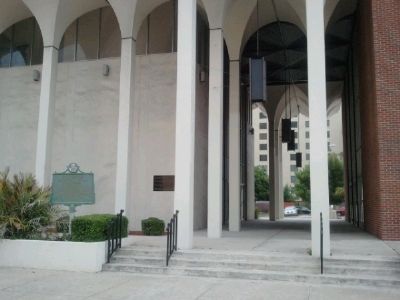
Photographed by AGS Media, June 7, 2011
2. First United Methodist Church Marker
Another marker is no longer nearby. Oaklawn Cemetery (was about 600 feet away but has been permanently removed).
More about this marker. The marker is capped with the crest of the Tampa Historical Society.
Regarding First United Methodist Church. First United Methodist was not just the area's oldest Methodist congregation. When it formed in 1846, it was the first organized church of any denomination or religious faith to come to Tampa. The next church to grace the area, organized by local Baptists, was not established until 1859. Thus, First Methodist, for thirteen years was the only church available to the small community.
It was during this early period that the primitive driftwood structure in which they initially met was lost in a storm, and their more permanent second home, the "Little White Church" was built. Donations were collected to fund the church's construction, and one such donation, a five-dollar gold coin, came from a none other than the future Confederate General, Thomas J. "Stonewall" Jackson,
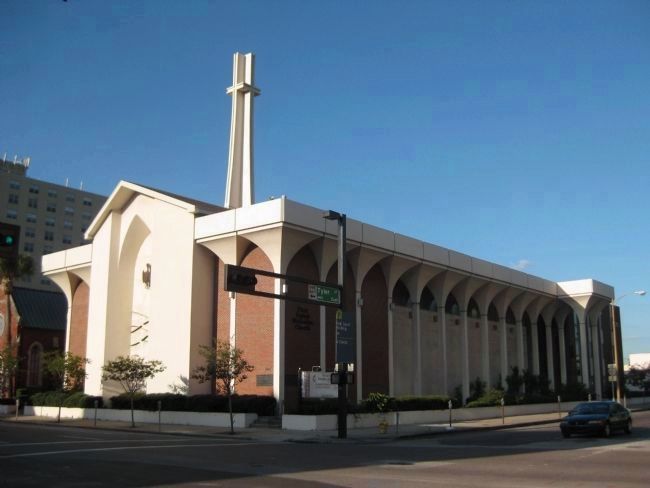
Photographed by AGS Media, September 20, 2010
3. First United Methodist Church of Tampa
Over succeeding decades, the faithful of First Methodist brought the church through times of extreme hardship such as the Civil War, Reconstruction, and epidemics of Yellow Fever. By the 1890's, however, the arrival of railroads to Tampa brought an end to the city's long isolation, and ushered in a new period of development and opportunity for the area. Now in need of a larger church facility, First Methodist chose to relocate from their earlier property to a site on the northern edge of downtown (the same site where this historical marker now stands). The congregation constructed a stately, new, sanctuary built of brick and stained glass and topped with a soaring spire which could be seen from all over the city. This, their third new church facility,
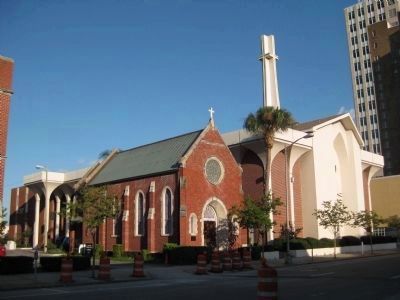
Photographed by AGS Media, September 20, 2010
4. First United Methodist Church
From the late 19th century, through most of the 20th, First United Methodist Church played an integral part within the growing community, serving the spiritual and social needs of generations of Tampa's faithful. As the city expanded through the years, the church successful established five new independent Methodist congregations to serve new areas of the city. First Methodist was one of the first organized ministries of charity and assistance to Tampa's hungry, homeless, and needy; and its membership was instrumental in the establishment of many local non-profit assistance agencies and programs, including Meals-on-Wheels, Metro Charities, and the Tampa Children's Home, among others.
By the late 20th century, as Tampa's residents fled its downtown to live in the suburbs, the community surrounding the church was left in decay and the church's prominence began to wane. The congregation experienced a steady decline in membership and saw attendance at church
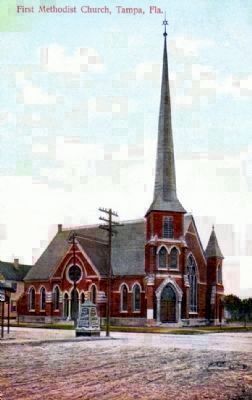
Photographed by International Post Card, circa 1900
5. First Methodist Church, Tampa, Florida
This vintage postcard shows the Methodists' third church facility. The brick sanctuary was the church's home from the 1890's until it was razed 1967 and replaced by the current neo-gothic building. This building is remembered for its enormous spire, which so prominently stood as a pinnacle of Tampa's early 1900's skyline that it played a small role in aviation history. When Tony Jannus in 1914 piloted the world's first commercial airline flight, carrying a single passenger across Tampa Bay from St. Petersburg to Tampa, he used the giant spire atop First Methodist Church to plot his course. Florida Photographic Collection, State Library and Archives of Florida [PC4434]
Sources: "History of Tampa, Florida".Wikipedia. (http://en.wikipedia.org/wiki/History_of_Tampa,_Florida) • Sprott, Gary (2011-06-05). "Church Closes Doors". The Tampa Tribune. (http://www2.tbo.com/news/community-news/2011/jun/05/MENEWSO3-church-closes-doors-ar-235213/) • Bearden, Michelle (2011-05-29). "Members clash with leadership to keep 164-year-old church open". The Tampa Tribune. (http://www2.tbo.com/lifestyles/faith/2011/may/29/MENEWSO1-members-clash-with-leadership-to-keep-164-ar-233530/)
Related marker. Click here for another marker that is related to this marker. Site of Tampa's First Church Building
Additional keywords. Religion
Credits. This page was last revised on July 28, 2024. It was originally submitted on June 5, 2011, by Glenn Sheffield of Tampa, Florida. This page has been viewed 2,597 times since then and 95 times this year. Photos: 1. submitted on June 5, 2011, by Glenn Sheffield of Tampa, Florida. 2. submitted on June 7, 2011, by Glenn Sheffield of Tampa, Florida. 3, 4. submitted on June 5, 2011, by Glenn Sheffield of Tampa, Florida. 5. submitted on June 6, 2011, by Glenn Sheffield of Tampa, Florida. • Bernard Fisher was the editor who published this page.
