
Near Acarlar in Selçuk, Izmir, Turkiye — West Asia or Southeast Europe
The Celsus Library
Photographed by Richard E. Miller, May 22, 2011
1. Celsus Library Marker
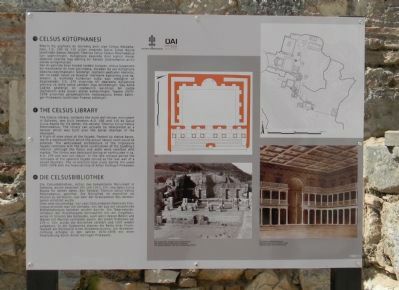
Celsus Kütüphanesi [text in Turkish]:
Efes'in hiç şüphesiz en tanınmış anıtı olan Celsus Kütüphanesi, İ.S. 100 ile 110 yılları arasında Gaius İulius Aquila tarafından babası Senatör Tiberius İulius Celsus Polemaeanus için yaptırılmıştır. Kütüphane esasında ölen kişinin mezar odasının üzerine inşa edilmiş bir heroon (kahramanlık anıtı) olarak anlaşılmalıdır.
Her iki yanında birer heykel kaidesi bulunan, dokuz basamaklı bir merdivenle ön hole çıkılmakta, buradan da asıl kütüphane odasına ulaşılmaktadır. Gösterişli cephenin aediculalı mimarisi, her ne kadar taban ve duvarlar mermerle kaplanmış olsa da, binanın iç kısmında kullanılan tuğla yapı tekniğine zıt düşmektedir. İ.S. 270 civarında bir depremle kütüphane yıkılmış ve daha sonra yeniden inşa edilmemiştir. Geç Antik Çağ'da gösterişli ön cephensinin
this page online
The Celsus Library [text in English]:
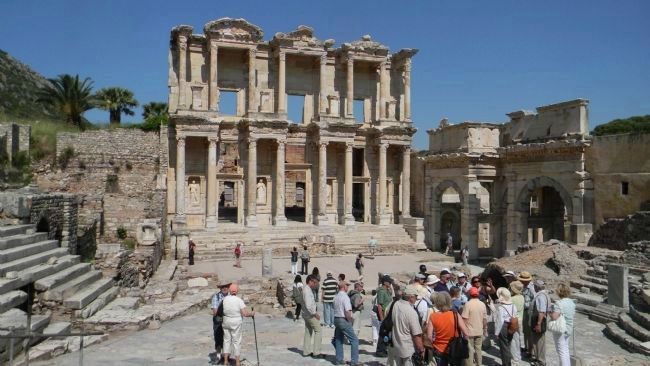
The Celsus Library, certainly the most well-known monument in Ephesos, was built between A.D. and 110 by Gaius Iulius Aquila for his father, the senator Tiberius Iulius Celsus Polemaeanus. The library can actually be interpreted as a heroon which was built over the burial chamber of the deceased.
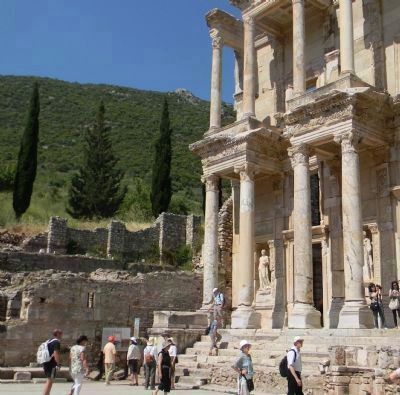
A flight of nine steps at the façade, flanked by statue bases, led to a vestibule from which the actual library room could be entered. The aediculated architecture of the impressive façade contrasts with the brick construction of the building’s interior, although the floors and walls were revetted with marble. The library was destroyed during an earthquake in ca. A.D. 270 and was not rebuilt. In the late antique period the remnants of the splendid façade served as the rear wall of a street fountain. The re-erection took place during the
Photographed by Richard E. Miller, May 22, 2011
2. The Celsus Library
Die Celsusbibliothek [text in German]:
Die Celsusbibliothek, sicher das bekannteste Monument in Ephesos, wurde zwischen 100 und 100 n. Chr. von Gaius Iulius Aquila für seinen Vater, den Senator Tiberius Iulius Celsus Polemaeanus, gestiftet. Die Bibliothek ist eigentlich als Heroon zu verstehen, das über der Grabkammer des Verstorbenen errichtet wurde.
Über eine neunstufige, von zwei Statuenbasen flankierte Freitreppe erreicht man die Vorhalle, von der aus der tatsächliche Bibliotheksraum betreten werden konnte. Die Tabernakelarchitektur der Prunkfassade kontrastiert mit der Ziegelbauweise im Inneren des Gebäudes, auch wenn dessen Böden und Wände mit Marmor verkleidet waren. Bei einem Erdbeben um 270 n. Chr. wurde die Bibliothek zerstört und nicht wieder aufgebaut. In der Spätantike dienten die Reste ihrer Prunkfassade als Rückwand eines Straßenbrunnens. Die Wiedererrichtung erfolgte in den Jahren 1970–1978 mit einer Finanzierung durch Anton Kallinger-Prskawetz.
[Diagrams]:
the Library floor plan and the Ephesus archaeological site.
[Photo captions]:
Photographed by Richard E. Miller, May 22, 2011
3. The Celsus Library marker, visible to the left of the stairs
The Celsus Library after the excavations
Die Celsusbibliothek nach den freilegungsarbeiten
İç mekanın rekonstrüksiyonu
Reconstruction of the interior room
Rekonstruktion des Innenraumes
T.C. Kültür Ve Turizm Bakanliği and Osterrichisches Archaologisthes Insitut, Gradung Ephesos
Erected by T.C. Kültür Ve Turizm Bakanligi and Osterrichisches Archaologisthes Insitut, Gradung Ephesos.
Topics. This historical marker is listed in these topic lists: Arts, Letters, Music • Notable Buildings.
Location. 37° 56.348′ N, 27° 20.445′ E. Marker is near Acarlar, Izmir, in Selçuk. It can be reached from Efes Harabeleri (Marble Road/Curetes Street) south of Efes Yolu. The library is within the restored Ephesus Archaeological Site, off the intersection of the old Marble Road and the Curetes Street. Touch for map. Marker is in this post office area: Acarlar, Izmir 35920, Turkiye. Touch for directions.

Regionally, this marker is in Turkish Asia Minor — Anatolia. Globally, it is in West Asia,
Photographed by Richard E. Miller, May 22, 2011
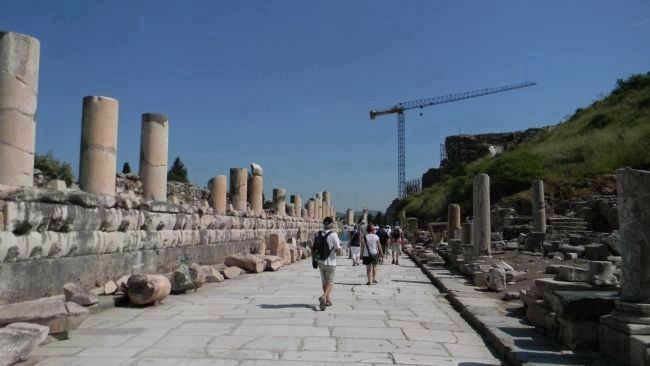
4. Marble Road - connecting the Celsus Library with the Great Theatre at Harbor Street
Other nearby markers. At least 8 other markers are within walking distance of this marker: The South Gate of the Agora (within shouting distance of this marker); Hadrian's Gate (within shouting distance of this marker); The Archaic-Classical Settlement and the Sepulchre Street (within shouting distance of this marker); Tetragonos Agora - The Commercial Market (within shouting distance of this marker); The Heroon of Androclos (within shouting distance of this marker); The So-Called House of Pleasure (within shouting distance of this marker); The Latrine (about 90 meters away, measured in a direct line); Terrace House 2 (about 90 meters away). Touch for a list and map of all markers in Acarlar.
Also see . . .
1. Library of Celsus. Wikipedia entry (Submitted on June 27, 2011, by Richard E. Miller of Oxon Hill, Maryland.)
2. Library of Celsus in Ephesus. Discover Kusadasi website entry (Submitted on June 27, 2011, by Richard E. Miller of Oxon Hill, Maryland.)
3. Heroön.
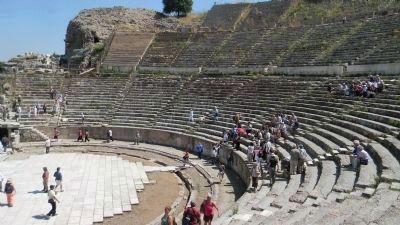
Photographed by Richard E. Miller, May 22, 2011
5. The Great Ephesus Theatre on the slope of Panayir Hill, off the Marble Road opposite Harbor Street
Additional keywords. antiquities; Efes; Anatolia; Asia Minor; Marble Road; Artemis Temple.
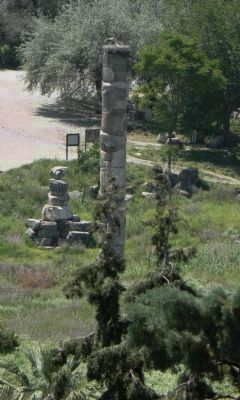
Photographed by Richard E. Miller, May 22, 2011
6. The Artemis Temple site at the northern end of the sacred route from Efes
Credits. This page was last revised on October 1, 2024. It was originally submitted on June 27, 2011, by Richard E. Miller of Oxon Hill, Maryland. This page has been viewed 1,711 times since then and 64 times this year. Last updated on June 30, 2011, by Richard E. Miller of Oxon Hill, Maryland. Photos: 1, 2, 3, 4. submitted on June 27, 2011, by Richard E. Miller of Oxon Hill, Maryland. 5, 6. submitted on June 28, 2011, by Richard E. Miller of Oxon Hill, Maryland. • Bill Pfingsten was the editor who published this page.
