Hilton Head Island in Beaufort County, South Carolina — The American South (South Atlantic)
St. James Baptist Church
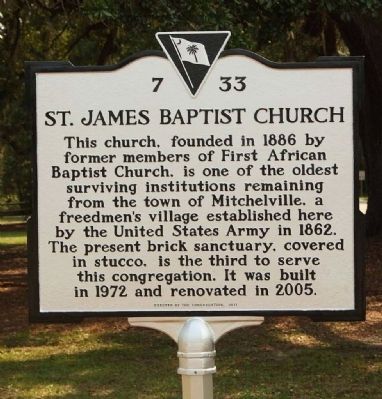
Photographed by Mike Stroud, July 3, 2011
1. St. James Baptist Church Marker
Erected 2011 by The Congregation. (Marker Number 7-33.)
Topics. This historical marker is listed in these topic lists: African Americans • Religion & Religious Structures. A significant historical year for this entry is 1886.
Location. 32° 14.076′ N, 80° 41.491′ W. Marker is on Hilton Head Island, South Carolina, in Beaufort County. It is at the intersection of Beach City Road and Dillon Road, on the right when traveling north on Beach City Road. Touch for map. Marker is at or near this postal address: 209 Dillon Rd, Hilton Head Island SC 29926, United States of America. Touch for directions.

Regionally, this marker is in the Lowcountry and on the Sea Islands. It is also in the American South, specifically in the Deep South, and on the Eastern
this page online
Other nearby markers. At least 8 other markers are within walking distance of this marker: Cherry Hill School (within shouting distance of this marker); Mitchelville Site (within shouting distance of this marker); Fort Howell - 1864 (within shouting distance of this marker); Fort Howell (within shouting distance of this marker); Forts of the Civil War Era (approx. 0.2 miles away); General Howell / Captain Suter (approx. 0.2 miles away); The Troops that Built Fort Howell / Camp Baird (approx. 0.2 miles away); The Story of Fort Howell (approx. 0.2 miles away). Touch for a list and map of all markers in Hilton Head Island.
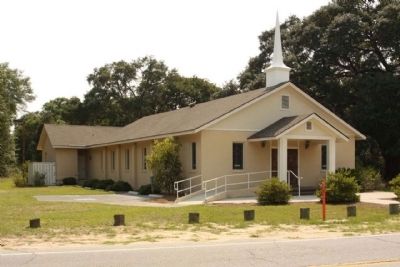
Photographed by Mike Stroud, July 3, 2011
2. St. James Baptist Church
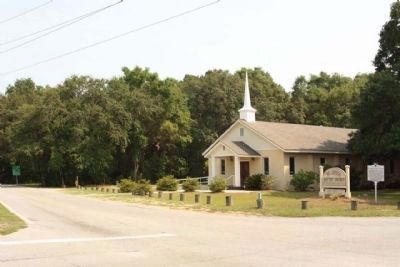
Photographed by Mike Stroud, July 3, 2011
3. St. James Baptist Church and Marker looking southeast at Dillon Road
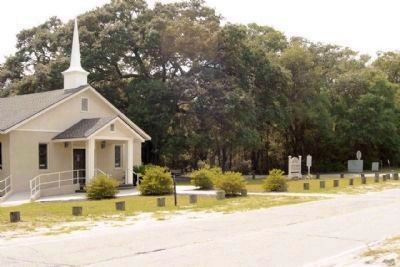
Photographed by Mike Stroud, July 3, 2011
4. St. James Baptist Church and Marker, at Dillon Road and Beach City Road
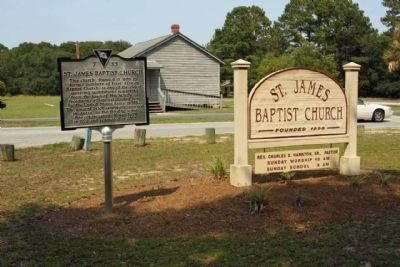
Photographed by Mike Stroud, July 3, 2011
5. St. James Baptist Church Marker
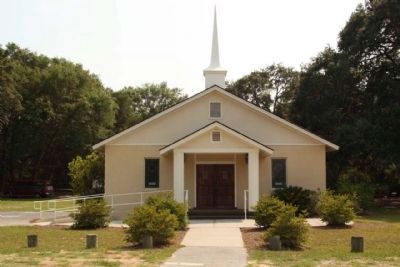
Photographed by Mike Stroud, July 3, 2011
6. St. James Baptist Church
Credits. This page was last revised on December 5, 2020. It was originally submitted on July 3, 2011, by Mike Stroud of Bluffton, South Carolina. This page has been viewed 2,372 times since then and 306 times this year. Photos: 1, 2, 3, 4, 5, 6. submitted on July 8, 2011, by Mike Stroud of Bluffton, South Carolina.
