Forest Hill in Newark in Essex County, New Jersey — The American Northeast (Mid-Atlantic)
Branch Brook Park
Historic Site
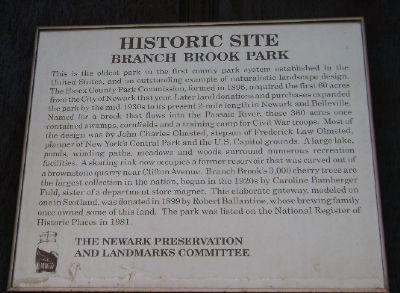
Photographed by James True, July 5, 2011
1. Branch Brook Park Historic Site Marker
this page online
Erected by The Newark Preservation and Landmarks Committee.
Topics. This historical marker is listed in this topic list: Landmarks. A significant historical year for this entry is 1895.
Location. 40° 46.268′ N, 74° 10.412′ W. Marker is in Newark, New Jersey, in Essex County. It is in Forest Hill. It is at the intersection of Lake Street and Ballantine Parkway, on the left when traveling north on Lake Street. Marker is attached to the gatehouse on the right as you enter the park from Lake Street. Touch for map. Marker is in this post office area: Newark NJ 07104, United States of America. Touch for directions.

Regionally, this marker is in North Jersey and in the New York City Metropolitan Area. It is also in the American Northeast, in the Mid-Atlantic, and on the Eastern Seaboard. Globally, it is in the North Atlantic Region, North America, the Western Hemisphere, the Western World, and the Anglosphere. Historically, it finds itself in what was once New Netherland and also one of the original Thirteen
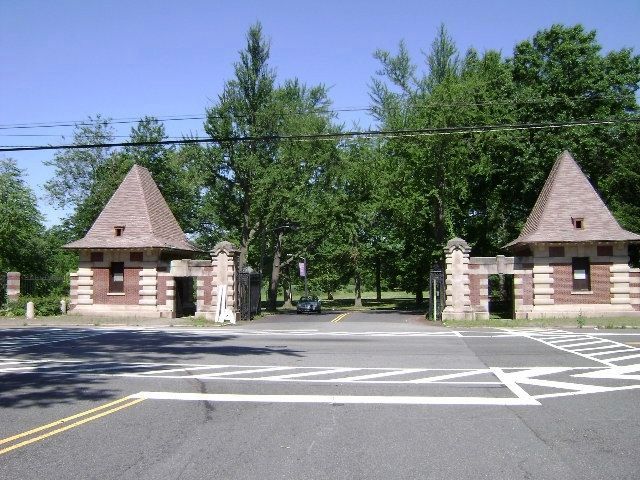
Photographed by James True, July 5, 2011
2. The Ballantine Gates at the entrance to Branch Brook Park.
Other nearby markers. At least 8 other markers are within walking distance of this marker: A different marker also named Branch Brook Park (a few steps from this marker); Forest Hill (within shouting distance of this marker); Dewey Joseph Sherbo, III (approx. 0.2 miles away); William Hayes Ward Home (approx. 0.3 miles away); Sydenham House (approx. 0.4 miles away); Forest Hill Historic District (approx. half a mile away); Joseph A. Pocchio (approx. half a mile away); Soldiers of the Revolution (approx. half a mile away). Touch for a list and map of all markers in Newark.
Also see . . . The Branch Brook Park Alliance. (Submitted on July 8, 2011, by Bernard Fisher of Richmond, Virginia.)
Credits. This page was last revised on January 4, 2026. It was originally submitted on July 5, 2011, by James True of Newark, New Jersey. This page has been viewed 997 times since then and 28 times this year. Photos: 1, 2. submitted on July 5, 2011, by James True of Newark, New Jersey. • Bernard Fisher was the editor who published this page.
