Cooke City in Park County, Montana — The American West (Mountains)
The New World Mining District
Photographed by Bernard Fisher, July 25, 2011
1. The New World Mining District Marker
Inscription.
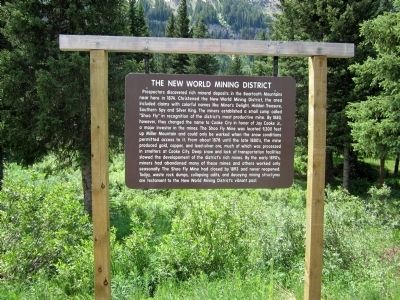
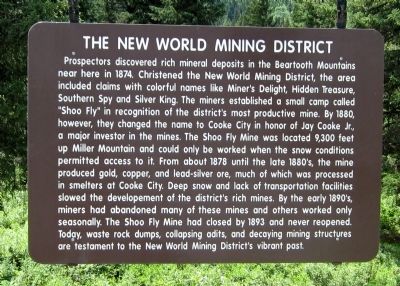
The New World Mining District. . Prospectors discovered rich mineral deposits in the Beartooth Mountains near here in 1874. Christened the New World Mining District, the area included claims with colorful names like Miners Delight, Hidden Treasure, Southern Spy and Silver King. The miners established a small camp called “Shoo Fly” in recognition of the districts most productive mine. By 1880, however, they changed the name to Cooke City in honor of Jay Cooke, Jr., a major investor in the mines. The Shoo Fly Mine was located 9,300 feet up Miller Mountain and could only be worked when the snow conditions permitted access to it. From about 1878 until the late 1880s, the mine produced gold, copper, and lead-silver ore, much of which was processed in smelters at Cooke City. Deep snow and lack of transportation facilities slowed the development of the districts rich mines. By the early 1890s, miners had abandoned many of these mines and others worked only seasonally. The Shoo Fly Mine had closed by 1893 and never reopened. Today, waste rock dumps, collapsing adits, and decaying mining structures are testament to the New World Mining Districts vibrant past.
Prospectors discovered rich mineral deposits in the Beartooth Mountains near here in 1874. Christened the New World Mining District, the area included claims with colorful names like Miners Delight, Hidden Treasure, Southern Spy and Silver King. The miners established a small camp called “Shoo Fly” in recognition of the districts most productive mine. By 1880, however, they changed the name to Cooke City in honor of Jay Cooke, Jr., a major investor in the mines. The Shoo Fly Mine was located 9,300 feet up Miller Mountain and could only be worked when the snow conditions permitted access to it. From about 1878 until the late 1880s, the mine produced gold, copper, and lead-silver ore, much of which was processed in smelters at Cooke City. Deep snow and lack of transportation facilities slowed the development of the districts rich mines. By the early 1890s, miners had abandoned many of these mines and others worked only seasonally. The Shoo Fly Mine had closed by 1893 and never reopened. Today, waste rock dumps, collapsing adits, and decaying mining structures are testament to the New World Mining Districts vibrant past.
Erected by Montana Highway Department.
Topics. This historical marker is listed in these topic lists: Industry & Commerce
Location. 45° 1.101′ N, 109° 56.591′ W. Marker is in Cooke City, Montana, in Park County. It is on U.S. 212 0.2 miles west of Montana Street, on the right when traveling east. Touch for map. Marker is in this post office area: Cooke City MT 59020, United States of America. Touch for directions.

Regionally, this marker is in Yellowstone Country and in Greater Bozeman. It is also in the American Mountain West and in the Lewis & Clark Corridor. Globally, it is in North America, the Rocky Mountains, the Western Hemisphere, the Western World, and the Anglosphere. Historically, it finds itself in what was once Ruperts Land and also the Louisiana Purchase.
Credits. This page was last revised on June 16, 2016. It was originally submitted on July 29, 2011, by Bernard Fisher of Richmond, Virginia. This page has been viewed 1,417 times since then and 61 times this year. Photos:1, 2, 3. submitted on July 29, 2011, by Bernard Fisher of Richmond, Virginia.