Vasa in Goodhue County, Minnesota — The American Midwest (Upper Plains)
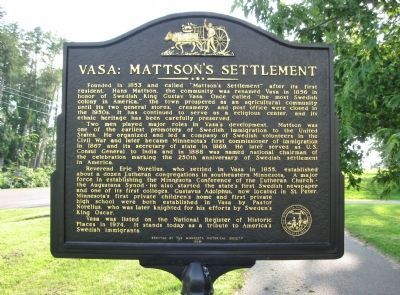
Vasa: Mattson's Settlement
Photographed by Keith L, July 22, 2011
1. Vasa: Mattson's Settlement Marker
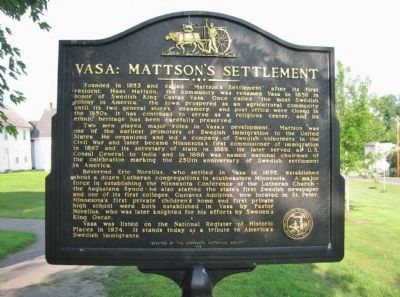
Two men played major roles in Vasa’s development. Mattson was one of the earliest promoters of Swedish immigration to the United States. He organized and led a company of Swedish volunteers in the Civil War and later became Minnesota’s first commissioner of immigration in 1867 and its secretary of state in 1869. He later served as U.S. Consul General to India and in 1888 was named national chairman of the celebration marking the 250th anniversary of Swedish settlement in America.
Reverend Eric Norelius, who settled in Vasa in 1855, established about a dozen Lutheran congregations in southeastern Minnesota. A major force in establishing the
this page online
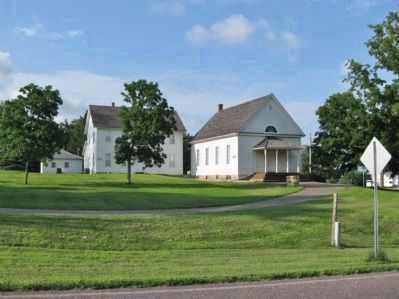
Vasa was listed on the National Register of Historic Places in 1974. It stands today as a tribute to America's Swedish immigrants.
Erected by the Minnesota Historical Society
1988
Erected 1988 by the Minnesota Historical Society.
Topics and series. This historical marker is listed in these topic lists: Education • Religion & Religious Structures • Settlements & Settlers. In addition, it is included in the Minnesota Historical Society series list. A significant historical year for this entry is 1853.
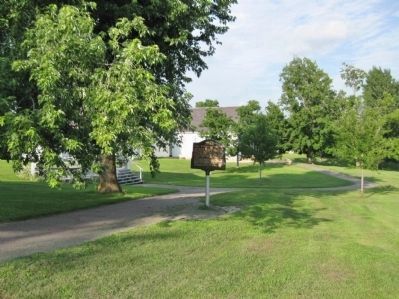
Location. 44° 30.216′ N, 92° 43.415′ W. Marker is in Vasa, Minnesota, in Goodhue County. It is on Norelius Road (County 7 Boulevard) 0.2 miles east of Old Childrens Home Road, on the left
Photographed by Keith L, July 22, 2011
2. Vasa: Mattson's Settlement Marker

Regionally, this marker is in Southeast Minnesota. It is also in the American Midwest, in the Corn Belt, in the Driftless Area — Bluff Country, and in the Great River Road Region. Globally, it is in North America, the Western Hemisphere, the Western World, and the Anglosphere. Historically, it finds itself in what was once Rupert’s Land, the territory of the Mississippian Culture, and the Louisiana Purchase.
Other nearby markers. At least 8 other markers are within 7 miles of this marker, measured as the crow flies: The Belle Creek Watershed (approx. 3½ miles away); Cannon Valley Trail Archaeology (approx. 4.2 miles away); Oak Trees in the Tallgrass Prairie (approx. 6.2 miles away); Restoring the Land (approx. 6.2 miles away); Early Inhabitants (approx. 6.2 miles away); Our Native Forests (approx. 6.3 miles away); Military Roads (approx. 6.3 miles away); Anderson Center and Outdoor Sculpture Garden (approx. 6.4 miles away).
Photographed by Keith L, July 22, 2011
3. Vasa: Mattson's Settlement Marker
Photographed by Keith L, July 22, 2011
4. Vasa Museum
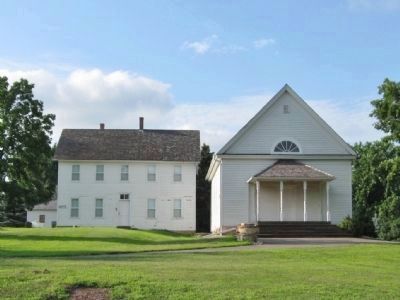
Photographed by Keith L, July 22, 2011
5. Vasa Historic District
Credits. This page was last revised on June 7, 2021. It was originally submitted on August 1, 2011, by Keith L of Wisconsin Rapids, Wisconsin. This page has been viewed 2,064 times since then and 134 times this year. Photos: 1, 2, 3, 4, 5. submitted on August 1, 2011, by Keith L of Wisconsin Rapids, Wisconsin.
