Kearney in Buffalo County, Nebraska — The American Midwest (Upper Plains)
Historic Kearney
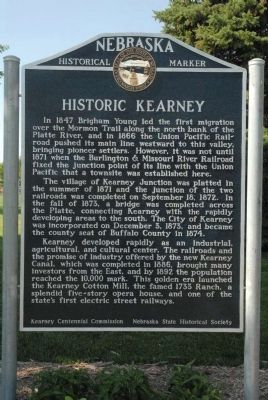
Photographed by Charles T. Harrell, June 29, 2011
1. Historic Kearney Marker
In 1847 Brigham Young led the first migration over the Mormon Trail along the north bank of the Platte River, and in 1866 the Union Pacific Railroad pushed its main line westward to this valley, bringing pioneer settlers. However, it was not until 1871 when the Burlington & Missouri River Railroad fixed the junction point of its line with the Union Pacific that a townsite was established here.
The village of Kearney Junction was platted in the summer of 1871 and the junction of the two railroads was completed on September 18, 1872. In the fall of 1873, a bridge was completed across the Platte, connecting Kearney with the rapidly developing areas to the south. The City of Kearney was incorporated on December 3, 1873 and became the county seat of Buffalo County in 1874.
Kearney developed rapidly as an industrial, agricultural, and cultural center. The railroads and the promise of industry offered by the new Kearney Canal, which was completed in 1886, brought many investors from the East, and by 1892 the population reached the 10,000 mark. This golden era launched the Kearney Cotton Mill, the famed 1733 Ranch, a splendid five-story opera house, and on of the state’s first electric street railways.
Erected by Kearney Centennial Commission, Nebraska State Historical Society. (Marker Number 153.)
Topics and series. This historical marker is listed in this topic list: Settlements & Settlers. In addition, it is included in the Daughters of the American Revolution (DAR), and the Nebraska State Historical Society series lists. A significant historical month for this entry is September 1910.
Location. 40° 41.12′ N, 99° 5.418′ W. Marker is in Kearney, Nebraska, in Buffalo County. It is at the intersection of West 11th Street and 6th Avenue, on the right when traveling west on West 11th Street. Touch for map. Marker is
this page online

Regionally, this marker is in Central Nebraska and in the Platte River Valley. It is also in the American Midwest, in the Corn Belt, and on the prairies. Globally, it is in North America, the Western Hemisphere, the Western World, and the Anglosphere. Historically, it finds itself in what was once the Louisiana Purchase.
Other nearby markers. At least 8 other markers are within walking distance of this marker: Shelton Union Pacific Depot (about 500 feet away, measured in a direct line); Baldwin Engine 481 (about 600 feet away); Loup River Freighter Hotel (about 600 feet away); German Baptist Church of the Brethren (about 700 feet away); Boyd House (about 700 feet away); Kearney (approx. 0.7 miles away); Site of Bauer Drug (approx. 0.7 miles away); Old Oregon Trail (approx. 0.8 miles away). Touch for a list and map of all markers in Kearney.
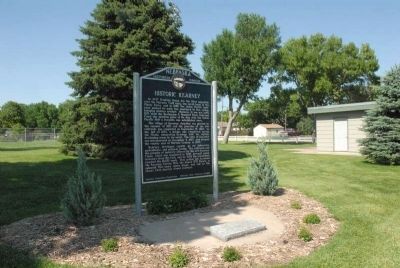
Photographed by Charles T. Harrell, June 29, 2011
2. Historic Kearney Marker
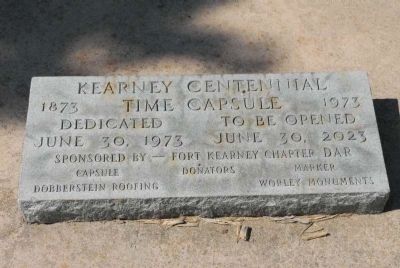
Photographed by Charles T. Harrell, June 29, 2011
3. Historic Kearney Time Capsule
Kearney Centennial Time Capsule
1873-1973
Dedicated June 30, 1973
To be opened June 30, 2023
Sponsored by—Fort Kearney Chapter DAR
Capsule Conators Marker
Dobberstein Roofing, Worley Monuments
Credits. This page was last revised on March 5, 2026. It was originally submitted on August 2, 2011, by Charles T. Harrell of Woodford, Virginia. This page has been viewed 1,407 times since then and 27 times this year. Photos: 1, 2, 3. submitted on August 2, 2011, by Charles T. Harrell of Woodford, Virginia. • Bill Pfingsten was the editor who published this page.
