Auburn in Fauquier County, Virginia — The American South (Mid-Atlantic)
Grapewood Farm Engagement
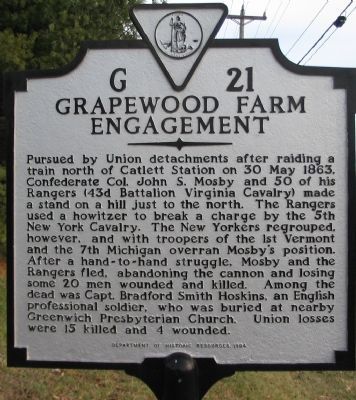
Photographed by Craig Swain, January 5, 2008
1. Grapewood Farm Engagement Marker
Pursued by Union detachments after raiding a train north of Catlett Station on 30 May 1863, Confederate Col. John S. Mosby and 50 of his Rangers (43rd Battalion Virginia Cavalry) made a stand on a hill just to the north. The Rangers used a howitzer to break a charge by the 5th New York Cavalry. The New Yorkers regrouped, however, and with troopers of the 1st Vermont and the 7th Michigan overran Mosby's position. After a hand-to-hand struggle, Mosby and the Rangers fled, abandoning the cannon and losing some 20 men wounded and killed. Among the dead was Capt. Bradford Smith Hoskins, an English professional soldier, who was buried at nearby Greenwich Presbyterian Church. Union losses were 15 killed and 4 wounded.
Erected 1994 by Department of Historic Resources. (Marker Number G-21.)
Topics and series. This historical marker is listed in this topic list: War, US Civil. In addition, it is included in the Virginia Department of Historic Resources (DHR) series list. A significant historical date for this entry is May 30, 1863.
Location. 38° 44.144′ N, 77° 41.032′ W. Marker is in Auburn, Virginia, in Fauquier County. It is at the
this page online

Regionally, this marker is in the Washington Metropolitan Area and in Northern Virginia. It is also in the American South, specifically in the Upper South, and in the Mid-Atlantic. Globally, it is in North America, the Western Hemisphere, the Western World, and the Anglosphere. Historically, it finds itself in what was once the territory of the Mississippian Culture, one of the original Thirteen Colonies, one of the Confederate States of America, and the Antebellum South.
Other nearby markers. At least 8 other markers are within 3 miles of this marker, measured as the crow flies: Vint Hill Farms Station (approx. 0.6 miles away); Greenwich (approx. 2.2 miles away); Stony Lonesome Farm (approx. 2.2 miles away); a different marker also named “Greenwich” (approx. 2.2 miles away); Neavil's Ordinary (approx. 2.3 miles away); Neavil’s Mill (approx. 2.4 miles away); Battle of Coffee Hill
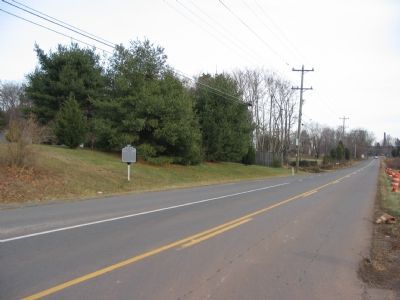
Photographed by Craig Swain, January 5, 2008
2. Grapewood Farm Engagement Marker
Another marker is no longer nearby. Neavil's Ordinary (was approx. 2.3 miles away but has been replaced with another marker now near it).
Also see . . .
1. The Mosby Gun. Warfare History Museum website entry:
Part of the The Reaves Military Weapons Collection. The gun captured here eventually found its way to the 45th Infantry Division Museum in Oklahoma City, OK. If the weapon could talk, it would indeed have an interesting story to tell. (Submitted on January 6, 2008, by Craig Swain of Leesburg, Virginia.)
2. Mosby’s Raid at Catlett’s Station. Several markers trace the raid and the subsequent pursuit. The grave of Bradford Smith Hoskins mentioned on this marker is pictured on the Greenwich marker page. (Submitted on January 6, 2008, by Craig Swain of Leesburg, Virginia.)
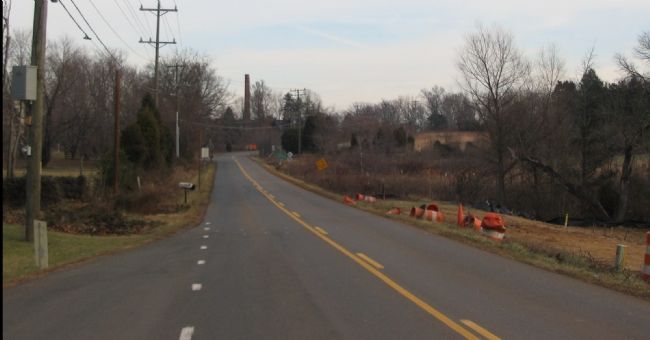
Photographed by Craig Swain, January 5, 2008
3. Mosby's Hasty Defense
On the high ground just short of the old Vint Hill Farm military base entrance, Mosby chose to turn on his pursuers and challenge them with his cannon. The smokestacks in the distance are those of the power plant for the old base complex.
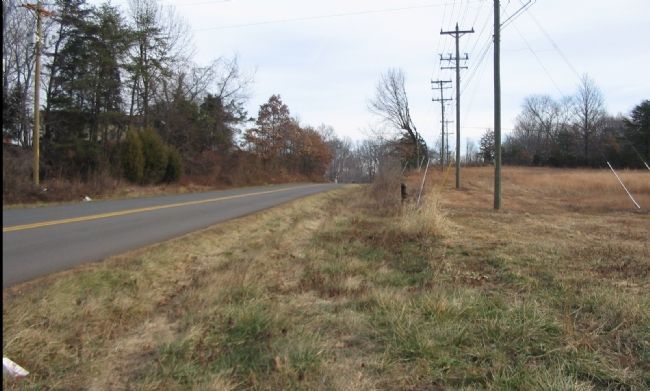
Photographed by Craig Swain, January 5, 2008
4. Mosby's High Ground
Further down the road from the previous photo, near the site of Mosby's defense. The actual site cannot be pinpointed with certainty, as the farm lanes have shifted as they evolved into county routes.
Photographed by Craig Swain, January 5, 2008
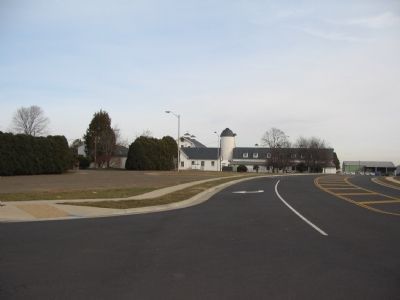
5. Vint Hill Farms
A location calling for a marker or at least better interpretation is the site of the old Army base at Vint Hill Farms. Initially established during World War II, the base was used at that time to intercept and monitor radio communications between Germany and Japan. During the Cold War the site was similarly used to monitor radio transmissions, to include those by spies operating within the United States. Intelligence information interpreted here found its way to decision makers in the Pentagon.
Credits. This page was last revised on June 1, 2024. It was originally submitted on January 6, 2008, by Craig Swain of Leesburg, Virginia. This page has been viewed 4,675 times since then and 131 times this year. Photos: 1, 2, 3, 4, 5. submitted on January 6, 2008, by Craig Swain of Leesburg, Virginia.
