Near Springfield in Washington County, Kentucky — The American South (East South Central)
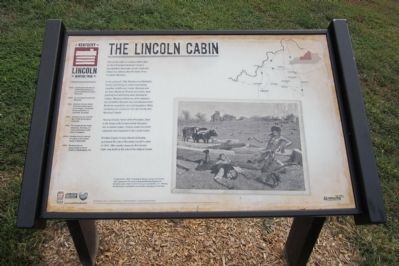
The Lincoln Cabin
Photographed by Bernard Fisher, August 17, 2011
1. The Lincoln Cabin Marker
In the spring of 1786, Abraham and Bersheba Lincoln were living on a farm overlooking Long Run in Jefferson County. Abraham and his sons, Mordecai, Thomas and Josiah, were planting corn when they were attacked by Indians. Mordecai killed one of the attackers but not before Abraham was mortally wounded. Bersheba moved her sons and daughters, Mary and Nancy, to a house on this site shortly after Abraham’s death.
Thomas Lincoln, father of the President, lived in the house until he was twenty-five years old. A cabinet maker, Thomas made the corner cupboard now displayed in the Lincoln Cabin.
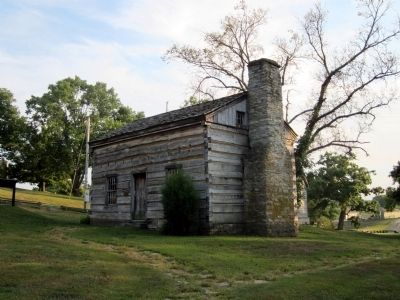
The Washington County Historical Society purchased the site of Bersheba Lincoln’s cabin in 1933. After careful research, the Lincoln Cabin was built on the site of the original house.
(sidebar)
Kentucky Lincoln Heritage Trail
1809 Abraham Lincoln born at Sinking Spring farm, in present-day Larue County, Kentucky.
1816 Lincoln family moved
this page online
1841 Abraham Lincoln visited his friend Joshua Speed at Farmington, the Speed family plantation, in Louisville, Kentucky.
1842 Abraham Lincoln married Mary Todd of Lexington, Kentucky.
1847 The Lincoln family visited Lexington, Kentucky, en route to Abraham’s only term in Congress.
1860 Abraham Lincoln elected President of the United States in November.
1865 Abraham Lincoln assassinated at Ford’s Theatre in Washington, D.C.
www.kylincolntrail.com www.heritage.ky.gov www.kylincolntrail.org www.history.ky.gov www.transportation.ky.gov
A project of the Kentucky Abraham Lincoln Bicentennial Commission produced by the Kentucky Heritage Council in partnership with the Kentucky Historical Society and the Kentucky Transportation Cabinet
Erected by Kentucky Abraham Lincoln Bicentennial Commission.
Topics and series. This historical marker is listed in this topic list: Notable Buildings. In addition, it is included in the Former U.S. Presidents: #16 Abraham Lincoln series list. A significant historical year for this entry is 1786.
Location. 37° 45.651′ N, 85° 12.894′ W. Marker is near Springfield, Kentucky,

Photographed by Bernard Fisher, August 17, 2011
2. The Lincoln Cabin Marker

Regionally, this marker is in Kentucky’s The Knobs. It is also in the American South and specifically in the Upper South. Globally, it is in North America, the Western Hemisphere, the Western World, and the Anglosphere. Historically, it finds itself in what was once the territory of the Mississippian Culture and also the Antebellum South.
Other nearby markers. At least 8 other markers are within walking distance of this marker: The Berry Cabin (here, next to this marker); The Lincolns Move West (a few steps from this marker); The Nancy Hanks Memorial (a few steps from this marker); Nancy Hanks and Thomas Lincoln (a few steps from this marker); The Marriage of Nancy & Thomas Lincoln (a few steps from this marker); a different marker also named Lincoln Cabin
Photographed by Bernard Fisher, August 17, 2011
3. The Lincoln Cabin (replica)
More about this marker. On the lower right: This illustration, titled “The killing of Abraham Lincoln, the Pioneer, 1786,” appeared in The Century Illustrated Monthly Magazine in November 1886. Drawn by Henry Farny and engraved by J. H. E. Whitney, the illustration is rendered in the dramatic style popular at the time.
Also see . . . Kentucky Lincoln Heritage Trail. (Submitted on August 21, 2011, by Bernard Fisher of Richmond, Virginia.)

Photographed by Allen C. Browne, February 16, 2015
4. Abraham Lincoln
This 1887 portrait of Abraham Lincoln by George P. A. Healy hangs in the National Portrait Gallery in Washington DC.
“Today Abraham Lincoln is universally regarded as one of our greatest presidents. But from the start of his administration, Lincoln, guiding the nation in a time of civil war, was beset with criticism from all sides. Some charged him with moral cowardice for initially insisting that an end to slavery was not one of his wartime goals; others accused him of overstepping his constitutional powers; still others blamed him for military reverses in the field. But as Union forces moved toward victory, Lincoln's eloquent articulation of the nation's ideals and his eventual call for an end to slavery gradually invested him with grandeur. following his assassination in 1865, that grandeur beca.me virtually unassailable.
The original version of this portrait was a template for artist George P. A. Healy's large painting The Peacemakers, depicting Lincoln in consultation with three of his main military advisers at the end of the Civil War. But Healy recognized that this made a fine portrait in its own right and eventually made three replicas, including this one.” — National Portrait Gallery
“Today Abraham Lincoln is universally regarded as one of our greatest presidents. But from the start of his administration, Lincoln, guiding the nation in a time of civil war, was beset with criticism from all sides. Some charged him with moral cowardice for initially insisting that an end to slavery was not one of his wartime goals; others accused him of overstepping his constitutional powers; still others blamed him for military reverses in the field. But as Union forces moved toward victory, Lincoln's eloquent articulation of the nation's ideals and his eventual call for an end to slavery gradually invested him with grandeur. following his assassination in 1865, that grandeur beca.me virtually unassailable.
The original version of this portrait was a template for artist George P. A. Healy's large painting The Peacemakers, depicting Lincoln in consultation with three of his main military advisers at the end of the Civil War. But Healy recognized that this made a fine portrait in its own right and eventually made three replicas, including this one.” — National Portrait Gallery
Credits. This page was last revised on June 28, 2023. It was originally submitted on August 21, 2011, by Bernard Fisher of Richmond, Virginia. This page has been viewed 1,207 times since then and 42 times this year. Photos: 1, 2, 3. submitted on August 21, 2011, by Bernard Fisher of Richmond, Virginia. 4. submitted on October 29, 2015, by Allen C. Browne of Silver Spring, Maryland.
