Near Shipman in Nelson County, Virginia — The American South (Mid-Atlantic)
Peter Cartwright
(1 Sept. 1785 – 25 Sept. 1872)
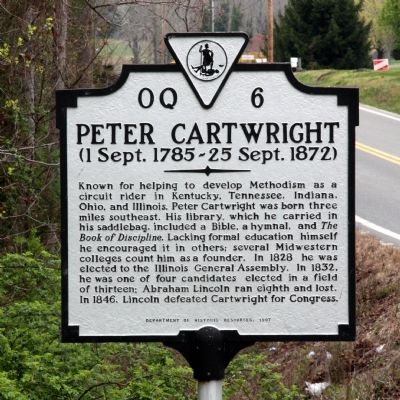
Photographed by J. J. Prats, April 9, 2011
1. Peter Cartwright Marker
Erected 1997 by Department of Historic Resources. (Marker Number OQ-6.)
Topics and series. This historical marker is listed in this topic list: Religion & Religious Structures. In addition, it is included in the Virginia Department of Historic Resources (DHR) series list. A significant historical year for this entry is 1828.
Location. 37° 43.153′ N, 78° 49.632′ W. Marker is near Shipman, Virginia, in Nelson County. It is at the intersection of James River Road (U.S. 56) and Findlay Mountain Road (County Route 647), on the right when traveling
this page online

Regionally, this marker is in the Piedmont and in Central Virginia. It is also in the American South and specifically in the Upper South. Globally, it is in North America, the Western Hemisphere, the Western World, and the Anglosphere. Historically, it finds itself in what was once the territory of the Mississippian Culture, one of the original Thirteen Colonies, one of the Confederate States of America, and the Antebellum South.
Other nearby markers. At least 8 other markers are within 4 miles of this marker, measured as the crow flies: Lovingston High School (approx. 3.6 miles away); Nelson Memorial Library (approx. 3.6 miles away); Nelson County Courthouse (approx. 3.6 miles away); Nelson County World War Memorial (approx. 3.6 miles away); Nelson County World War II Memorial (approx. 3.6 miles away); Confederate Memorial (approx. 3.6 miles away); Hurricane Camille Memorial (approx. 3.6 miles away); Lovingston (approx. 3.7 miles away).
Also see . . . Peter Cartwright, Revivalist.
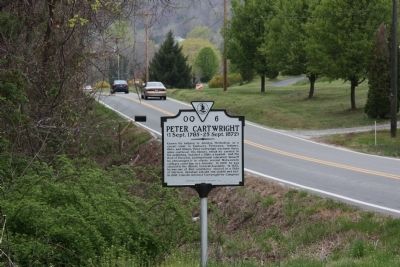
Photographed by J. J. Prats, April 9, 2011
2. Peter Cartwright Marker
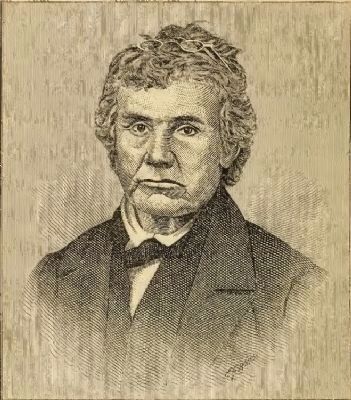
Wikimedia Commons Collection
3. Methodist Clergyman Peter Cartwright
Illustration in the 1897 book A Youth’s History of Kentucky for School and General Reading by Ed Porter Thompson.
Credits. This page was last revised on June 16, 2016. It was originally submitted on August 21, 2011, by J. J. Prats of Powell, Ohio. This page has been viewed 1,121 times since then and 46 times this year. Photos: 1, 2, 3. submitted on August 21, 2011, by J. J. Prats of Powell, Ohio.
