Midtown - Downtown in Columbia in Richland County, South Carolina — The American South (South Atlantic)
Howard School Site
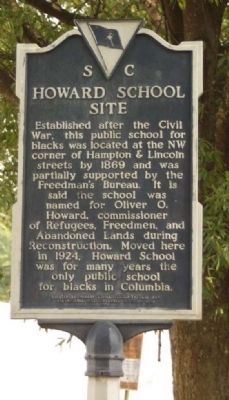
Photographed by Mike Stroud, 2011
1. Howard School Site Marker
Erected 1988 by The Howard School Community Club and the Arsenal Hill Concerned Citizens Club. (Marker Number 40-111.)
Topics and series. This historical marker is listed in these topic lists: African Americans • Education. In addition, it is included in the Historically Black Colleges and Universities, and the South Carolina Historical Markers series lists. A significant historical year for this entry is 1869.
Location. 34° 0.31′ N, 81° 3′ W. Marker is in Columbia, South Carolina, in Richland County. It is in Midtown - Downtown. It is on Laurel Street near Williams Street, on the left when traveling west. Touch for map. Marker is in this post office area: Columbia SC 29201, United States of America. Touch for directions.

Regionally, this marker is in the Midlands. It is also in the American South and specifically in the Deep South. Globally, it is in North America, the Western Hemisphere, the Western World, and the Anglosphere. Historically, it finds itself in what was once the territory of the Mississippian Culture, one of the original Thirteen Colonies, one of the Confederate States of America, and the Antebellum South.
Other nearby markers. At least 8 other markers are within walking distance of this marker: The Allie Scollon Puppetry Center (within shouting distance of this marker); Historic Columbia Canal (about 700 feet away, measured in a direct line); In Memory of the Irish Who Built the Canal
this page online
Regarding Howard School Site. Oliver Otis Howard
Known as the "Christian general" because he tried to base his policy decisions on his deep religious piety, he was given charge of the Freedmen's Bureau in mid 1865, with the mission of integrating the freed slaves into Southern society and politics during the second phase of the Reconstruction Era. Howard took charge of labor policy, setting up a system that required free slaves to work on former plantation land under pay scales fixed by the Bureau, on terms negotiated by the Bureau with white land owners. Howard's Bureau was primarily responsible for the legal affairs of the Freedmen. He attempted to protect the negros from hostile conditions, but lacked adequate power, and was repeatedly frustrated by President Andrew Johnson. Howard's allies, the Radical Republicans,
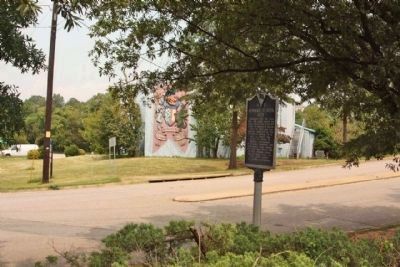
Photographed by Mike Stroud, August 21, 2011
2. Howard School Site and Marker here on Laurel Street
Also see . . .
1. The Freedmen's Bureau, Wikipedia entry. The Bureau was part of the United States Department of War. Headed by Union Army General Oliver O. Howard, the Bureau was operational from 1865 to 1871. It was disbanded under President Ulysses S. Grant. (Submitted on August 21, 2011, by Mike Stroud of Bluffton, South Carolina.)
2. Oliver Otis Howard. November 8, 1830 – October 26, 1909 was a career United States Army officer and a Union general in the American Civil War. He was a corps commander noted for suffering two humiliating defeats, at Chancellorsville and Gettysburg, but he recovered from the setbacks while
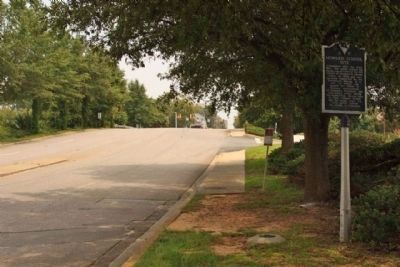
Photographed by Mike Stroud, August 21, 2011
3. Howard School Site Marker, looking eastward on Laurel Street
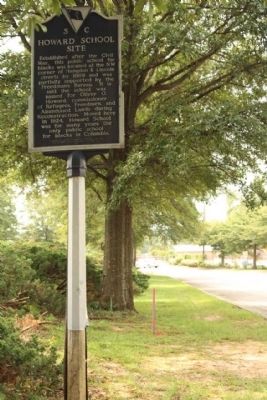
Photographed by Mike Stroud, August 21, 2011
4. Howard School Site Marker, looking west
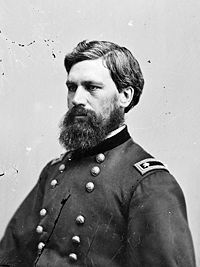
M. Brady; Library of Congress, Prints and Photographs Division, Brady-Handy Collection
5. Gen. O.O.Howard , USA
Credits. This page was last revised on February 16, 2023. It was originally submitted on August 21, 2011, by Mike Stroud of Bluffton, South Carolina. This page has been viewed 1,164 times since then and 53 times this year. Photos: 1, 2, 3, 4. submitted on August 23, 2011, by Mike Stroud of Bluffton, South Carolina. 5. submitted on August 24, 2011, by Mike Stroud of Bluffton, South Carolina.
