Capitol District in Richmond, Virginia — The American South (Mid-Atlantic)
Edgar Allen Poe
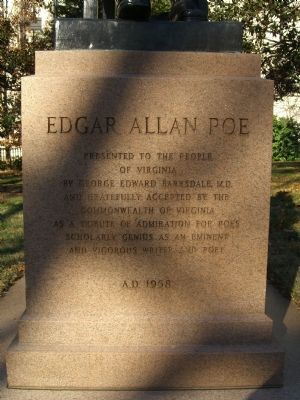
Photographed by Kevin W., January 3, 2008
1. Edgar Allen Poe Marker
Erected 1958 by George Edward Barksdale, M.D.
Topics. This historical marker is listed in this topic list: Arts, Letters, Music.
Location. 37° 32.367′ N, 77° 26.089′ W. Marker is in Richmond, Virginia. It is in the Capitol District. It can be reached from Capitol Street. Marker is located in Capitol Square. Touch for map. Marker is in this post office area: Richmond VA 23219, United States of America. Touch for directions.

Regionally, this marker is in Central Virginia. It is also in the American South and specifically in the Upper South. Globally, it is in North America, the Western Hemisphere, the Western World, and the Anglosphere. Historically,
this page online
Other nearby markers. At least 8 other markers are within walking distance of this marker: Voices from the Garden (within shouting distance of this marker); a different marker also named Voices from the Garden (within shouting distance of this marker); Zero Milestone (within shouting distance of this marker); Mantle (within shouting distance of this marker); The Bell Tower (within shouting distance of this marker); George Washington Monument (within shouting distance of this marker); Inauguration of Davis (within shouting distance of this marker); Anna Maria Lane (about 300 feet away, measured in a direct line). Touch for a list and map of all markers in Richmond.
Other markers no longer nearby. The Bell Tower (was within shouting distance of this
Photographed by J. J. Prats, June 4, 2008
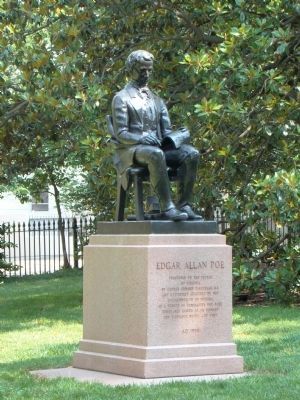
2. Edgar Allen Poe Monument
Bronze by Charles Rudy (1904–1986) is approx 5¼ feet high on a 3¾ foot high base.
More about this marker. Charles Rudy created this sculpture in 1957, and cast it at the Modern Art Foundry of New York. It features a seated portrait of Edgar Allan Poe holding a writing tablet in his proper left hand and a pen in his proper right hand. Three books are piled beneath his chair. The sculpture rests on a square granite base. The bronze sculpture stands approximately five feet tall on a four foot pink granite base.
The sculpture, which cost $9,500, was a gift of retired Richmond physician and Poe admirer, Dr. George Edward Barksdale, who wanted the city's visitors to remember Edgar Allan Poe's connection to Richmond. Although Poe was born in Boston, he was adopted by a Richmond family when he was three and raised in Richmond, later attending
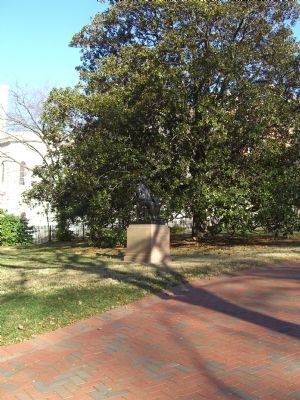
Photographed by Kevin W., January 3, 2008
3. Edgar Allen Poe Marker
Photographed by Allen C. Browne, February 16, 2015
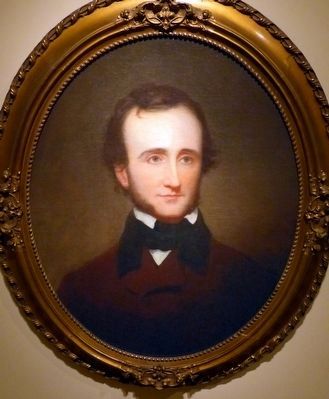
4. Edgar Allen Poe
This 1845 portrait of Edgar Allan Poe by Samuel Stillman Osgood hangs in the National Portrait Gallery in Washington, DC.
“Edgar Allan Poe is popularly known for his poem ‘The Raven’ (1844), and like the raven itself, Poe was a dark presence amid the optimism of early American culture. Not for him was the glorification of the individual or the celebration of nature as life-giving. Poe peeled back the underside of America to sketch a world in which nothing, especially human motivation, was transparent, predictable, or even knowable. In their dark, hallucinatory imagery, Poe's writings profoundly influenced such European poets as Baudelaire and Rimbaud. In America, his voice is still singular for the strength with which it spoke against the spirit of the Romantic age in which he lived. Poe's great subject was death, and he seemed to court it in his life as well as art, dying early after proving himself unable to function in the society he dissected so remorselessly.” — National Portrait Gallery
“Edgar Allan Poe is popularly known for his poem ‘The Raven’ (1844), and like the raven itself, Poe was a dark presence amid the optimism of early American culture. Not for him was the glorification of the individual or the celebration of nature as life-giving. Poe peeled back the underside of America to sketch a world in which nothing, especially human motivation, was transparent, predictable, or even knowable. In their dark, hallucinatory imagery, Poe's writings profoundly influenced such European poets as Baudelaire and Rimbaud. In America, his voice is still singular for the strength with which it spoke against the spirit of the Romantic age in which he lived. Poe's great subject was death, and he seemed to court it in his life as well as art, dying early after proving himself unable to function in the society he dissected so remorselessly.” — National Portrait Gallery
Photographed by Kevin W., January 3, 2008
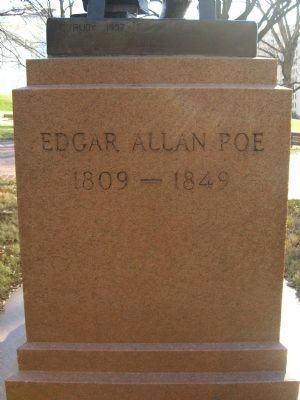
5. Back of the Edgar Allen Poe Marker
1809 - 1849
Credits. This page was last revised on February 1, 2023. It was originally submitted on January 9, 2008, by Kevin W. of Stafford, Virginia. This page has been viewed 2,425 times since then and 49 times this year. Photos: 1. submitted on January 9, 2008, by Kevin W. of Stafford, Virginia. 2. submitted on June 5, 2008, by J. J. Prats of Powell, Ohio. 3. submitted on January 9, 2008, by Kevin W. of Stafford, Virginia. 4. submitted on November 5, 2015, by Allen C. Browne of Silver Spring, Maryland. 5. submitted on January 9, 2008, by Kevin W. of Stafford, Virginia.
