Historic District in St. Augustine in St. Johns County, Florida — The American South (South Atlantic)
Fort Marion
Photographed by Craig Swain, August 2, 2011
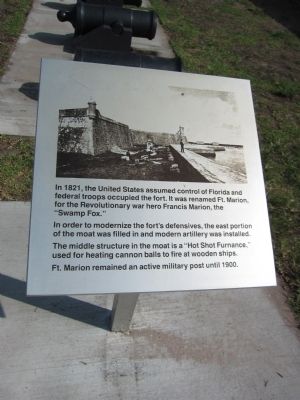
1. Fort Marion Marker
In order to modernize the fort's defensives, the east portion of the moat was filled in and modern artillery was installed.
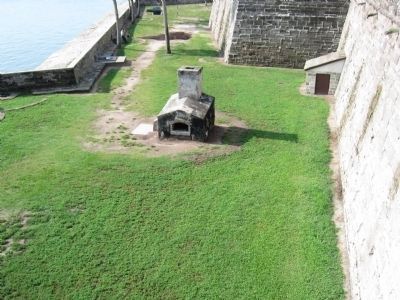
The middle structure in the moat is a "Hot Shot Furnace," used for heating cannon balls to fire at wooden ships.
Ft. Marion remained an active military post until 1900.
Topics. This historical marker is listed in this topic list: Forts and Castles. A significant historical year for this entry is 1821.
Location. 29° 53.835′ N, 81° 18.652′ W. Marker is in St. Augustine, Florida, in St. Johns County. It is in the Historic District. It can be reached from South Castillo Drive (State Road A1A), on the right when traveling north. Located outside the Castillo de San Marcos. Touch for map. Marker is at or near this postal address: 11 S Castillo Dr, Saint Augustine FL 32084, United States of America. Touch for directions.

Regionally, this marker is in First Coast and in Greater Jacksonville. It is also in the American South and
this page online
Other nearby markers. At least 8 other markers are within walking distance of this marker: Weapons of War / Artillería (here, next to this marker); Multi-Use Moat / ¿Un foso sin agua? (a few steps from this marker); Spanish Stronghold / Ciudadela española (within shouting distance of this marker); Sentry Box (within shouting distance of this marker); Covered Way (within shouting distance of this marker); Crumbling Coquina / Piedra frágil (within shouting distance of this marker); Guarding the Back Door / Vigilando dos entradas (within shouting distance of this marker); Fortress Facelift / Nuevo dueño, obras nuevas (within shouting distance of this marker). Touch for a list and map of all markers in St. Augustine.
Also see . . . Castillo de San Marcos National Monument. NPS
Photographed by Craig Swain, August 2, 2011
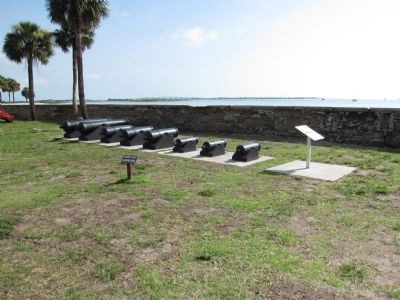
2. Fort Marion Marker and Howitzers
Lined up beside the marker are three 24-pounder field howitzers, three 8-inch siege howitzers, and two 8-inch seacoast howitzers.
Photographed by Craig Swain, August 2, 2011
3. Pintle and Hot Shot Furnace
A pintle and platform remain along the seawall in front of the hot shot furnace on the bay side of the fort.
Photographed by Craig Swain, August 2, 2011
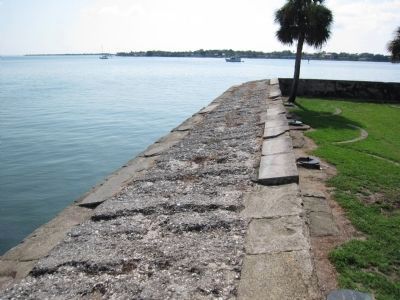
4. Gun Carriage Positions
The pintles and stone arcs remain on the northeast side of the fort.
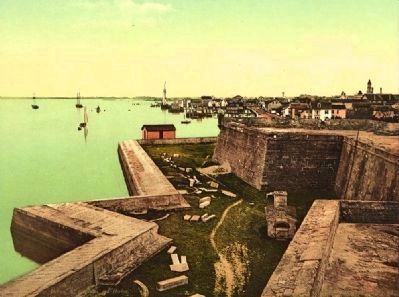
Postcard by the Detroit Photographic Company, circa 1898
5. Fort Marion, St. Augustine and harbor
The hot shot furnace visible in Photo #3 above is also visible here in the center lower right of the photograph.
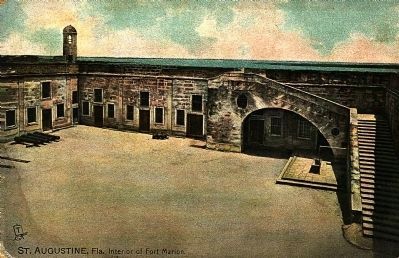
Postcard by Tuck & Sons', circa 1908
6. St. Augustine, FLA., Interior of Fort Marion
Credits. This page was last revised on January 2, 2019. It was originally submitted on August 26, 2011, by Craig Swain of Leesburg, Virginia. This page has been viewed 1,218 times since then and 62 times this year. Photos: 1, 2, 3, 4. submitted on August 26, 2011, by Craig Swain of Leesburg, Virginia. 5, 6. submitted on December 12, 2014.
