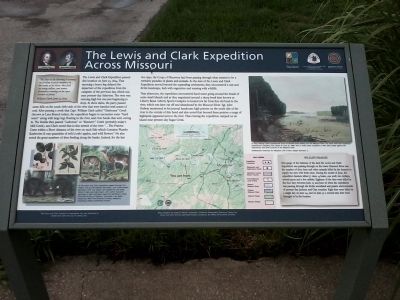
The Lewis and Clark Expedition Across Missouri
William Clark, June 25, 1804.
The Lewis and Clark Expedition passed this location on June 25, 1804. That morning a heavy fog delayed the departure of the expedition from the campsite of the previous day, which was near present-day Atherton. The river was running high but was just beginning to drop. At three miles, the party passed some hills on the south (left) side of the river that were banded with seams of coal. After passing a creek that Capt. William Clark called “Chabonea” Creek (known as Lazy Branch today), the expedition began to encounter some “hard water” along with large logs floating in the river, and river banks that were caving in. The Flotilla then passed “Labeenie” or “Bennet’s Creek (probably today’s Mill Creek), and Clark noted that in the stretch of the river “…The Prairies Come within a Short distance of the river on each Side which Contains Plumbs Rasberries & vast
this page online
That afternoon, the expedition encountered hard water going around the heads of some small islands and as they negotiated around a sharp bend later known as Liberty Bend. Liberty Sports Complex is located not far from this old bend in the river, which was later cut off and abandoned by the Missouri River. Sgt. John Ordway mentioned in his journal handsome high prairies on the south side of the river in the vicinity of this bend and also noted that beyond these prairies a range of highlands appeared next to the river. That evening the expedition camped on an island near present-day Sugar Creek.
As the Lewis and Clark Expedition passed through this region, the journal keepers described a lush
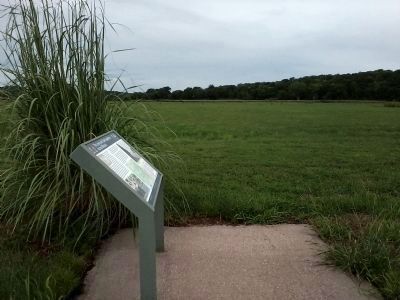
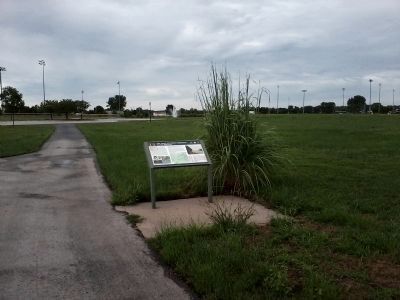
The Lewis and Clark Expedition interpretive sign was produced in cooperation with the City of Liberty, Mo.
Map prepared by James D. Harlan, University of Missouri Geographic Resources Center, for Lewis and Clark Historic Landscape Project, funded by the Office of Secretary of State.
In 1832, George Catlin painted this scene of alluvial banks falling into the Missouri River. The Lewis and Clark Expedition experienced collapsing river banks on June 25, 1804, and on many other occasions in their daily battle against the treacherous and swift currents of the Missouri River. Smithsonian American Art Museum, Gift of Mrs. Joseph Harrison, Jr.
Wildlife Paradise
One gauge of the lushness of the land the Lewis and Clark Expedition was passing through on the lower Missouri River was the number of deer, bear and other animals
Missouri Department of Natural Resources.
Lewis and Clark National Historic Trail
National Park Service
U.S. Department of Interior.
Missouri Lewis and Clark Bicentennial Commission.
Erected by Missouri Department of Natural Resources; National Park Service; Missouri Lewis and Clark Bicentennial Commission; The City of Liberty, Missouri.
Topics and series. This historical marker is listed in this topic list: Exploration. In addition, it is included in the Lewis & Clark Expedition series list. A significant historical date for this entry is June 25, 1900.
Location. 39° 12.343′ N, 94° 22.998′ W. Marker is in Liberty, Missouri,

Regionally, this marker is in the Missouri River Corridor and in Greater Kansas City. It is also in the American Midwest, in the Lewis & Clark Corridor, and in the Corn Belt. Globally, it is in North America, the Western Hemisphere, the Western World, and the Anglosphere. Historically, it finds itself in what was once the territory of the Mississippian Culture, the Louisiana Purchase, and the Antebellum South.
Other nearby markers. At least 8 other markers are within 4 miles of this marker, measured as the crow flies: World War II POW Camp (within shouting distance of this marker); The Liberty Landing (within shouting distance of this marker); Liberty Arsenal (approx. 1.1 miles away); Ruth Ewing (approx. 1.3 miles away); Battle of Liberty / Blue Mills Landing (approx. 1½ miles away); Ruth Stocksdale Park (approx. 1.9 miles away); Martha Lafite Thompson Nature Sanctuary (approx. 3.1 miles away); The Liberty Spring (approx. 3.2 miles away). Touch for a list and map of all markers in Liberty.
Credits. This page was last revised on June 16, 2016. It was originally submitted on August 21, 2011, by Tony Meyers of Liberty, Missouri. This page has been viewed 1,588 times since then and 92 times this year. Last updated on August 31, 2011, by Tony Meyers of Liberty, Missouri. Photos: 1, 2, 3. submitted on August 21, 2011, by Tony Meyers of Liberty, Missouri. • Bill Pfingsten was the editor who published this page.
