St. Augustine in St. Johns County, Florida — The American South (South Atlantic)
Slave Market
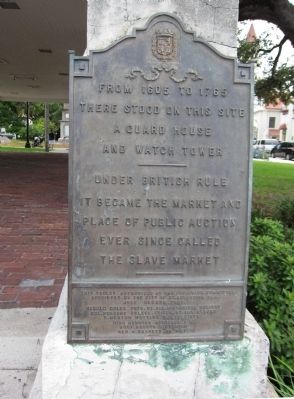
Photographed by Craig Swain, August 1, 2011
1. Slave Market Marker
there stood on this site
a guard house
and watch tower
Under British rule
it became the market and
place of public auction
ever since called
the slave market
Harold Colee Pres. St. Aug. Historical Society
Col. Herbert Felkel, editor, St. Aug. Record
C. Morton Matting, M.D., Tourists
Nina Hawking, Member D.A.R.
Robt. Ranson, historian
Geo. W. Babbett, Jr., Mayor.
Topics and series. This historical marker is listed in these topic lists: African Americans • Industry & Commerce. In addition, it is included in the Daughters of the American Revolution (DAR) series list. A significant historical year for this entry is 1605.
Location. 29° 53.555′ N, 81° 18.691′ W. Marker is in St. Augustine, Florida, in St. Johns County. It is at the intersection of Cathedral Plaza and Charlotte Street, on the left when traveling west on Cathedral Plaza. Located in the Plaza de la Constitucion. Touch for map. Marker is in this post office area: Saint Augustine FL 32084, United States of America. Touch for directions.

Regionally,
this page online
Other nearby markers. At least 8 other markers are within walking distance of this marker: Juan Ponce de Leon (a few steps from this marker); The St. Augustine Foot Soldiers Monument (a few steps from this marker); Public Market Place (a few steps from this marker); World War II Memorial (within shouting distance of this marker); St. Augustine Foot Soldiers (within shouting distance of this marker); Juan Ponce De Leon (within shouting distance of this marker); Public Well (within shouting distance of this marker); St. Augustine First World War Memorial (within shouting distance of this marker). Touch for a list and map of all markers in St. Augustine.

Photographed by Craig Swain
2. Reconstructed Market and Marker
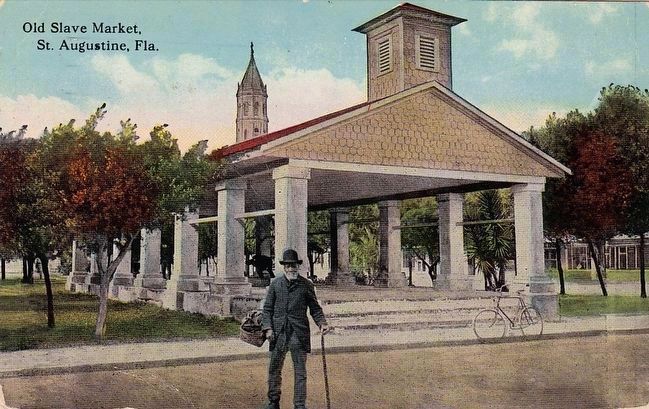
Photographed by W.J. Harris, circa 1920
3. Old Slave Market, St. Augustine, Fla.
The largest promotion of St. Augustine's public market as a "Slave Market" came when the famous photographer W.J. Harris depicted it on this mass-produced post card...'The caption on the back says, "OLD SLAVE MARKET
ST. AUGUSTINE, FLA." The old market in the east end of the Plaza is an interesting landmark of antebellum days.
Old slave in foreground.'...Not only was Harris interested in selling his post cards, he was also the business manager for St. Augustine's historical society. He embodied the Ancient City's struggle between historical accuracy and economic survival. Harris' biggest adversary was Charles B. Reynolds, who published an article in Mr. Foster's Travel Magazine in 1921 refuting Duffus, Harris, and all of the historical embellishing that went on in St. Augustine. Harris defended himself and the historical society by saying Reynolds was bad for the town's economic backbone, tourism. Nevertheless, Harris eventually distributed a revised version of the Slave Market post card. The newer version reads, 'OLD SLAVE MARKET ST. AUGUSTINE, FLA., The old slave market in the east end of the Plaza is an interesting landmark of antebellum days. Built in 1840 for a public market. Called "slave market" by an enterprising photographer to make his pictures sell.' -- Augustine.com
Note that this postcard was sold by multiple publishers, not only with variations in both the front and back text (as noted above) but also with variations in coloring (as would be expected from hand-colored postcard images) and cropping. Other postcard publishers, when depicting the market, simply called the structure the "Old Market" or "Spanish Market".
Note that this postcard was sold by multiple publishers, not only with variations in both the front and back text (as noted above) but also with variations in coloring (as would be expected from hand-colored postcard images) and cropping. Other postcard publishers, when depicting the market, simply called the structure the "Old Market" or "Spanish Market".
Credits. This page was last revised on January 2, 2019. It was originally submitted on September 3, 2011, by Craig Swain of Leesburg, Virginia. This page has been viewed 2,318 times since then and 96 times this year. Photos: 1, 2. submitted on September 3, 2011, by Craig Swain of Leesburg, Virginia. 3. submitted on September 17, 2015.
