Orange in Orange County, Virginia — The American South (Mid-Atlantic)
Town of Orange
Confederate Hardships
| — | Lee vs. Grant - The 1864 Campaign | — |
Photographed by Craig Swain, January 5, 2008
1. Town of Orange Marker
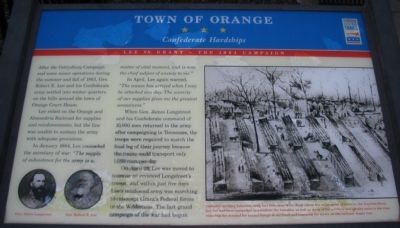
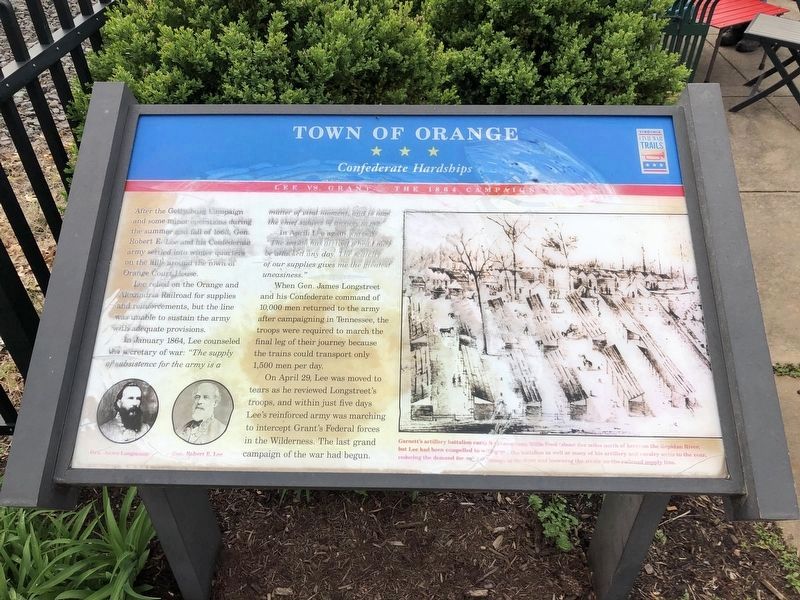
After the Gettysburg campaign and some minor operations during the summer and fall of 1863, Gen. Robert E. Lee and his Confederate army settled into winter quarters on the hills around the town of Orange Court House.
Lee relied on the Orange and Alexandria Railroad for supplies and reinforcements, but the line was unable to sustain the army with adequate provisions.
In January 1864, Lee counseled the secretary of war: "The supply of subsistence for the army is a matter of vital moment, and is now the chief subject of anxiety to me."
In April, Lee again warned, "The season has arrived when I may be attacked any day. The scarcity of our supplies gives me the greatest uneasiness."
When Gen. James Longstreet and his Confederate command of 10,000 men returned to the army after campaigning in Tennessee, the troops were required to march the final leg of their journey because the trains could transport only 1,500 men per day.
On April 28, Lee was moved to tears as he reviewed Longstreet's troops, and within just five days Lee's reinforced army was marching to intercept Grant's Federal forces in the Wilderness.
this page online
(captions)
Gen. James Longstreet • Gen. Robert E. Lee
Garnett's artillery battalion camp had been near Willis Ford (about five miles north of here) at the Rapidan River, but Lee had been compelled to withdraw the battalion as well as many artillery and cavalry units to the rear, reducing the demand for animal forage at the front and lessening the strain on the railroad supply line.
Erected by Virginia Civil War Trails.
Topics and series. This historical marker is listed in this topic list: War, US Civil. In addition, it is included in the Virginia Civil War Trails series list. A significant historical month for this entry is January 1864.
Location. This marker has been replaced by another marker nearby. It was located near 38° 14.69′ N, 78° 6.593′ W. Marker was in Orange, Virginia, in Orange County. It was on Short Street south of East Main Street, on the right when traveling south. Located at the entrance to the Orange Visitors Center, which is the old train station. Touch for map. Marker was at or near this postal address: 122 E Main St, Orange VA 22960, United States of America.
Photographed by Devry Becker Jones (CC0), April 9, 2021
2. Town of Orange Marker
Unfortunately, the marker has significantly weathered and is partially illegible.

Regionally, this marker was in Northern Virginia and in the Piedmont. It was also in the American South and specifically in the Upper South. Globally, it was in North America, the Western Hemisphere, the Western World, and the Anglosphere. Historically, it found itself in what was once the territory of the Mississippian Culture, one of the original Thirteen Colonies, one of the Confederate States of America, and the Antebellum South.
Other nearby markers. At least 8 other markers are within walking distance of this location: Battle of Orange Court House (here, next to this marker); Historic Downtown Orange (a few steps from this marker); Welcome to… The Town of Orange (a few steps from this marker); The Orange Railroad Depot (a few steps from this marker); Orange County Visitor Center (within shouting distance of this marker); Orange Train Station (within shouting distance of this marker); Crosthwaite Alley (within shouting distance of this marker); Railroad Avenue and Beyond (about 300 feet away, measured in a direct line). Touch for a list and map of all markers in Orange.
Related marker.
Photographed by Craig Swain, January 5, 2008
3. Town of Orange Marker next to the Old Train Station
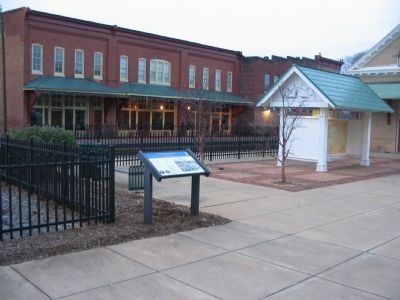
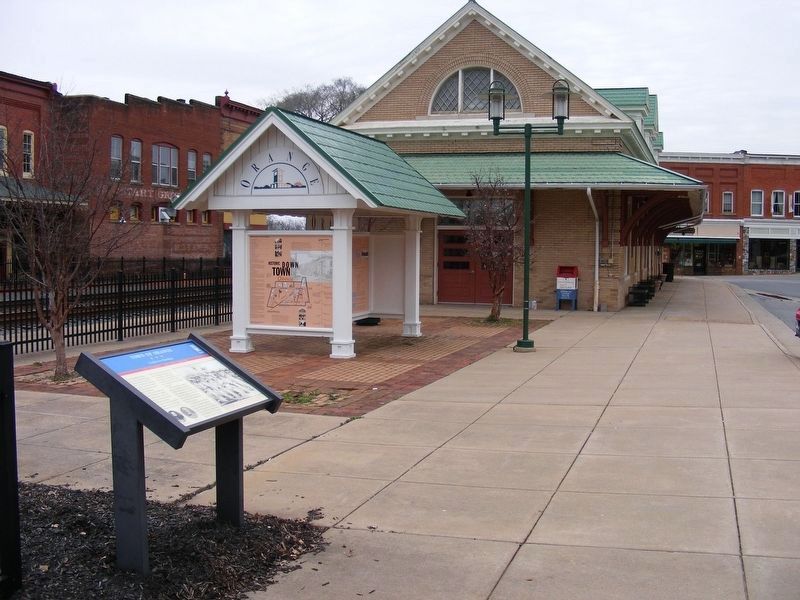
The depot here was a busy location as the terminus of the Confederate supply line. Personnel, munitions, horses, mules, and other supplies arrived here from Richmond, Charlottesville, and points south on the rail lines.
Also see . . .
1. Orange, Virginia. Wikipedia entry (Submitted on July 23, 2024, by Larry Gertner of New York, New York.)
2. St. Thomas's Episcopal Church. Diocese of Virginia website entry (Submitted on July 23, 2024, by Larry Gertner of New York, New York.)
Photographed by Pete Payette, March 2, 2012
4. Town of Orange Marker
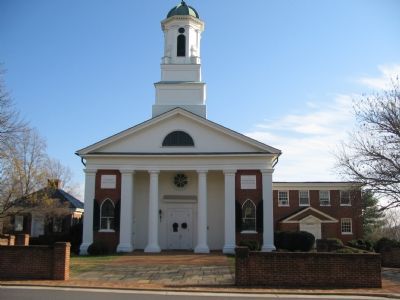
Photographed by Craig Swain, January 12, 2008
5. St. Thomas Episcopal Church
During his stay in the winter of 1863-64, General Lee frequented this church in downtown Orange. The pew he used is indicated. The church is on the National Register, and tours are available.
Credits. This page was last revised on December 7, 2025. It was originally submitted on January 13, 2008, by Craig Swain of Leesburg, Virginia. This page has been viewed 2,491 times since then and 193 times this year. Last updated on December 6, 2025, by Mike McKeown of Baltimore, Maryland. Photos: 1. submitted on January 13, 2008, by Craig Swain of Leesburg, Virginia. 2. submitted on April 11, 2021, by Devry Becker Jones of Washington, District of Columbia. 3. submitted on January 13, 2008, by Craig Swain of Leesburg, Virginia. 4. submitted on May 2, 2017, by Pete Payette of Orange, Virginia. 5. submitted on January 13, 2008, by Craig Swain of Leesburg, Virginia. • Bernard Fisher was the editor who published this page.
