Community Settlement
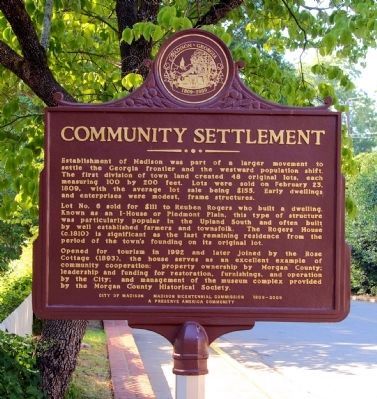
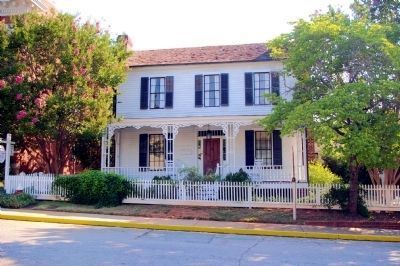
Lot No. 6 sold for $111 to Reuben Rogers who built a dwelling. Known as an I-House or Piedmont Plain, this type of structure was particularly popular in the Upland South and often built by well established farmers and townsfolk. The Rogers House (c.1810) is significant as the last remaining residence from the period of the town’s original founding on its original lot.
Opened for tourism in 1992 and later joined by the Rose Cottage (1893), the house serves as an excellent example of community cooperation: property ownership by Morgan County; leadership and funding for restoration, furnishings, and operation by the City; and management of the museum complex provided by the Morgan County Historical Society.
Erected 2011 by City of Madison, Madison Bicentennial Commission
this page online
Topics. This historical marker is listed in this topic list: Settlements & Settlers. A significant historical date for this entry is February 23, 1809.
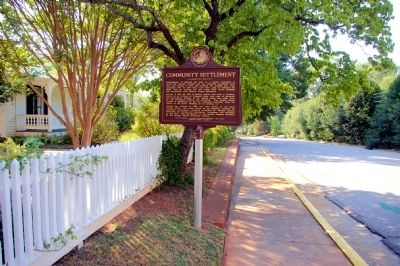
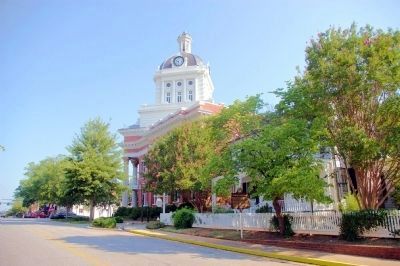
Location. 33° 35.717′ N, 83° 27.967′ W. Marker is in Madison, Georgia, in Morgan County. It is on East Jefferson Street 0 miles east of Hancock Street, on the right when traveling west. Touch for map. Marker is at or near this postal address: 179 East Jefferson Street, Madison GA 30650, United States of America. Touch for directions.

Regionally, this marker is in the Antebellum Trail and in the Piedmont. It is also in the American South and specifically in the Deep South. Globally, it is in North America, the Western Hemisphere, the Western World, and the Anglosphere. Historically, it finds itself in what was once the territory of the Mississippian Culture, one of the original Thirteen Colonies, one of the Confederate States of America, and the Antebellum South.
Other nearby markers. At least 8 other markers are within walking distance of this marker: Morgan County Veterans Memorial Walk (within shouting distance of this marker); Morgan County (within shouting distance of
Credits. This page was last revised on June 16, 2016. It was originally submitted on September 22, 2011, by David Seibert of Sandy Springs, Georgia. This page has been viewed 1,131 times since then and 43 times this year. Photos: 1, 2, 3, 4. submitted on September 22, 2011, by David Seibert of Sandy Springs, Georgia. • Bill Pfingsten was the editor who published this page.
