Paducah in McCracken County, Kentucky — The American South (East South Central)
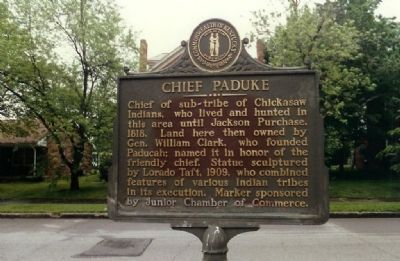
Chief Paduke
Photographed by Michael Stroud, circa June 1991
1. Chief Paduke Marker
The Jackson Purchase is a region in the state of Kentucky bounded by the Mississippi River to the west, the Ohio River to the north, and Tennessee River to the east.
Erected by Paducah Junior Chamber of Commerce. (Marker Number 793.)
Topics and series. This historical marker is listed in these topic lists: Government & Politics • Indigenous Peoples and Communities • Settlements & Settlers. In addition, it is included in the Kentucky Historical Society series list. A significant historical year for this entry is 1818.
Location. 37° 4.734′ N, 88° 37.243′ W. Marker is in Paducah, Kentucky, in McCracken County. It is on Jefferson Street near North 19th Street, in the median. Touch for map. Marker is in this post office area: Paducah KY 42001, United States of America. Touch for directions.

Regionally, this marker is in the Jackson Purchase. It is also in the American Midwest, in the South, in the Upper South, and in the Ohio River Valley. Globally, it is in North
this page online
Other nearby markers. At least 8 other markers are within walking distance of this marker: Linn Boyd Home — 1853 (about 700 feet away, measured in a direct line); Fountain Avenue United Methodist Church (approx. 0.2 miles away); Gen. Lloyd Tilghman (approx. 0.2 miles away); St. Paul Lutheran Church (approx. 0.2 miles away); Otis Dinning Drive (approx. ¼ mile away); Oscar Turner (approx. 0.4 miles away); Forrest's Headquarters (approx. 0.4 miles away); Patriot Burials (approx. half a mile away). Touch for a list and map of all markers in Paducah.
Another marker is no longer nearby. Dr. Reuben Saunders (1808-1891) (was approx. half a mile away but has been confirmed missing).
Also see . . .
1. Wikipedia entry for Paducah, Kentucky. (Submitted on January 16, 2008, by Mike Stroud of Bluffton, South Carolina.)
2. Wikipedia entry for Jackson Purchase. (Submitted on January 16, 2008, by Mike Stroud of Bluffton, South Carolina.)
Additional commentary.
1.
May 29, 2006
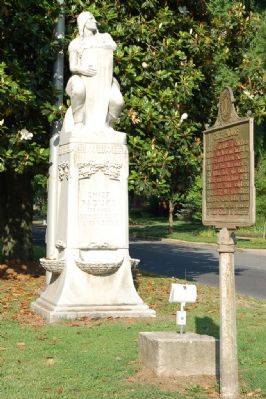
2. Chief Paduke Marker
Paducah is located on the Ohio River below the mouth of the Tennessee River. Paducah boasts more historic markers than any other city in Kentucky. Landmarks include the legendary Chief Paduke statue, 19th & Jefferson; Wacinton carved Indian statue, Noble Park; Steam Locomotive No. 1518, downtown; and the Rev. Martin Luther King, Jr. monument.
Union General U. S. Grant occupied Paducah on September 6, 1861, building a pontoon bridge across the Ohio River to the Illinois shore. Fort Anderson was built and named after Kentuckian and Fort Sumter commander Major Robert Anderson. Attacked March 25 and April 14, 1964, the fort was successfully defended by both white and black troops commanded by Colonel Stephen G. Hicks of Illinois. In the spring of 1864, African Americans were recruited in Kentucky for federal service in the "United States Colored Volunteers." The 8th Colored artillery (Heavy) was raised almost exclusively in Paducah as were elements of five other black regiments.
The organizer of the American Red Cross, Clara Barton, came to Paducah March 13, 1884, on the steamboat "Josh V. Throop" to help direct relief work during
Photographed by Michael Stroud, circa June 1991
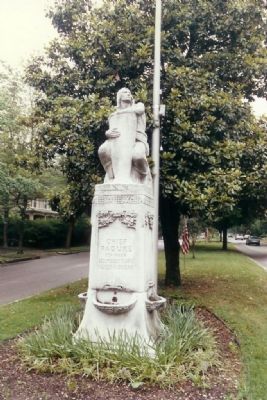
3. Monument to Chief Paduke
Chief Paduke
for whom Gen. William Clark
named Paducah
— Submitted January 16, 2008, by Mike Stroud of Bluffton, South Carolina.
2. The adjacent sculpture of Chief Paduke
The adjacent sculpture, titled "Chief Paduke," was sculpted by Lorado Taft and dedicated May 19, 1909. It was relocated to this site on June 3, 1937. Made from Georgia marble, it stands five feet tall on a seven foot tall stone base.
The sculpture commemorates Chief Paduke, for whom the city was named. It was commissioned by the Paducah Chapter of the Daughters of the American Revolution for $3,000, at the suggestion of the Paducah chapter's regent, Mrs. E. G. Boone. Chief Paduke was reported to be either from a Chickasaw tribe or a Comanche tribe. The sculpture was originally titled "Paducah Fountain" and was originally placed on the northwest corner of Broadway and 5th Street, in front of the Paducah Post Office (which might have also been called the Custom House), but was moved after the Ohio Valley Flood of June 1937.
Source: Smithsonian Institution Research Information System
— Submitted January 16, 2008, by Kevin W. of Stafford, Virginia.
Photographed by Michael Stroud, circa June 1991
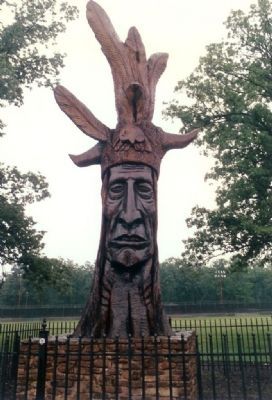
4. Nearby Hand-Chiseled Artwork
Hand chiseled in 1985 from a local 56,000 pound Red Oak to honor the Chickasaw Indians who lived and hunted in this area until the Jackson Purchase, 1818. Chief Paduke was a Chickasaw Indian.
Click for more information.
Click for more information.
Credits. This page was last revised on February 12, 2026. It was originally submitted on January 16, 2008, by Mike Stroud of Bluffton, South Carolina. This page has been viewed 7,990 times since then and 174 times this year. Photos: 1. submitted on January 16, 2008, by Mike Stroud of Bluffton, South Carolina. 2. submitted on January 16, 2008, by Kevin W. of Stafford, Virginia. 3, 4. submitted on January 16, 2008, by Mike Stroud of Bluffton, South Carolina. • Kevin W. was the editor who published this page.
