Celio in Roma in Città metropolitana di Roma Capitale, Latium, Rome, Italy — Central Italy (Tyrrhenian Coast)
Arch of Constantine
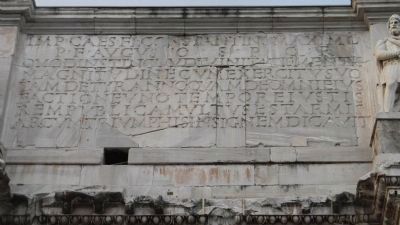
Photographed by Richard E. Miller, May 31, 2011
1. Arch of Constantine Marker
IMP • CAES • FL • CONSTANTINO • MAXIMO • P • F • AVGUSTO • S • P • Q • R • QVOD • INSTINCTV • DIVINITATIS • MENTIS • MAGNITVDINE • CVM • EXERCITV • SVO • TAM • DE • TYRANNO • QVAM • DE • OMNI • EIVS • FACTIONE • VNO • TEMPORE • IVSTIS • REM-PVBLICAM • VLTVS • EST • ARMIS • ARCVM • TRIVMPHIS • INSIGNEM • DICAVIT
[English trans.:]
To the Emperor Caesar Flavius Constantinus, the greatest, pious, and blessed Augustus: because he, inspired by the divine, and by the greatness of his mind, has delivered the state from the tyrant and all of his followers at the same time, with his army and just force of arms, the Senate and People of Rome have dedicated this arch, decorated with triumphs.
Erected 315AD
Erected by The Senate and People of Rome.
Topics. This historical marker is listed in this topic list: Government & Politics.
Location. 41° 53.383′ N, 12° 29.45′ E. Marker is in Roma, Lazio (Latium, Rome), in Città metropolitana di Roma Capitale. It is in Celio. It is on Piazza del Colosseo 0.3 kilometers south of Via Sacra, on the right when traveling west. Touch for map.
this page online

Regionally, it is in Europe, the European Union, the Schengen Area, a coastal Mediterranean country, and the Western World. Historically, it finds itself in what was once the Roman Empire.
Other nearby markers. At least 8 other markers are within walking distance of this marker: Anfiteatro Flavio/The Flavian Amphitheatre (within shouting distance of this marker); Domus Tardo-Antica con Ambiente Absidato / Late Antique Domus with Apsed Room (about 90 meters away, measured in a direct line); Terme di Elagabalo / Baths of Elagabalus (about 120 meters away); a different marker also named Terme di Elagabalo / Baths of Elagabalus (about 120 meters away); Dell'Arco di Costantino e dell'Anfiteatro Flavio / The Arch of Constantine and Flavian Amphitheater (about 120 meters away); Sostruzioni della Terrazza di Vigna Barberini / Substructures of the Barberini Vineyard Terrace (about 120 meters away); a different marker also named Terme di Elagabalo / Baths of Elagabalus (about 120 meters away); a different marker also named Terme di Elagabalo / Baths of Elagabalus
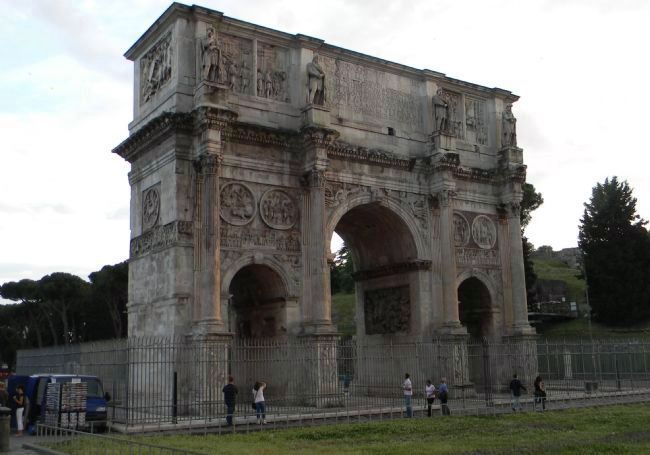
Photographed by Richard E. Miller, May 31, 2011
2. Arch of Constantine
Also see . . .
1. Battle of Milvian Bridge. (Submitted on October 1, 2011, by Richard E. Miller of Oxon Hill, Maryland.)
2. Constantine the Great and Christianity. ...The accession of Constantine was a turning point for Early Christianity, generally considered the beginning of Christendom. After his victory, Constantine took over the role of the patron for the Christian faith. He supported the Church financially, had an extraordinary number of basilicas built, granted privileges (e.g. exemption from certain taxes) to clergy, promoted Christians to high-ranking offices, returned property confiscated during the Great Persecution of Diocletian, and endowed the church with land and other wealth. Between 324 and 330, Constantine built, virtually from scratch, a new imperial capital at Byzantium on the Bosphorus, which would be named Constantinople for him. Unlike "old" Rome, the city employed overtly Christian architecture and contained churches within the city walls, and had no pre-existing temples from other religions to contend with. ... (Submitted on October 1, 2011, by Richard E. Miller of Oxon Hill, Maryland.)
Credits. This page was last revised on December 19, 2023. It was originally submitted on October 1, 2011, by Richard E. Miller of Oxon Hill, Maryland. This page has been viewed 1,025 times since then and 11 times this year. Photos: 1, 2. submitted on October 1, 2011, by Richard E. Miller of Oxon Hill, Maryland. • Bill Pfingsten was the editor who published this page.
