South of Broad in Charleston in Charleston County, South Carolina — The American South (South Atlantic)
23 Tradd Street
William Bell House
| — | circa 1797-1800 | — |
Photographed by Mike Stroud, October 6, 2011
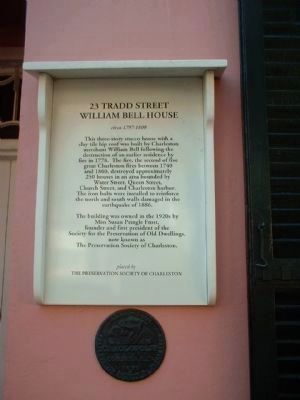
1. 23 Tradd Street William Bell House Marker and
Award 1966
Carolopolis
Condita A.D.
1670
Preservation Society of Charleston
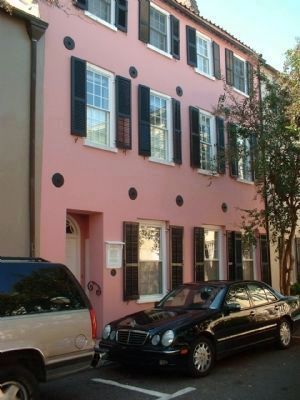
This three-story stucco house with a clay tile hip roof was built by Charleston merchant William Bell following the destruction of an earlier residence by fire in 1778. The fire, the second of five great Charleston fires between 1740 and 1860, destroyed approximately 250 houses in an area bounded by Water Street, Queen Street, Church Street, and Charleston harbor. The iron bolts were installed to reinforce the north and south walls damaged in the earthquake of 1886.
The building was owned in the 1920s by Miss Susan Pringle Frost, founder and first president of the Society for the Preservation of Old Dwellings, now known as The Preservation Society of Charleston.
Erected by Preservation Society of Charleston.
Topics and series. This historical marker is listed in this topic list: Notable Buildings. In addition, it is included in the South Carolina, Preservation Society of Charleston series list. A significant historical year for this entry is 1778.
Location. 32° 46.496′ N, 79° 55.705′ W. Marker is in Charleston, South Carolina, in Charleston County. It is in South of Broad. It is on Tradd Street, on the right when
this page online

Regionally, this marker is in Historic Charleston and in the Lowcountry. It is also in the American South, specifically in the Deep South, and on the Eastern Seaboard. Globally, it is in the North Atlantic Region, North America, the Western Hemisphere, the Western World, and the Anglosphere. Historically, it finds itself in what was once the territory of the Mississippian Culture, one of the original Thirteen Colonies, one of the Confederate States of America, and the Antebellum South.
Other nearby markers. At least 10 other markers are within walking distance of this marker: 26 Tradd Street (a few steps from this marker); 8-10 Tradd Street (within shouting distance of this marker); Alexander Christie House (within shouting distance of this marker); Thomas Legare House (within shouting distance of this marker); DuBose Heyward House (within shouting distance of this marker); The John Fabre Jr. House (within shouting
Photographed by Mike Stroud, October 6, 2011
2. 23 Tradd Street William Bell House Marker
Also see . . . National Trust for Historic Preservation. ...an ardent suffragist, championing the most radical wing of the movement, the National Woman’s Party. While her role as an elite woman agitating for the vote is significant, her lasting legacy is in preserving her beloved Charleston, SC. (Submitted on October 9, 2011, by Mike Stroud of Bluffton, South Carolina.)
Additional commentary.
1. Susan Pringle Frost and the Front Family
Susan Pringle Frost, one of several sisters who have been distinguished by their efforts as educators and business women in Charleston, is a daughter of Francis le Jau Frost, who gained distinction as a Confederate soldier, and a granddaughter of Judge Edward Frost, one of the finest characters in the public leadership of South Carolina during the first
Photographed by Brian Scott, July 28, 2010
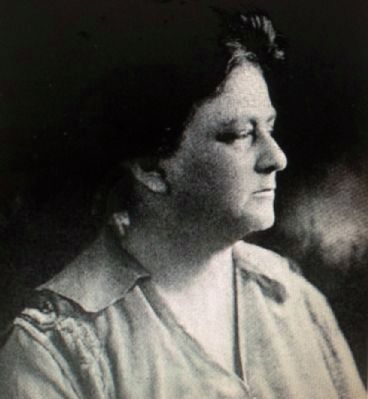
3. Susan Pringle Frost
January 21, 1873 - October 6, 1960
January 21, 1873 - October 6, 1960
Judge Edward Frost was born at Charleston in 1801, son of Rev. Thomas Frost, an Episcopal minister. Judge Frost was educated at Yale College, was admitted to the bar in 1823, and in 1832 resigned his post as United States district attorney. He was many times a representative of Charleston in the State Legislature. In 1843 he was elected to the bench, but resigned that life office in 1853 and soon became president of the Blue Ridge Railway Company. He was a member of the Constitutional Convention of 1865 and was one of the delegates from South Carolina sent to Washington to interview President Johnson on the establishment of a Provisional Government. He died July 31, 1868.
Francis LeJau Frost was born June 1, 1837, at Charleston, and was educated for medicine. During the war he was body and staff servant to General Hill and later to General Longstreet. Following the war he took up planting, and was one of the organizers of the fertilizer business in South Carolina, and for eighteen years was head of a large industry of that kind in Charleston.
Miss Frost's mother was Rebecca Brewton Pringle, who was born at the old Pringle home in Charleston, daughter of William Bull and Mary Motte (Alston) Pringle. She was educated in private schools.
To Francis and Rebecca Frost were born five children, the oldest now deceased. Mary Pringle was born March 15, 1871; Susan, January 21, 1873; Francis le Jau, March 27, 1875, now a priest of the Episcopal Church at Staten Island, New York; and Rebecca Motte Frost, born August 12, 1877. All were educated in private schools, attending the institution of the Misses Sass of Charleston. Mary and Susan were afterward graduated from St. Mary's at Raleigh, North Carolina, and Rebecca is a graduate of St. Mary's at New York. Mary and Rebecca for the last twenty years have conducted a private school, primary and preparatory, at 4 Logan Street, Charleston.
Miss Susan Frost began her business career as a Federal Court reporter in May, 1902, and gained a wide acquaintance with public and business affairs through that experience. Later she resigned and opened a real estate office and has developed a large and important clientage. She is also a leader in the suffrage movement of South Carolina and a member of the national woman's party, being chairman of the Charleston division and a member of the National Advisory Council. (Source: History of South Carolina, Vol. IV by Yates Snowden (1903).)
— Submitted June 20, 2012, by Brian Scott of Anderson, South Carolina.
Credits. This page was last revised on May 26, 2026. It was originally submitted on October 8, 2011, by Mike Stroud of Bluffton, South Carolina. This page has been viewed 1,435 times since then and 71 times this year. Photos: 1. submitted on October 8, 2011, by Mike Stroud of Bluffton, South Carolina. 2. submitted on November 6, 2011, by Mike Stroud of Bluffton, South Carolina. 3. submitted on June 20, 2012, by Brian Scott of Anderson, South Carolina.
