South of Broad in Charleston in Charleston County, South Carolina — The American South (South Atlantic)
Colonel John Stuart House
circa 1767
Photographed by Mike Stroud, September 29, 2011
1. Colonel John Stuart House Marker
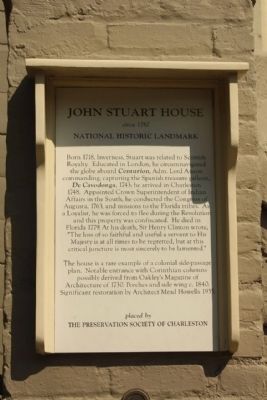
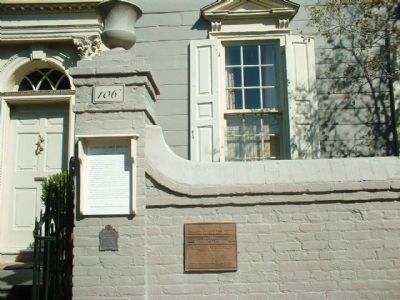
Born 1718, Inverness, Stuart was related to Scottish Royality. Educated in London, he circumnavigated the globe aboard Centurion, Adm. Lord Anson commanding, capturing the Spanish treasure galleon, De Cavodonga, in 1743; he arrived in Charleston 1748. Appointed Crown Superintendent of Indian Affairs in the South, he conducted the Congress of Augusta, 1763, and missions to the Florida tribes. As a Loyalist, he was forced to flee during the Revolution and this property was was confiscated. He died in Florida 1779. At his death, Sir Henry Clinton wrote, "The loss of so faithful and useful a servant to His Majesty is at all times to be regretted, but at this critical juncture is most sincerely to be lamented."
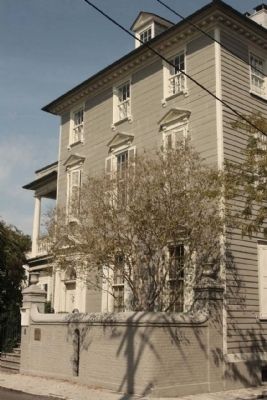
The house is a rare example of a colonial side-passage plan. Notable entrance with Corinthian columns possibly derived from Oakley's Magazine of Architecture of 1730. Porches and side wing c. 1840. Significant restoration by Architect Mead Howells 1935.
Erected by The Preservation Society of Charleston.
Topics and series. This historical marker is listed in this topic list: Notable Buildings. In addition, it is included in the National Historic Landmarks series list. A significant historical year for this entry is 1718.
Location. 32° 46.465′ N, 79° 55.999′ W. Marker is in Charleston, South Carolina, in Charleston County. It is in South of Broad. It is on Tradd Street near Orange Street, on the left when traveling east. Touch for map. Marker is at or near this postal address: 106 Tradd Street, Charleston SC 29401, United States of America. Touch for directions.

Regionally, this marker is in Historic Charleston and in the Lowcountry. It is also in the American South, specifically in the Deep South, and on the Eastern Seaboard. Globally, it is
this page online
Other nearby markers. At least 8 other markers are within walking distance of this marker: William Elliott House (within shouting distance of this marker); The Samuel Wainwright House (about 300 feet away, measured in a direct line); 32 Legare Street (about 300 feet away); Dewar-Lee-Pringle House (about 400 feet away); 54 King Street (about 400 feet away); Edgar Wells House (about 400 feet away); Lewis Timothy Print Shop (about 400 feet away); 123 Tradd Street (about 400 feet away). Touch for a list and map of all markers in Charleston.
Regarding Colonel John Stuart House. Colonel John Stuart was appointed the King’s Superintendent of Indian Affairs for the Southern District in 1762. By 1765 he obtained full imperial status for his department and was active in handling the Indian affairs of East and West Florida. In
Photographed by Mike Stroud, September 29, 2011
2. Colonel John Stuart House Marker
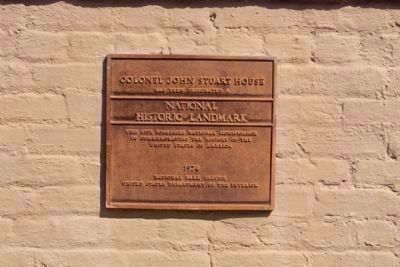
♦ Listed in the National Register of Historic Places October 22, 1970;
♦ Designated a National Historic Landmark November 7, 1973.
Stuart, Col. John, House *** (added 1970 - - #70000578)
104--106 Tradd St. , Charleston
♦ Historic Significance: Architecture/Engineering
♦ Architectural Style: Georgian
♦ Area of Significance: Architecture
♦ Period of Significance: 1750-1799
♦ Designated a National Historic Landmark November 7, 1973.
Stuart, Col. John, House *** (added 1970 - - #70000578)
104--106 Tradd St. , Charleston
♦ Historic Significance: Architecture/Engineering
♦ Architectural Style: Georgian
♦ Area of Significance: Architecture
♦ Period of Significance: 1750-1799
Photographed by Mike Stroud, October 6, 2011
3. Colonel John Stuart House Markers including the smaller plaque :
c. 1778
Is protected
by a
Conservation
Easement
donated to
Historic
Charleston
Foundation
1984
Additional commentary.
1. John Stuart,
recently arrived from Scotland, became Superintendent of Indian Affairs for the Southern District in 1762—the counterpart of Sir William Johnson of the Northern District. He became an influential member of various colonial councils and in 1772, at the height of his career, at a cost of £18,000, he built a fine three-story white frame residence in Charleston. He lived here until the outbreak of the War for Independence when he fled to British Florida where he continued to manage British-Indian relations in the South until his death in 1779. The Stuart House is surmounted by a hip roof with a captain's walk. The house is privately owned and has been remodeled in the original style. (National Park Service; Colonials and Patriots)
— Submitted October 9, 2011, by Mike Stroud of Bluffton, South Carolina.
Photographed by Mike Stroud, September 29, 2011
4. Colonel John Stuart House and Marker
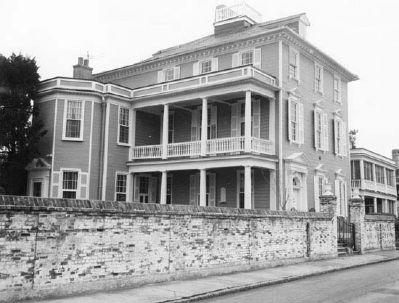
South Carolina Department of Archives and History, circa 1973
5. Colonel John Stuart House
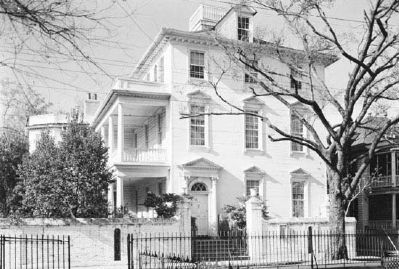
Historic American Buildings Survey, C.O. Greene, circa May 1940
6. Colonel John Stuart House, Historic American Engineering Record
Habs 20 SC,10-CHAR,81-3
Credits. This page was last revised on February 16, 2023. It was originally submitted on October 9, 2011, by Mike Stroud of Bluffton, South Carolina. This page has been viewed 1,742 times since then and 76 times this year. Photos: 1, 2, 3, 4, 5, 6. submitted on October 10, 2011, by Mike Stroud of Bluffton, South Carolina.
