Near Camden in Kershaw County, South Carolina — The American South (South Atlantic)
Camden Battlefield
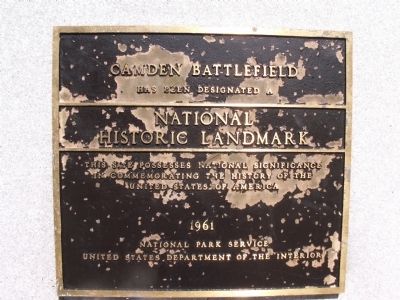
Photographed by Anna Inbody, October 2, 2011
1. Camden Battlefield Marker
National Park Service
United States Department of the Interior
Erected 1961 by National Park Service.
Topics and series. This historical marker is listed in this topic list: War, US Revolutionary. In addition, it is included in the National Historic Landmarks series list. A significant historical year for this entry is 1961.
Location. 34° 21.5′ N, 80° 36.624′ W. Marker is near Camden, South Carolina, in Kershaw County. It is on Flat Rock Road (State Highway 58), on the right when traveling north. Located 6.2 miles North of Camden off US 521 & 601 on SC road 58. Touch for map. Marker is in this post office area: Camden SC 29020, United States of America. Touch for directions.

Regionally, this marker is in the Midlands and in the Olde English District. It is also in the American South and specifically in the Deep South. Globally, it is in North America, the Western Hemisphere, the Western World, and the Anglosphere. Historically, it
this page online
Other nearby markers. At least 8 other markers are within walking distance of this marker: Flight of the Patriots (within shouting distance of this marker); The Forest of 1780 (within shouting distance of this marker); Baron DeKalb (within shouting distance of this marker); Battle of Camden (about 300 feet away, measured in a direct line); The Armies March to Camden (about 300 feet away); Revolutionary War Patriots (about 300 feet away in South carolina); Contest with the Continentals (about 300 feet away); Pursued Beyond the Battlefield (about 400 feet away). Touch for a list and map of all markers in Camden.
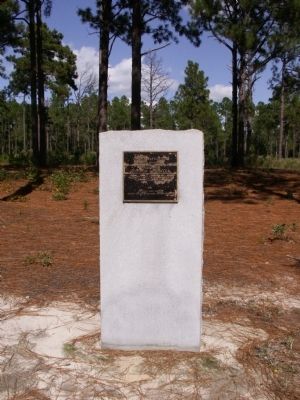
Photographed by Anna Inbody, October 2, 2011
2. Camden Battlefield Marker
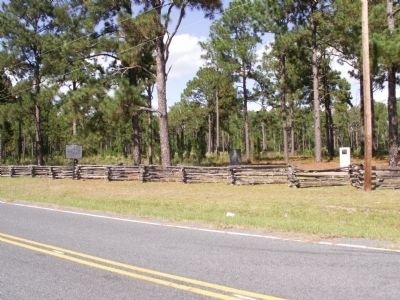
Photographed by Anna Inbody, October 2, 2011
3. Overview
Baron De Kalb Monument and SC State Roadside marker 28-1 Battle of Camden are also in the photo
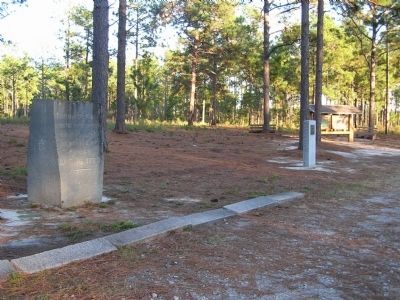
Photographed by Anna Inbody, October 2, 2011
4. Overview
Information kiosk can also be seen.
Photographed by Anna Inbody, October 2, 2011
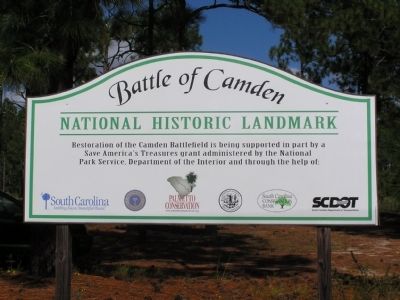
5. Battle of Camden
Photographed by Anna Inbody, October 2, 2011
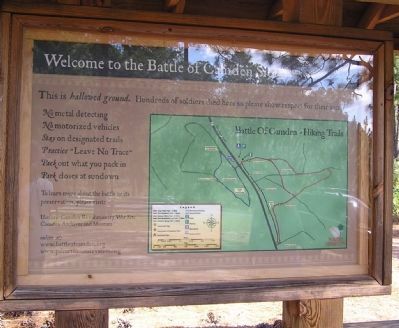
6. Welcome to the Battle of Camden Site
This is hallowed ground. Hundreds of soldiers died here so please show respect for their sacrifice.
No metal detecting
No motorized vehicles
Stay on designated trails
Practice “Leave No Trace”
Pack out what you pack in
Park closes at sundown
To learn more about the battle or its preservation, please visit:
Historic Camden Revolutionary War Site
Camden Archives and Museum
online at:
www.battleofcamden.org
www.palmettoconservation.org
Photographed by Anna Inbody, October 2, 2011
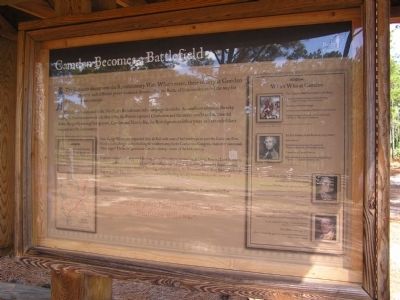
7. Camden Becomes a Battlefield
The Redcoats almost won the Revolutionary War. What’s more, their victory at Camden was the high-water mark of British power in colonial America. Yet, the Battle of Camden also paved the way for America’s ultimate triumph.
With the war stalemated in the North, the British launched a campaign to subdue the southern colonies, thereby forcing an American surrender. In May 1780, the British captured Charleston and the entire southern Continental Army. By quickly seizing Georgetown, Camden and Ninety Six, the British protected their prize and extended their conquest into the backcountry.
Gen. George Washington dispatched Gen. de Kalb with some of his best troops to save the Carolinas. Gen. Horatio Gates, charged with rebuilding the southern army by the Continental Congress, took over command. Their target? The British garrison at Camden, strategic center of the backcountry.
Loyalists, colonists who supported the king, warned Camden’s commander, Lt. Col. Francis, Lord Rawdon, of Gate’s approach. Gen. Charles, Lord Cornwallis, commander of the British army in the South, rushed from Charleston to assume command. Starving, exhausted and ill, the Americans made their final push late on August 15, 1780. They were unaware that the enemy was heading directly toward them under cover of darkness.
In a prophetic statement to Gates on his appointment to the southern command, General Charles Lee counseled him to:
“Take care lest your Northern laurels turn to Southern willows.”
Left Inset
Convinced that he must threaten Camden while British troops were temporarily dispersed, Gates chose the most direct route for his advance.
However, doing so took his troops through areas where food could be found.
Right Inset
Who’s Who at Camden
Gen. Charles, Earl Cornwallis (1738-1805)
Prominent English nobleman and British army’s second-highest ranking officer in America.
Numerous 1776-1778 campaigns
In 1780, became commander of British forces in the South.
Despite distinguished record, best known for 1781 surrender to Washington at Yorktown.
Lt. Col. Francis, Lord Rawdon (1754-1826)
Irish nobleman
Established provincial unit of Loyalists, the Volunteers of Ireland, in Philadelphia in 1777
Commander of Camden Garrison
Followed victory at Camden by defeating Nathanael Greene at nearby Hobkirk’s Hill in 1781
Gen. Baron Johann de Kalb (1721-1780)
German peasant, served in French army
Commissioned Maj. General of Continental army in 1777
At Camden, shot, bayoneted, captured and died three days later.
Gen. Horatio Gates (1728-1806)
English - born, in British army before immigrating to America
In 1775, commissioned Brig. General and Adjutant General in Continental Army
Hero of Battle of Saratoga, 1777
After Charleston fell, appointed commander of American forces in the Southern theater
Cornwallis Picture Caption: “General Charles, first Marquis and second Earl Cornwallis, Commander of the British Forces,” by Werner Willis, Werner Willis Fine Art.
Rawdon Picture Caption: “Earl of York, Francis, Lord Rawdon, engraved by I. Jones, after Reynolds. Courtesy of South Caroliniana Library, USC, Columbia (SC)
De Kalb Picture Caption: “Johann, Baron De Kalb by Charles Willson Peale, from life, 1781 - 1782.” Courtesy of Independence National Historical Park
Gates Picture Caption: “Horatio Gates by Charles Willson Peale, from life, 1782.” Courtesy of Independence National Historical Park
Photographed by Anna Inbody, October 2, 2011
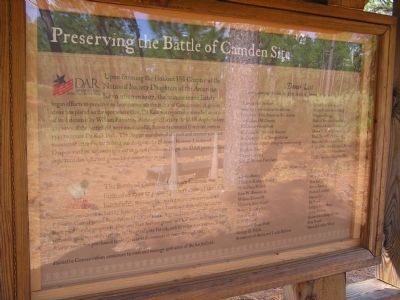
8. Preserving the Battle of Camden Site
Upon forming the Hobkirk Hill Chapter of the National Society Daughters of the American Revolution in 1907, the women immediately began efforts to preserve and commemorate the Battle of Camden site. A granite stone was placed on the spot where Gen. De Kalb was reportedly wounded on an acre of land donated by William Edwards. Although efforts by the DAR chapter to buy 425 acres of the battlefield were unsuccessful, Edwards donated five more acres in 1942 to create De Kalb Park. The chapter maintained the park and erected a second monument after the battlefield was designated a National Historic Landmark.
Despite vandals, unlawful tree cutting, and Hurricane Hugo, the DAR protected and improved this hallowed ground for almost 100 years.
The Battle of Camden Advisory Council was formed in 1999 to pursue preservation of the core battlefield. Bowater, Inc. agreed to put 310 acres under a conservation easement held by Katawba Valley Land Trust, and then sold the land to Palmetto Conservation Foundation (PFC) in 2002. A grant from the SC Conservation Bank paid for the property. National Park Service grants to PCF were used to conduct archaeological research, restore the longleaf pine forest, and develop interpretive trails. A large tract was purchased from Crescent Resources in 2007 through state funding.
Palmetto Conservation continues to own and manage 476 acres of the battlefield.
Donor List
Preservation and Restoration of the Battle of Camden site was made possible by:
National Park Service; Palmetto Conservation Foundation; Daughters of the American Revolution - Hobkirk Hill Chapter; SC Conservation Bank; SC Parks, Recreation & Tourism; SC Department of Transportation; SC Institute of Archaeology & Anthropology; Kershaw County; City of Camden; John T. Stevens Foundation; Upton Foundation; Artist Preservation Group; Progress Energy; Bank of America Foundation; American Forest Management; Daniel Riddick & Associates; Black River Electric Co-op; Katawba Valley Land Trust; Kershaw County Historical Society; Historic Camden Foundation; DAR - 19th Star Chapter, IN
And major private donors:
Charles Baxley; Daniel & Kathryn Baxley; H. Gaffney Blalock; John W. Bonner, Jr.; William Bosworth; Walter & Mary Clark; Robert H. Coughlin; David Cutler; C.P. Dubose; Augustus & Susan Field; George D. Fields; In Memory of Austin and Lucile Sheheen; Phyllis Gate; William & Sarah Graves; Ann Kelly; Kevin Linskey; Michael Lockhart; John Miller; Ed Royall; Larry & Betty Slade; Austin Sheheen; Kenneth & Christy Taucher; Don Terrell; Maxwell & Sibby Wood
Photographed by Anna Inbody, October 2, 2011
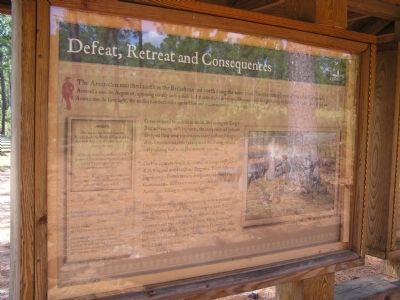
9. Defeat, Retreat and Consequences
The Americans marched south as the British moved north along the same road. Neither army knew if the other’s approach. Around 2 a.m. on August 16, opposing cavalry units collided. A chaotic skirmish ensued. Unaccustomed to night battle, the British halted after driving back the Americans. At first light, the artillery on both sides opened fire and within minutes smoke clogged the air.
Gates ordered his militia to attack. But seeing the King’s Best advancing with bayonets, the inexperienced patriots dropped their weapons and ran, many without firing a shot. Continental reserves replaced the fleeing militia, not realizing that even Gates was in retreat.
On two separate fronts, Cornwallis’s troops engaged de Kalb’s 1st and 2nd Maryland Brigades. Fierce fighting raged until a British cavalry charge overwhelmed the Continentals. Tarleton’s cavalry pursued the fleeing Americans, killing or capturing hundreds.
Despite this costly and demoralizing defeat, patriot forces regrouped and changed strategies. Less than two months later, Loyalists were annihilated at Kings Mountain and the tide began to turn. Gen. Nathanael Greene replaced the disgraced Gates in December 1780, and began a successful campaign that eventually drove the British back to the coast.
Left Inset
One reason the British beat the Americans at the Battle of Camden was the wide disparity of battle-readiness among the men.
Although American ranks included seasoned Continental regiments, over half of the patriot troops were inexperienced militia.
By contrast, King George III’s army was mostly well-trained professional soldiers and well-drilled Loyalists.
Forces:
British Regulars: 950; Loyalists - Provincials & Militias: 1230
Continental Soldiers: 1800; American Militia & State Troops: 2300
Losses:
British losses: 68 killed; 24 wounded; 11 missing
Exact American losses never known: 500-900 killed or wounded; 700 taken prisoner; all artillery, wagons and supplies captured; worst American field defeat in the Revolutionary War
Photographed by Anna Inbody, October 2, 2011
10. Battle of Camden
Credits. This page was last revised on June 16, 2016. It was originally submitted on October 11, 2011, by Anna Inbody of Columbia, South Carolina. This page has been viewed 3,029 times since then and 108 times this year. Photos: 1, 2, 3, 4, 5, 6, 7, 8, 9, 10. submitted on October 11, 2011, by Anna Inbody of Columbia, South Carolina. • Craig Swain was the editor who published this page.
