
Camden in Kershaw County, South Carolina — The American South (South Atlantic)
The British Army
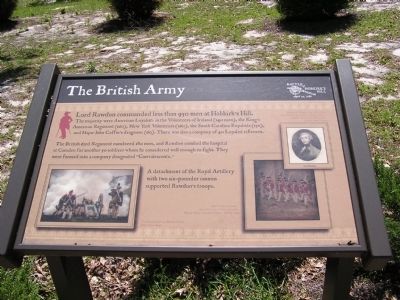
Photographed by Anna Inbody, October 2, 2011
1. The British Army Marker
The British 63rd Regiment numbered 180 men, and Rawdon combed the hospital at Camden for another 50 soldiers whom he considered well enough to fight. They were formed into a company designated “Convalescents.”
A detachment of the Royal Artillery with two six-pounder cannon supported Rawdon’s troops.
Topics. This historical marker is listed in this topic list: War, US Revolutionary.
Location. 34° 16.01′ N, 80° 36.081′ W. Marker is in Camden, South Carolina, in Kershaw County. It is on Kirkwood Lane, on the right when traveling east. Touch for map. Marker is in this post office area: Camden SC 29020, United States of America. Touch for directions.

Regionally, this marker is in the Midlands and in the Olde English District. It is also in
this page online
Other nearby markers. At least 8 other markers are within walking distance of this marker: The Battle of Hobkirk Hill (here, next to this marker); The American Army (a few steps from this marker); Capt. Robert Kirkwood (1756-1791) (about 300 feet away, measured in a direct line); Battle of Hobkirk's Hill (about 400 feet away); Fruitless Victory (approx. ¼ mile away); The British Attack (approx. ¼ mile away); A Daring Plan (approx. ¼ mile away); Struggle for the Hill (approx. ¼ mile away). Touch for a list and map of all markers in Camden.
Additional commentary.
1. Lieutenant Colonel Francis, Lord Rawdon (1754 - 1826)
Lord Radon went south to the Siege of Charleston with reinforcements, then Lord Cornwallis posted him at Camden (16 August 1780) as the British sought to occupy
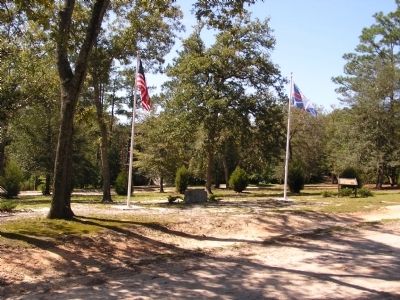
Photographed by Anna Inbody, October 2, 2011
2. Overview
Perhaps his most noted achievement was the victory in 1781 at the Battle of Hobkirk's Hill, where in command of only a small force, he defeated by superior military skill and determination, a much larger body of Americans rebels. Thinking, (in error) that Nathanael Greene had moved his artillery away, Rawdon attacked Greene's left wing, forcing the Americans to retire.
However, Rawdon was forced to begin a gradual retreat to Charleston, relieving the siege of Ninety-Six, but then evacuating it and withdrawing to Charleston. When the Loyalists he saved in the Siege of Ninety-Six were eventually relocated to Nova Scotia, they named their community of Rawdon, Nova Scotia after him. In July 1781, in poor health, he gave up his command. He was captured at sea, by De Grasse, but was exchanged. He was awarded the freedom of the city of Dublin in recognition of his service in America. After Rawdon's departure the decision was made to evacuate Charleston as the war drew to a close.
— Submitted October 13, 2011, by Anna Inbody of Columbia, South Carolina.
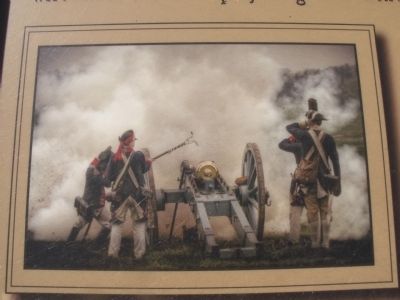
Photographed by Anna Inbody, October 2, 2011
3. Picture on the marker
“Six Pound Cannon” by Michael Ticcino, MJ Ticcino Images
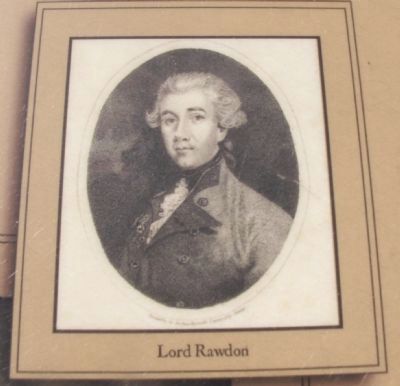
Photographed by Anna Inbody, October 2, 2011
4. Lord Rawdon
Engraved by Stanier, c. 1791, after Joshua Reynolds’s painting. Courtesy of South Caroliniana Library, University of South Carolina, Columbia, South Carolina
Photographed by Anna Inbody, October 2, 2011
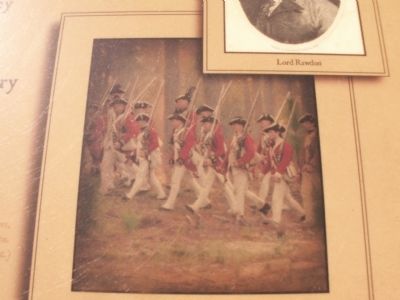
5. British Soldier Reenactors
225th Anniversary of Battle of Camden, Photo by Major Lansdale Williams, USMC (ret.)

Photographed by Mark Parker, June 7, 2024
6. The British Army Marker
with British flag
Credits. This page was last revised on June 22, 2024. It was originally submitted on October 13, 2011, by Anna Inbody of Columbia, South Carolina. This page has been viewed 823 times since then and 32 times this year. Photos: 1, 2, 3, 4, 5. submitted on October 13, 2011, by Anna Inbody of Columbia, South Carolina. 6. submitted on June 21, 2024, by Mark Parker of Hickory, North Carolina. • Craig Swain was the editor who published this page.
